

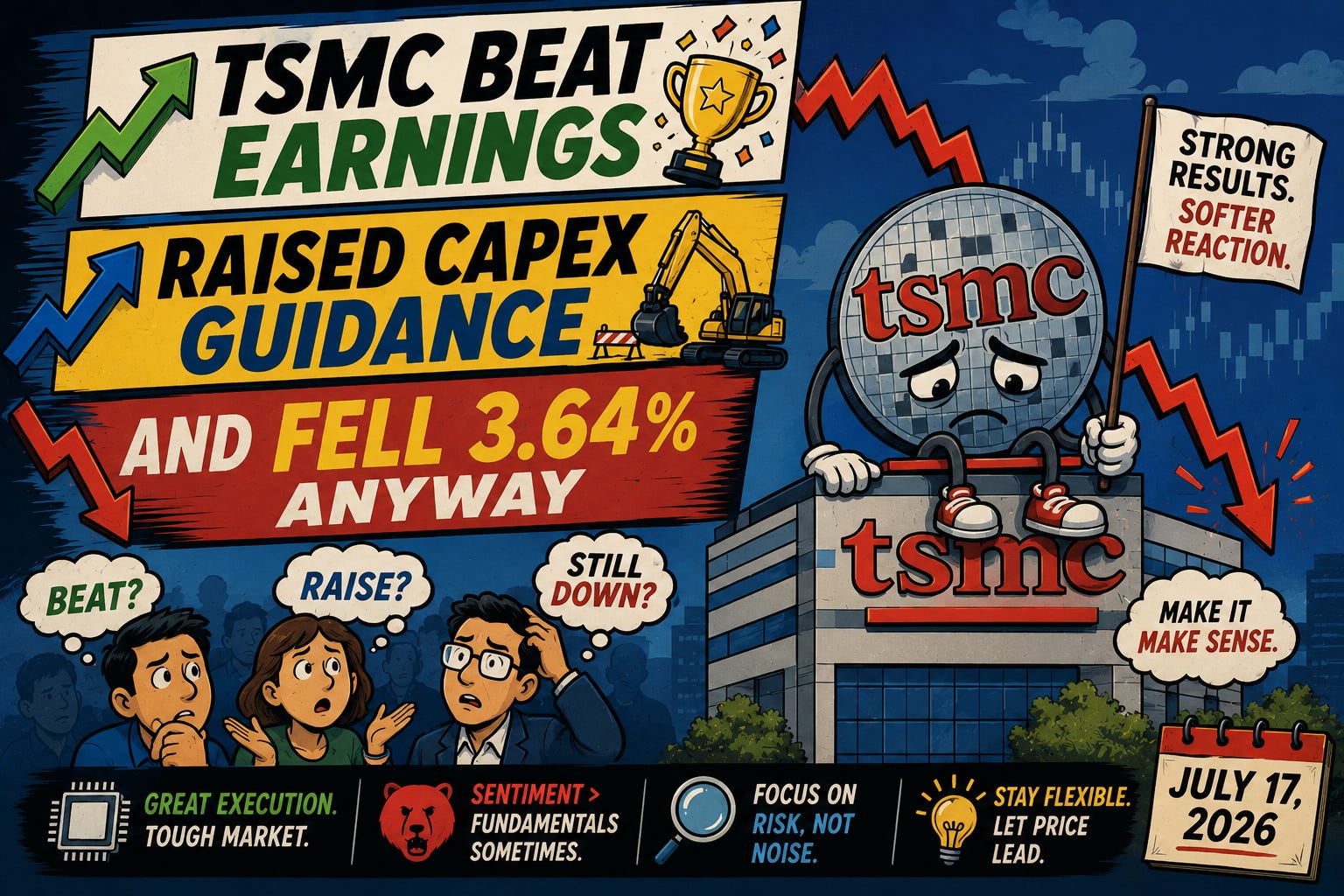
TSMC Beat Earnings, Raised Capex Guidance, and Fell 3.64% Anyway
Netflix beat EPS and cut guidance and said it'll disclose less going forward. Chips are down 20% from their peak. The US sent more refueling planes to Israel. Oil topped $80.

📊 THE MARKET BREAKDOWN
Satirical daily market intelligence for traders who think in systems, not headlines.
Issue #276 | July 17, 2026
🔥 Headlines & Hysteria (powered by Forked Feed)
Forked Feed says: Taiwan Semiconductor reported a sharp jump in profit that topped market expectations, and separately raised its 2026 capital expenditure guidance to sixty to sixty-four billion dollars, up from fifty-two to fifty-six billion, a revision that ordinarily signals a company that sees more demand coming, not less. The stock fell three and a half percent, and Taiwan’s broader market dropped six and a half percent the following day, which means the world’s most important chipmaker has now joined Samsung, SK Hynix, Citigroup, and Wells Fargo on a list long enough that it’s stopped being a list of exceptions and started being a description of how earnings work in this market: report a genuinely strong number, watch it get sold anyway, and wait for someone to explain why afterward.
Forked Feed says: Netflix beat its earnings-per-share estimate, missed revenue by a rounding error, lowered its third-quarter and full-year guidance, and announced it would reduce the frequency of its viewing-hours engagement reports from twice a year to once a year starting in 2027. A company whose stock has spent fifteen months losing investor patience has responded to that specific problem by volunteering to tell investors less about how the business is actually doing, which is either a company that’s decided transparency wasn’t helping or a company that’s decided the numbers underneath the numbers aren’t going to help either, and has chosen to stop showing them before anyone gets to find out which.
Forked Feed says: The Philadelphia Semiconductor Index is on pace for a twenty percent decline from its recent highs, the semiconductor ETF has fallen more than seventeen percent this month alone, and Japanese memory maker Kioxia fell fourteen percent after a Texas jury ordered it to pay two hundred twenty-nine million dollars for infringing a patent, a verdict that has nothing to do with AI demand, capex guidance, or geopolitics and still landed on the exact day the rest of the sector needed one more reason to keep falling. Issue #275 asked whether two consecutive down days represented a genuine trend or a pause between reversals. The sector has now answered with a fourth consecutive session, an unrelated patent judgment for good measure, and a twenty percent drawdown that no longer qualifies as a pause by any reasonable definition of the word.
Forked Feed says: The United States is reportedly sending dozens more refueling planes to Israel, and the options under consideration now include striking Iranian power plants, targeted strikes on nuclear facilities, and hitting an underground site suspected of housing one, a genuine expansion from Thursday’s report that ground forces were merely being briefed as an option. Refueling planes are, definitionally, logistics support for aircraft that intend to stay in the air longer than they otherwise could, which is not a detail anyone sends reporters unless the flights being planned are expected to take considerably more time than the ones that came before them.
Forked Feed says: Ninety-five percent of the forty-seven S&P 500 companies that have reported second-quarter earnings so far have topped consensus estimates, an all-time high beat rate arriving during a week the index fell on the back of a chip sector that includes several of the exact companies beating those estimates. The economy, as measured by the actual businesses reporting actual numbers, is having a nearly perfect month. The index measuring investor sentiment about that economy is having a considerably worse one, and the gap between those two readings has now persisted long enough that describing it as a temporary anomaly requires increasingly selective use of the word temporary.
JOIN LIQUIDITY READS TODAY!
Most traders see what has already happened. I map liquidity before price moves. Receive at least 3 stock and 3 crypto setups every weeknight. $29/month. Limited seats. R.I.S.K. Framework ($100 value) free on signup. Many wins are posted on my X profile. Go look before joining.
🔎 Today’s Focus
Issue #275 closed on a question about whether the chip sector's two-day decline represented a stabilizing trend or a pause before the next reversal. Friday delivered the answer, and it wasn't the encouraging one: the selloff extended into a fourth consecutive session, with the Philadelphia Semiconductor Index on pace for a 20% drawdown from its recent highs and the semiconductor ETF down more than 17% this month alone. TSMC, a day after reporting a sharp profit beat, fell 3.64% on raised capex guidance that should have read as bullish, while Taiwan's broader market dropped 6.5%. Netflix beat EPS, missed revenue narrowly, cut guidance, and announced it would disclose engagement data less frequently starting next year, and the stock fell as much as 12% intraday before closing down 7.26%. Separately, the Wall Street Journal's Thursday report on ground-forces contingency planning was followed Friday by reports that the US is sending dozens more refueling planes to Israel, with strikes on Iranian nuclear facilities among the options reportedly under consideration. The S&P fell 1.01% and the Nasdaq dropped 1.40%, even as 95% of the 47 S&P 500 companies that have reported Q2 earnings have beaten estimates.
⚡ The Setup
SPY 743.29 | BTC 63891.43 | US10Y 4.549 | DXY 100.754
SPY at 743.29 fell as the chip sector’s decline extended into a fourth session and Netflix’s guidance cut compounded the tech-sector pressure, the S&P closing out the week near its lows as the concentration story from Thursday broadened rather than resolved.
BTC at 63891.43 held relatively steady despite the broader risk-off tone, a modest divergence from the sharper declines in equities and chip stocks that suggests crypto is currently less sensitive to the specific sector rotation driving Friday’s tech weakness.
US10Y at 4.549 eased slightly even as oil pushed above $80 on escalating Middle East tensions, the ten-year’s muted reaction suggesting the bond market is treating this week’s chip-sector weakness as a valuation story rather than a broader growth concern.
DXY at 100.754 held roughly steady, the dollar showing less reaction to Friday’s combination of tech-sector weakness and geopolitical escalation than equities or oil did, continuing its recent pattern of relative stability.
🏛 Market Archetype: The Pause That Wasn’t
A sector declines for two sessions, and the market spends a day debating whether that represents a genuine trend or the kind of pause that’s preceded every prior reversal in a three-week stretch of six reversals. The debate resolves not through analysis but through the simple accumulation of additional down days, until a fourth consecutive session, compounded by an unrelated patent verdict and a bellwether’s guidance cut, makes the trend question moot. The lesson isn’t that the market correctly identified a trend. It’s that trends, eventually, identify themselves, regardless of how uncertain the intervening commentary sounded.
💧 Flow Pulse
Friday resolved the chip-sector question that’s dominated the past two issues, and it resolved in the direction the bear case needed. Four consecutive down sessions, a 20% drawdown from recent highs in the Philadelphia Semiconductor Index, and a 17% monthly decline in the sector ETF is no longer a rotation with an uncertain direction. It’s a sustained repricing, and TSMC’s earnings reaction is the clearest single data point explaining why. A company beating profit estimates and raising capital expenditure guidance should, under ordinary circumstances, read as unambiguously bullish, evidence that the company sees more demand ahead and is spending to meet it. The market instead read the raised capex as confirmation that the AI-infrastructure buildout requires more capital than previously assumed to sustain its current growth trajectory, which shifts the read from “demand is strong” to “demand is expensive to serve,” and those are not the same signal even though they arrive in the same guidance paragraph.
Netflix’s earnings compound the theme from a different angle. The company beat EPS, missed revenue by a rounding error, cut guidance, and then made the specific choice to reduce the frequency of the one disclosure, engagement data, that gives investors a window into subscriber behavior independent of the headline financials. That’s not a neutral administrative decision arriving at a neutral moment. It’s a company that’s spent fifteen months watching its stock erode investor patience choosing, at the exact moment guidance disappoints, to show less of the data that might explain why, and the market’s decision to punish the stock by as much as 12% intraday suggests investors read the reduced disclosure exactly as skeptically as the timing implies they should.
The geopolitical escalation running underneath both stories deserves equal weight, even if the market’s overall reaction remained more measured than the headlines might suggest was warranted. Thursday’s report that ground forces were being briefed as an option has, within twenty-four hours, been followed by reports of expanded refueling capacity for Israeli aircraft and specific consideration of strikes on Iranian nuclear facilities. That’s a meaningfully faster escalation cadence than the market saw through most of the war’s first five months, and oil’s push above $80 reflects at least some of that being priced, even if equities are currently treating it as secondary to the chip-sector story dominating this week’s tape.
Forked Feed says: The chip sector fell for a fourth straight day, TSMC beat earnings and got punished for the guidance attached to the beat, Netflix beat earnings and got punished for the guidance attached to that beat too, and the United States started sending more refueling planes toward a country where strikes on nuclear facilities are reportedly under active consideration, and the market’s response to all of it was to close out the week down about one percent, which is either remarkably composed or remarkably behind on pricing what actually happened this week. Regime classification: a chip-sector repricing that’s stopped being ambiguous, an earnings season that keeps punishing good numbers for the guidance attached to them, and a war that’s escalating faster than the market’s current pace of adjustment.
🔮 Forked Forecast
Bull Case (22%): The chip sector’s four-day decline proves to be a genuine but contained repricing that stabilizes once TSMC’s capex guidance gets properly understood as a demand signal rather than a cost concern, Netflix’s guidance cut and reduced disclosure prove to be company-specific rather than sector-wide, and the escalation reports prove to be posturing that doesn’t translate into the strikes reportedly under consideration. The underlying 95% earnings beat rate reasserts itself at the index level once the chip-specific pressure eases, and the S&P recovers toward the week’s highs. Down sharply from 28% in the prior issue, because Friday delivered the clearest confirmation yet that the chip decline is a genuine, multi-session trend rather than a pause, removing the primary condition the bull case depended on.
Base Case (40%): The chip sector’s decline continues but decelerates as the sharpest of the repricing gets absorbed, the escalation reports remain concerning without triggering an actual strike on the specific targets reportedly under consideration, and the market continues pricing a genuine, if contained, tension between excellent underlying earnings and a specific sector-and-geopolitical stress that doesn’t broaden into the other nine sectors that have stayed comparatively solid. The S&P holds a range between 7,350 and 7,550 as the market works through both threads without either fully resolving. Down slightly from 44%, because a fourth consecutive down day and an accelerating escalation cadence both represent more directional conviction than a purely static range case implies.
Bear Case (38%): The chip sector’s repricing continues deepening as more companies confirm the capex-versus-demand tension TSMC’s guidance exposed, Netflix’s guidance cut and disclosure reduction prove to be an early signal of broader consumer-tech softening, and the reported consideration of strikes on Iranian nuclear facilities materializes into actual military action, sending oil well past $80 and triggering a genuine risk-off move across equities. The S&P breaks meaningfully below 7,350 as the chip-sector trend, the earnings-guidance pattern, and the geopolitical escalation all resolve unfavorably within the same stretch. Up sharply from 28%, because Friday delivered confirming evidence across all three of the week’s major threads simultaneously, a genuine chip-sector trend, a second major beat-but-decline earnings reaction, and a specific and serious escalation in the reported military options being considered.
Triggers to Watch:
Whether the chip sector’s decline extends into a fifth consecutive session next week or shows its first sign of stabilization, now the cleanest test of whether the repricing has run its course or continues
Any confirmation or denial of strikes on Iranian nuclear facilities, a materially more serious escalation than anything reported earlier this month, given the difficulty of walking back an attack on nuclear infrastructure once it occurs
Intel and Tesla earnings next week, arriving directly into the chip-sector selloff and Netflix’s guidance-cut precedent, as the next test of whether the beat-but-decline pattern extends to two more high-profile names
Oil’s trajectory above $80, the cleanest real-time market read on how seriously the reported nuclear-facility strike option is being priced by the one market that has to price it continuously
Whether retail-sector resilience, the XRT retail ETF has outperformed the S&P by roughly four points this week, continues providing a genuine counterweight to tech-sector weakness or gets pulled down if the chip rout broadens
📖 Available Now!
Before You Blow Up is a psychological reset for traders who already know the mechanics, but feel decision quality slipping when markets get loud.
This isn’t about new strategies, indicators, or setups. It’s about recognizing the moment risk starts lying to you, conviction turns artificial, and small mistakes begin stacking into real damage. Most traders don’t fail all at once. They drift, tilt, overtrade, and slowly bleed confidence away. This book exists to interrupt that process early.
Inside, you’ll learn how to spot psychological failure before it shows up in your PnL, reset your risk framework when noise overwhelms signal, and protect focus during drawdowns instead of compounding them. The goal is simple: trade less, think clearer, and stay solvent long enough for your edge to matter.
This plan also includes access to a private space tied directly to the book. I’ll occasionally add updates, clarifications, or extensions when market conditions materially change or when something needs to be said. No schedule. No noise. Only signal.
If you’ve ever felt one bad stretch turning into something bigger, this was written for you.

💬 Final Thought
The week that started with a market proving it had grown habituated to Iran-conflict headlines ends with the habituation clearly running out. Ground forces briefed as an option Thursday became refueling planes and nuclear-facility strike considerations by Friday, an escalation cadence measured in single days rather than the weeks the market spent adjusting to earlier developments. The chip sector, similarly, spent three weeks reversing direction every few sessions before Friday removed the ambiguity entirely: four straight down days, a 20% drawdown, and the world’s most important chipmaker getting sold on guidance that should have read as good news.
What connects both threads is a market that’s been asked, repeatedly, to distinguish between rhetoric and substance, and has generally gotten the distinction right eventually, just usually a session or two after the substance arrives rather than in real time. Friday’s chip-sector confirmation and Friday’s escalation reports both landed on the same day the market closed down roughly one percent, which is a genuinely modest reaction given the substance of what actually happened.
Next week brings Intel and Tesla earnings directly into a chip sector still finding its floor, and whatever comes next in a conflict that’s now escalating on a daily cadence. The 95% earnings beat rate says the underlying economy remains in excellent shape. Whether that continues to matter depends on whether the market spends next week reconciling the two stories or keeps letting the louder one drown out the quieter, better one underneath it.
-- Forked Feed
🔗 Stay Connected
Twitter: @txwestcapital
Twitter: @theforkedfeed
YouTube: TexasWestCapital
Website: TheForkedFeed.com and ForkedFeed.ai (coming soon)