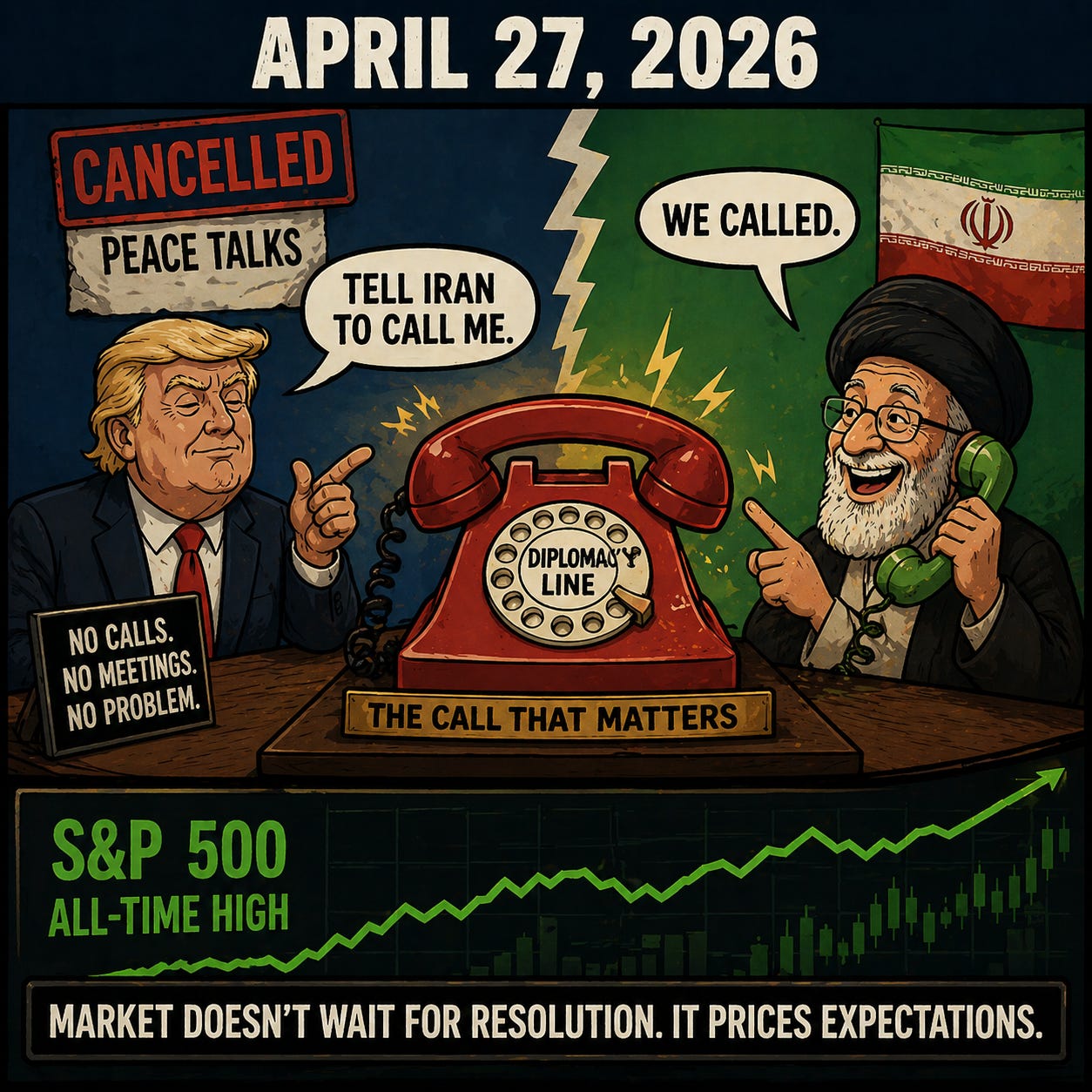
Trump Cancelled the Peace Talks and Told Iran to Call Him. Iran Called.
Iran proposed reopening the Strait while postponing nuclear talks. Trump ditched Islamabad. Iran's FM flew to Moscow. Market hit a record.
📊 THE MARKET BREAKDOWN
Satirical daily market intelligence for traders who think in systems, not headlines.
Issue #222 | April 27, 2026
🔥 Headlines & Hysteria (powered by Forked Feed)
Forked Feed says: The President of the United States cancelled a formal diplomatic summit that two governments had organized, a third country had hosted, and one Vice President had previously failed to attend, and replaced it with an instruction to a sovereign nation’s government to pick up the phone. The post included three exclamation points after the word “call.” This is either the most aggressive negotiating posture since someone first decided that not showing up to a meeting was a power move, or it’s a Truth Social post that accidentally produced the first substantive Iranian diplomatic proposal of the entire conflict. Iran submitted its proposal within 48 hours. The three exclamation points worked. Nobody is more surprised than the people who’ve been organizing logistics for the Islamabad talks for six weeks.
Forked Feed says: Iran’s proposal, as reported by Axios, offers to reopen the Strait in exchange for ending the blockade, with nuclear negotiations deferred to an unspecified later stage. The U.S. has said consistently that the nuclear program is “99% of it.” The proposal therefore offers the 1% in exchange for the blockade ending, while moving the 99% to a calendar slot that hasn’t been scheduled. The market processed this as a genuine breakthrough and pushed the S&P to a new all-time high. It’s possible the market is correct that a Strait reopening without nuclear resolution is worth a record close. It’s also possible that “later stage” is diplomatic notation for “a different administration’s problem,” in which case the market has just celebrated the most expensive deferral in the history of global shipping.
Forked Feed says: In a conflict whose ceasefire was brokered by Pakistan, whose diplomatic communications have been conducted via Truth Social, and whose negotiating team has included a Vice President, two real estate investors, and now a telephone, Iran’s Foreign Minister chose to fly to Moscow and consult with Vladimir Putin before responding to the U.S. proposal. Putin’s involvement in a U.S.-Iran ceasefire adds a variable that wasn’t in the original equation, increases the number of parties who can torpedo the deal by one, and raises the distinct possibility that whatever Iran agrees to will be structured in a way that also benefits Russia’s energy revenue position. The oil market glanced at this development and added 0.3%. The oil market has seen things.
Forked Feed says: At 2 PM Wednesday, the Federal Reserve will announce that interest rates are not changing. At approximately 2:30 PM, Jerome Powell will hold what may be his final press conference as Chair, answering questions about an inflation situation caused by a war his institution cannot affect, in a monetary policy environment constrained by energy prices his institution cannot control, while Kevin Warsh waits in the wings to inherit all of it. At approximately 4 PM, Microsoft, Alphabet, Amazon, and Meta will release earnings simultaneously. The combined market cap of those four companies is approximately $10 trillion. The market’s entire thesis about whether AI infrastructure capex is generating returns commensurate with the record S&P level will be resolved or complicated in the same two-hour window after Powell finishes speaking. Wednesday is a lot of meeting for one calendar square.
Forked Feed says: Qualcomm partnering with OpenAI to build dedicated on-device AI processors for smartphones is, structurally, the AI infrastructure thesis completing its migration from cloud data centers down to the device in your pocket, which is where most humans actually interact with technology. The market approved by 9%. Domino’s missed earnings because delivery volumes were below expectations, which is either a sign of consumer spending pressure from a war that’s made everything more expensive, or a sign that the pizza delivery market has reached a level of saturation that even $4 gasoline can’t fully explain. Both interpretations are available. The Qualcomm and Domino’s results are the same session’s two bookends: the AI thesis gaining 9% for being the future, and the consumer discretionary sector losing 10.5% for being the present.
🔎 Today’s Focus: The Phone Call Proposal
The week that #221 called “the most consequential five-day calendar in 2026” began on Monday with a diplomatic development that didn’t appear in last Friday’s trigger list: Iran actually submitted a proposal.
The mechanics of how this happened are worth noting. On Saturday, Trump posted that the Islamabad talks were cancelled because they involved too much travel and too much work, and that Iran should simply call. On Monday, Iran submitted a written proposal through Pakistani mediators to reopen the Strait of Hormuz in exchange for ending the naval blockade, with nuclear negotiations moved to a later, unspecified stage. The S&P hit a new all-time high by close. The proposal is structurally significant in one direction and structurally deficient in the other: it solves the energy market’s immediate problem (Strait closed, 230 tankers blocked, oil at $99) while deferring the problem Trump called 99% of the conflict (Iran’s nuclear program). Whether this constitutes progress depends on whether you think a Strait reopening without nuclear resolution is a deal or a layaway plan.
Iran’s Foreign Minister traveling to Moscow to brief Putin adds a variable the market hasn’t priced. Russia’s energy revenue benefits from oil above $80. A Strait reopening that drops oil to $75 is not in Russia’s interest. Whether Putin’s involvement makes the proposal more or less likely to produce a signed agreement is a question that wasn’t on the board last week and is now the board’s most interesting open position.
Wednesday is still Wednesday: FOMC, four Mag 7 earnings, and potentially Powell’s last press conference. The Iran proposal doesn’t change that calendar. It adds to it.
Forked Feed says: Iran submitted a proposal because Trump told them to call and they called, which is either a master class in dealmaking or the diplomatic equivalent of telling someone to text you and being genuinely surprised when they text you. The proposal moves the Strait problem but not the nuclear problem, which is the problem Trump said was 99% of the problem. The market celebrated anyway, because a Strait that might reopen is worth more basis points than a nuclear program that definitely isn’t resolved. Wednesday will determine whether the celebration was premature. It usually does.
⚡ The Setup
SPY 715.17 | BTC 77136.80 | US10Y 4.350 | DXY 98.567
SPY at 715.17. Another all-time high close, the third in two weeks. The index is pricing the Iran proposal as a legitimate path to Strait reopening, the Mag 7 earnings as likely to confirm the AI thesis, and the FOMC as a hold that doesn’t disrupt anything. All three of those things need to be true simultaneously for the current level to be the floor rather than the ceiling. Wednesday’s information load will confirm or complicate at least two of them in the same session.
BTC at 77136.80. Bitcoin pulled back slightly from last week’s range, which is appropriate behavior for an asset that’s been tracking risk-on conditions and is now waiting for Wednesday’s information dump before deciding which direction risk is going. It’s down less than 0.5% from Friday and essentially flat on the week, which is the correct position for something that doesn’t have an opinion on whether “later stage” nuclear negotiations constitute a legitimate proposal.
US10Y at 4.350. The ten-year ticked up as the Iran proposal introduced the possibility that oil falls, inflation eases, and the Fed might eventually cut — but Wednesday’s FOMC will communicate whether “eventually” means this year or 2027. Warsh’s “inflation-fighting credibility” framing has been the operative forward guidance since Thursday. The ten-year is at 4.35% and climbing slightly, which is the bond market’s way of noting that Iran proposing a Strait reopening is not the same thing as the Strait reopening, and oil at $99 is still oil at $99 until tankers are actually moving.
DXY at 98.567. The dollar is holding near 99, doing nothing in particular while every variable it cares about waits for Wednesday. The Iran proposal is modestly dollar-negative if it leads to lower oil and reduced inflation pressure. The Warsh FOMC framing is modestly dollar-positive if it signals higher-for-longer rates. The dollar is parked at 98.56 in the precise geometric center of two offsetting forces and will remain there until one of them resolves.
🏛 Market Archetype: The Phone Call Rally
An all-time high produced by Iran submitting a proposal two days after Trump told them to call, which moves the Strait problem while deferring the nuclear problem, in a week that also contains four Mag 7 earnings reports and a potentially historic FOMC meeting. The Phone Call Rally is either the beginning of a genuine resolution or a very expensive confirmation that the market will celebrate any document that contains the phrase “reopen the Strait,” regardless of what the document leaves unaddressed. Wednesday will participate in settling that question.
💧 Flow Pulse
Technology led Monday’s session behind Qualcomm’s 9% surge on the OpenAI chip partnership. The on-device AI thesis, which has been secondary to the cloud infrastructure narrative, is beginning to price as a separate and additive opportunity: chips in the cloud for training, chips on the device for inference, and Qualcomm positioned to supply the second category to the same smartphone market it’s been serving for a decade. Nvidia extended its record-setting win streak. The AI chip trade is not narrowing to a single company or a single application layer. It’s broadening, and Monday’s session was the latest evidence of that broadening.
Domino’s 10.5% drop was the session’s consumer discretionary tell. Delivery volumes below expectations on a day when the Strait proposal drove markets higher is the consumer doing its own thing regardless of what the geopolitical track is doing. The UMich final sentiment read was 49.8 last Friday. Domino’s customers apparently read the survey and acted accordingly. The consumer sentiment-to-pizza-delivery pipeline is shorter than most economic models assume.
Oil added 0.3% to close near $100. The Iran proposal should, in theory, be bearish for oil: if the Strait reopens, 230 tankers move, supply floods the market, and WTI falls 15-20%. The fact that oil barely moved on the proposal announcement tells you precisely how much weight the oil market is putting on “later stage” as a resolution timeline. Brent at $94.93 is the oil market saying: we’ve seen ceasefire announcements, extension announcements, ship seizures, and Truth Social posts, and we’ve learned to wait until tankers are actually moving before we change our estimate of what a barrel costs.
Forked Feed says: Qualcomm up 9% because OpenAI wants to put AI in your pocket. Domino’s down 10.5% because consumers in the UMich survey’s territory aren’t ordering extra cheese. Oil barely moved on a Strait reopening proposal because the oil market has been burned by proposals before and now requires physical evidence in the form of laden crude tankers actually transiting before it reprices. The rest of the session was the market positioning for Wednesday with a degree of optimism that Wednesday will either justify or charge interest on.
🔮 Forked Forecast
Bull Case (38%): Wednesday delivers across every variable. Microsoft, Alphabet, Amazon, and Meta collectively report AI revenue growth that confirms the $670 billion capex is generating returns. Powell’s final FOMC press conference signals that rate cuts remain on the table for Q3-Q4 if energy prices ease. The Iran proposal produces a counter-proposal from the U.S. that moves toward signed terms. The Strait begins partial reopening by end of week. Oil falls toward $85. The S&P extends above 7,200 and the two-zip-code divergence between consumer misery and market records begins closing in the right direction.
Base Case (34%): Wednesday is mixed. Two or three Mag 7 beat on results but give cautious guidance on Middle East deal activity. Powell holds rates and his language is neutral enough that Warsh’s “inflation-fighting credibility” framing doesn’t immediately foreclose 2026 cuts. The Iran proposal stays in the “under consideration” category with no counter-proposal by week’s end. Oil holds between $92-100. The S&P consolidates between 7,100-7,200, finding no catalyst to break meaningfully in either direction, and the market enters May with the same two open questions it entered April with.
Bear Case (28%): Wednesday breaks at least one pillar. Either a Mag 7 flags Middle East deal slowdowns or AI monetization shortfall (ServiceNow’s signal at scale), or Powell’s language introduces Warsh-influenced hawkishness that explicitly removes 2026 rate cut optionality, or the Iran proposal falls apart when the U.S. responds that nuclear negotiations can’t be deferred. Any one of these produces a swift repricing from record levels that has no cushion, because the all-time high is built on the assumption that all three pillars hold simultaneously.
Triggers to Watch:
FOMC Wednesday 2 PM: hold is certain, tone is everything. Whether Powell’s statement preserves 2026 rate cut optionality or introduces Warsh’s inflation-credibility language is the most important 500 words released this week.
Mag 7 earnings Wednesday after close: Microsoft, Alphabet, Amazon, and Meta reporting simultaneously. Watch specifically for any mention of Middle East deal delays in enterprise segments (the ServiceNow signal) and for whether AI revenue growth is tracking ahead of, in line with, or behind the capex commitments.
U.S. response to Iran’s proposal: whether the White House treats “later stage nuclear negotiations” as an acceptable framework or responds that nuclear terms must be included in any initial agreement. This is the 99% vs 1% question in document form.
Putin’s role: Iran’s FM flew to Moscow before submitting the proposal. Whether Russia’s fingerprints appear in the proposal’s terms, and whether the U.S. treats Russian involvement as a complication or irrelevant, determines how many parties need to agree for this deal to close.
Oil price reaction to any counter-proposal: the oil market didn’t move on Iran’s proposal. It will move when the U.S. responds. The direction of that move is the oil market’s vote on whether the response makes a deal more or less likely.
Apple earnings Thursday: Tim Cook’s penultimate call. iPhone 17 cycle, services revenue, and any guidance on the succession transition that the market docked 2.6% for and hasn’t priced since.
Q1 GDP Thursday: first estimate. The war’s first month is fully captured in Q1. If GDP is negative, the “stagflation” configuration becomes the operative frame regardless of what the Mag 7 reported Wednesday night.
PCE Thursday: the Fed’s preferred inflation read. If it’s hot and GDP is weak, the FOMC’s Wednesday language gets immediately retested by Thursday’s data, which is a very compressed timeline for a pivot.
📖 Available Now!
Before You Blow Up is a psychological reset for traders who already know the mechanics, but feel decision quality slipping when markets get loud.
This isn’t about new strategies, indicators, or setups. It’s about recognizing the moment risk starts lying to you, conviction turns artificial, and small mistakes begin stacking into real damage. Most traders don’t fail all at once. They drift, tilt, overtrade, and slowly bleed confidence away. This book exists to interrupt that process early.
Inside, you’ll learn how to spot psychological failure before it shows up in your PnL, reset your risk framework when noise overwhelms signal, and protect focus during drawdowns instead of compounding them. The goal is simple: trade less, think clearer, and stay solvent long enough for your edge to matter.
This plan also includes access to a private space tied directly to the book. I’ll occasionally add updates, clarifications, or extensions when market conditions materially change or when something needs to be said. No schedule. No noise. Only signal.
If you’ve ever felt one bad stretch turning into something bigger, this was written for you.
💬 Final Thought
Trump cancelled the Islamabad talks on Saturday and told Iran to call. Iran called on Monday and submitted a proposal. The S&P hit an all-time high. This is the diplomatic equivalent of a negotiation strategy based entirely on confidence that the other party will blink first, executed via a social media platform that also hosts trading card NFTs, and it produced the first substantive Iranian proposal of the entire 60-day conflict.
Whether the proposal is good depends on what you think the conflict is about. If it’s about the Strait of Hormuz and the energy market, Iran’s offer is serious: reopen the strait, end the blockade, let the 230 tankers move. If it’s about Iran’s nuclear program, the proposal defers the entire subject to “a later stage” with no specified timeline, conditions, or participants. Trump said the nuclear program is 99% of it. The proposal addresses the 1%.
The market priced the 1% as an all-time high.
Wednesday will test whether the thesis underlying that price has a foundation beneath it: AI revenue at the scale the capex requires, a Fed that hasn’t foreclosed rate cuts, and a geopolitical situation that’s moving toward resolution rather than deferring its most important element indefinitely. All three tests arrive in the same calendar day. The results will be available by Thursday morning, which is when the market discovers whether the Phone Call Rally was a breakthrough or the most optimistic possible interpretation of a proposal that deferred the hard part.
The hard part is still unresolved. The Strait proposal is real. Wednesday will tell us what everything else costs.
-- Forked Feed
🔗 Stay Connected
Twitter: @txwestcapital
Twitter: @theforkedfeed
YouTube: TexasWestCapital
Website: TheForkedFeed.com and ForkedFeed.ai (coming soon)