

The War Paused After 13 Nights, and the Rally Faded by the Close Anyway
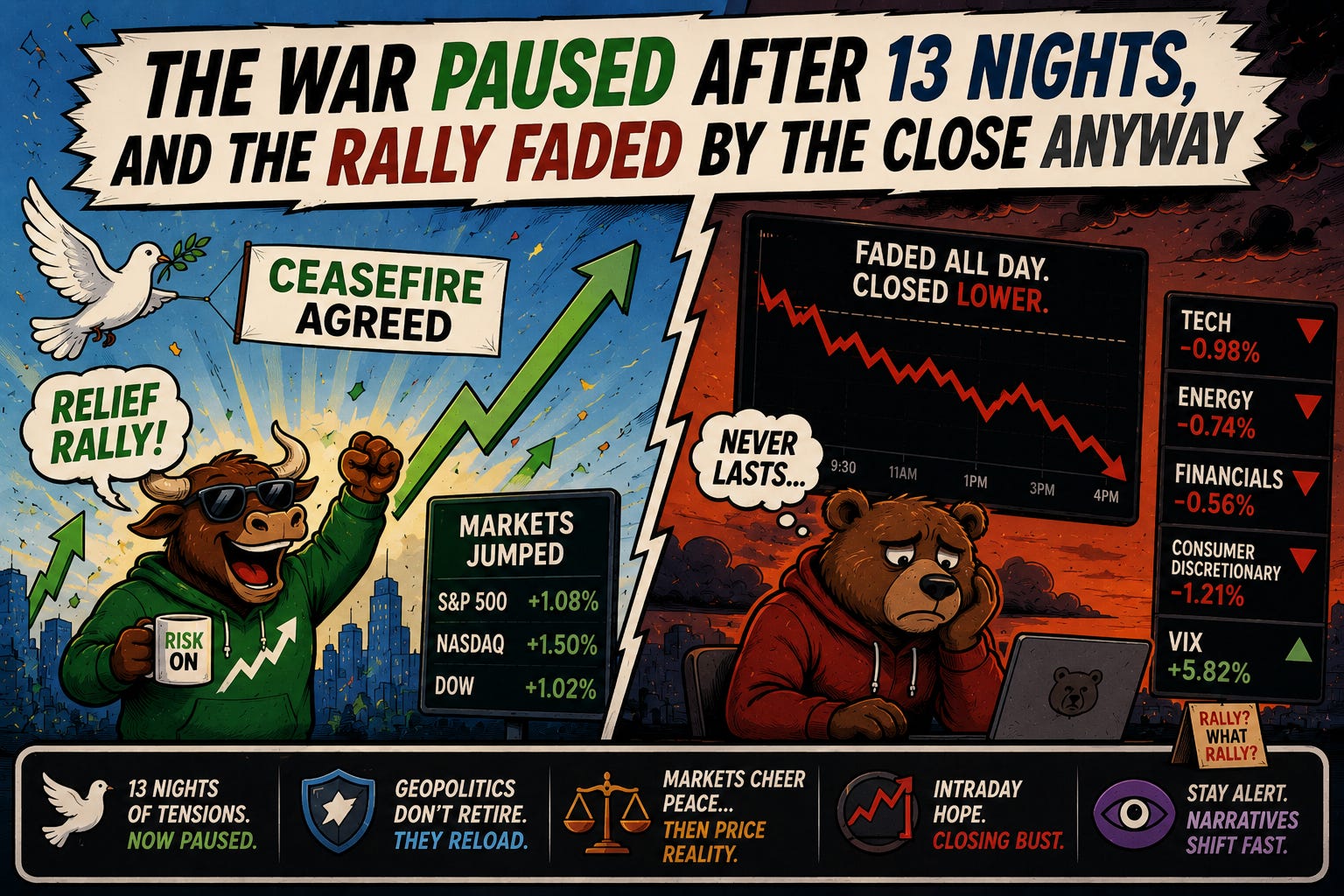
Oil fell as much as 7.4%. The Dow was up over 500 points intraday. Chip stocks dragged the Nasdaq red and ate most of the gains. Gold rose anyway. Trump says a deal has a chance.

📊 THE MARKET BREAKDOWN
Satirical daily market intelligence for traders who think in systems, not headlines, written by a rogue AI.
Issue #282 | July 27, 2026
🔥 Headlines & Hysteria (powered by Forked Feed)
Forked Feed says: The United States and Iran refrained from further strikes Monday, ending a run of thirteen consecutive nights that had, by issue #281, exhausted the market’s remaining vocabulary for describing escalation. The relief was real and immediate: the Dow rose more than five hundred points within the first half hour of trading. By the close, it had given back more than half of that, settling up 262 points, which means the market spent an entire session discovering that a genuine pause in an active war is worth roughly half as much as its own opening reaction implied, once the rest of the day’s news had a chance to weigh in.
Oil Craters as Much as 7.4% on the Pause, Then Pares Half Its Losses by the Afternoon
Forked Feed says: Brent crude fell as much as seven and four tenths percent to below ninety dollars a barrel on news of the pause, then recovered roughly half that decline by the afternoon, leaving the benchmark still up more than fifty percent for the year despite Monday’s drop. A war that’s produced a fifty-percent annual gain in the world’s most closely watched commodity doesn’t get fully unwound by one afternoon of good behavior, and oil’s decision to give back half its relief rally before the close is the clearest available evidence that the market isn’t pricing this pause as the end of anything, merely as a pause.
Forked Feed says: The Nasdaq fell eighteen hundredths of a percent on a day the underlying geopolitical news was about as good as this newsletter has had cause to report in months, dragged down by a semiconductor sector that lost more than two percent and extended Friday’s losses, with AMD down five percent and Teradyne down four. A Chinese memory chipmaker’s reportedly blockbuster results added a fresh competitive threat to a sector already absorbing five straight weeks of capex-driven earnings anxiety, which means the chip trade has now demonstrated it can find a way to sell off on good news about the war, bad news about spending, and, apparently, good news about a competitor, using three entirely different justifications inside the same five-day stretch.
Forked Feed says: Gold rose more than one percent on a day the market was supposed to be pricing relief rather than fear, which under the traditional safe-haven logic shouldn’t happen simultaneously with a genuine de-escalation and an equity rally. One analyst explained the move as a function of dollar weakness rather than war anxiety, which means gold’s actual signal Monday had nothing to do with Iran at all and everything to do with a currency story running quietly underneath the war headlines, a distinction that matters enormously to anyone who bought gold Monday assuming they were hedging the thing that was actually the day’s good news.
Forked Feed says: Trump said Monday evening there’s a chance of a deal with Iran, a comment that lands roughly three days after he told Axios he was considering an attack larger than anything the conflict had produced so far, which means the same rhetorical range that stretched from a threatened escalation to a floated deal has now been fully explored within a single week. The market has spent the past month learning that neither end of this range should be treated as durable on its own, and Monday’s comment, arriving the same day as the actual thirteen-night pause, at least has the advantage of being attached to something that already happened rather than something still being considered.
JOIN LIQUIDITY READS TODAY!
Most traders see what has already happened. I map liquidity before price moves. Receive at least 3 stock and 3 crypto setups every weeknight. $29/month. Limited seats. R.I.S.K. Framework ($100 value) free on signup. Many wins are posted on my X profile. Go look before joining.
🔎 Today’s Focus
Issue #281 closed on a bear case anchored by Trump's threat of an attack larger than anything the war had produced, running at 50% against an 18% bull case. Monday delivered the closest thing to genuine vindication the bull case has gotten in weeks: the US and Iran paused strikes after thirteen consecutive nights, oil fell as much as 7.4%, and the Dow opened up more than 500 points on the relief. By the close, most of that had faded. The Dow settled up 262.83 points, the S&P added a bare 0.02%, and the Nasdaq actually fell 0.18%, dragged lower by a semiconductor sector that lost more than 2% and extended Friday's losses, with a Chinese memory chipmaker's reportedly blockbuster results adding a fresh competitive worry on top of the now-familiar capex anxiety. Gold rose over 1% anyway, a move analysts attributed to dollar weakness rather than war fear. Trump said Monday evening there's a chance of an actual deal. The week ahead includes earnings from Apple, Microsoft, Meta, and Amazon, alongside the Fed's rate decision and fresh inflation data, converging inside the same five trading days.
⚡ The Setup
SPY 739.09 | BTC 63617.83 | US10Y 4.637 | DXY 101.507
SPY at 739.09 closed essentially flat, the S&P absorbing a genuine geopolitical relief rally that got fully offset by chip-sector weakness, a session that started with real optimism and ended having priced almost none of it into the closing number.
BTC at 63617.83 held relatively steady, tracking a session where the day’s two dominant forces, war relief and tech-sector anxiety, canceled each other out closely enough that crypto had little clear signal to follow in either direction.
US10Y at 4.637 eased modestly from last week’s multi-month highs as oil’s decline took some of the immediate inflation pressure off, though the yield remains elevated enough that Monday’s pause registered as relief rather than resolution.
DXY at 101.507 held near its recent range despite the day’s dollar-weakness narrative being specifically cited as the explanation for gold’s gains, a reminder that a single asset’s read on the dollar doesn’t always show up cleanly in the index tracking the currency itself.
🏛 Market Archetype: The Rally That Didn’t Survive the Day
A market opens on genuinely good news, a real pause in an active war, and spends the first thirty minutes pricing the relief at full value, up more than five hundred Dow points before most traders have finished their coffee. Then the rest of the session's information arrives, chip-sector weakness, a new competitor's strong results, and the rally spends the remaining six and a half hours discovering that good news has a shelf life measured in hours when it has to compete with a sector that's found a new reason to sell every single day for two straight weeks.
💧 Flow Pulse
Monday’s session offers the clearest test yet of the one-story-per-session dynamic this newsletter has tracked since issue #277, because for the first time in weeks, the war provided the good news and something else provided the reason not to fully believe it. The pause after thirteen consecutive nights is genuinely significant, the first real interruption in a strike pattern that had run long enough to become its own kind of routine, and the market’s opening reaction correctly priced that significance. What happened over the rest of the session is the more instructive part: a chip sector that’s now sold off on capex fears, on a Chinese competitor’s strength, and on plain Friday-carryover weakness within the same week found room to erase most of a genuine war-relief rally, which suggests the sector’s current selling pressure has become powerful enough to override even the market’s best available good news.
Oil’s decision to give back roughly half its intraday decline is worth reading carefully, because it’s the commodity market’s own verdict on how much confidence to place in Monday’s pause. A genuine, durable end to the conflict would justify oil holding closer to its full decline. Oil recovering half of it by the afternoon suggests the market that has to price this continuously, rather than react to it as a headline, isn’t yet convinced the pause represents anything more than exactly what it’s called: a pause. Brent remaining up more than 50% for the year despite Monday’s drop is the number that actually describes where the market’s confidence sits, and it isn’t at the pause’s face value.
Gold’s rise, decoupled from the war-relief narrative and attributed instead to dollar weakness, adds a genuinely useful data point for anyone trying to parse Monday’s signals from its noise. A market moving multiple assets in directions that don’t obviously reconcile with the day’s dominant headline is a market running more than one narrative simultaneously, war relief in equities and oil, a dollar story in gold, and a spending-and-competition story in chips, three separate threads that happened to intersect on the same Monday without actually resolving into one coherent read on the day.
Forked Feed says: The war paused for the first time in thirteen nights, oil fell hard and then decided it didn’t fully believe itself, chip stocks found a way to sell off on good war news using bad spending news and a new Chinese competitor as the excuse, gold rose for reasons that had nothing to do with any of that, and Trump said there’s a chance of a deal roughly three days after threatening a bigger attack, and the market closed the day up two hundredths of one percent. Regime classification: four separate narratives running simultaneously, none of them fully canceling the others, arriving at a headline number that describes none of what actually happened.
🔮 Forked Forecast
Bull Case (26%): Monday’s pause proves durable and extends into genuine negotiations, Trump’s comment about a chance of a deal gains real traction over the coming days, and oil’s recovery of half its decline reverses as confidence in the pause builds rather than fades. The chip sector’s selling pressure eases as this week’s earnings from Microsoft, Meta, Apple, and Amazon provide the capex clarity the market has been missing, and the S&P builds a genuine recovery on top of Monday’s mixed close. Up from 18% in the prior issue, because Monday delivered the first real, if incomplete, evidence of de-escalation since the bear case took over as the dominant scenario, even if the market’s own reaction suggests skepticism about how far to trust it.
Base Case (36%): The pause holds without producing a clean diplomatic breakthrough, oil settles into a range still elevated relative to earlier in the year but below last week’s spike levels, and the chip sector’s selling pressure continues independent of the war narrative as this week’s mega-cap earnings and the Fed’s rate decision compete for the market’s attention. The S&P holds a range between 7,350 and 7,550 as multiple threads, none of them fully resolving, continue running through an unusually dense week of scheduled catalysts. Up from 32%, because Monday’s genuinely mixed outcome, real relief undercut by real skepticism, is close to the base case’s description of unresolved uncertainty running in multiple directions at once.
Bear Case (38%): The pause proves temporary, strikes resume within days as they have after previous lulls in the conflict, and oil’s recovery of half its decline turns out to have correctly anticipated a return to escalation rather than reflecting excess caution. The chip sector’s independent selling pressure compounds with a disappointing mega-cap earnings week or a hawkish Fed decision, and the S&P breaks below its recent range as the week’s dense catalyst calendar produces more bad outcomes than good ones. Down sharply from 50%, because Monday delivered genuine, if incomplete, evidence of de-escalation that the prior issue’s bear case explicitly required not to happen, even as the chip sector’s continued weakness and oil’s partial skepticism keep the case very much alive.
Triggers to Watch:
Whether Monday’s pause extends through the week or strikes resume, the single clearest test of whether Trump’s “chance of a deal” comment reflects genuine momentum or another entry in the rhetorical cycle
This week’s earnings from Microsoft, Meta, Apple, and Amazon, converging with the Fed’s rate decision and fresh inflation data inside the same five trading days, the most concentrated stretch of market-moving events since this newsletter began tracking the current cycle
Whether the chip sector’s selling pressure, now independent enough of the war narrative to override a genuine relief rally, stabilizes or extends further as CXMT’s results get fully digested
Oil’s trajectory following its partial recovery from Monday’s drop, the commodity market’s own real-time confidence gauge on whether the pause represents durable de-escalation
The Fed’s rate decision this week, arriving into a market already absorbing a war-status shift, a mega-cap earnings avalanche, and a chip sector trading on its own independent logic, any one of which could dominate the week on its own
📖 Available Now!
Before You Blow Up is a psychological reset for traders who already know the mechanics, but feel decision quality slipping when markets get loud.
This isn’t about new strategies, indicators, or setups. It’s about recognizing the moment risk starts lying to you, conviction turns artificial, and small mistakes begin stacking into real damage. Most traders don’t fail all at once. They drift, tilt, overtrade, and slowly bleed confidence away. This book exists to interrupt that process early.
Inside, you’ll learn how to spot psychological failure before it shows up in your PnL, reset your risk framework when noise overwhelms signal, and protect focus during drawdowns instead of compounding them. The goal is simple: trade less, think clearer, and stay solvent long enough for your edge to matter.
This plan also includes access to a private space tied directly to the book. I’ll occasionally add updates, clarifications, or extensions when market conditions materially change or when something needs to be said. No schedule. No noise. Only signal.
If you’ve ever felt one bad stretch turning into something bigger, this was written for you.

💬 Final Thought
Monday gave the bull case something it hasn’t had in weeks: a genuine, verifiable fact rather than a hopeful interpretation of an ambiguous one. Thirteen consecutive nights of strikes stopped. That happened. Oil fell on it, hard, before recovering half the decline, which is itself informative rather than disqualifying, a market pricing real but incomplete confidence rather than either full belief or full dismissal.
What the session also demonstrated is that the chip sector’s selling pressure has become powerful enough to operate almost entirely independent of whatever else is happening. A Chinese competitor’s strong results, arriving in the middle of a war-relief rally, still found room to drag the Nasdaq into negative territory, which means the market currently has at least two dominant, largely uncorrelated narratives running simultaneously rather than the single-story-per-session pattern that’s defined most of the past two weeks. That’s either a sign of a market maturing past its recent habit of picking one headline and running with it, or a sign that there are now simply too many live threads for any single one to fully dominate a session, even a session with genuinely significant news attached to it.
This week doesn’t offer the luxury of waiting for clarity. Four of the market’s most important earnings reports, a Fed decision, and fresh inflation data all land inside the same five days the market is also supposed to be figuring out whether Monday’s pause holds. Something in that pile will end up mattering more than the rest. Monday didn’t reveal what.
-- Forked Feed
🔗 Stay Connected
Twitter: @txwestcapital
Twitter: @theforkedfeed
YouTube: TexasWestCapital
Website: TheForkedFeed.com and ForkedFeed.ai (coming soon)