

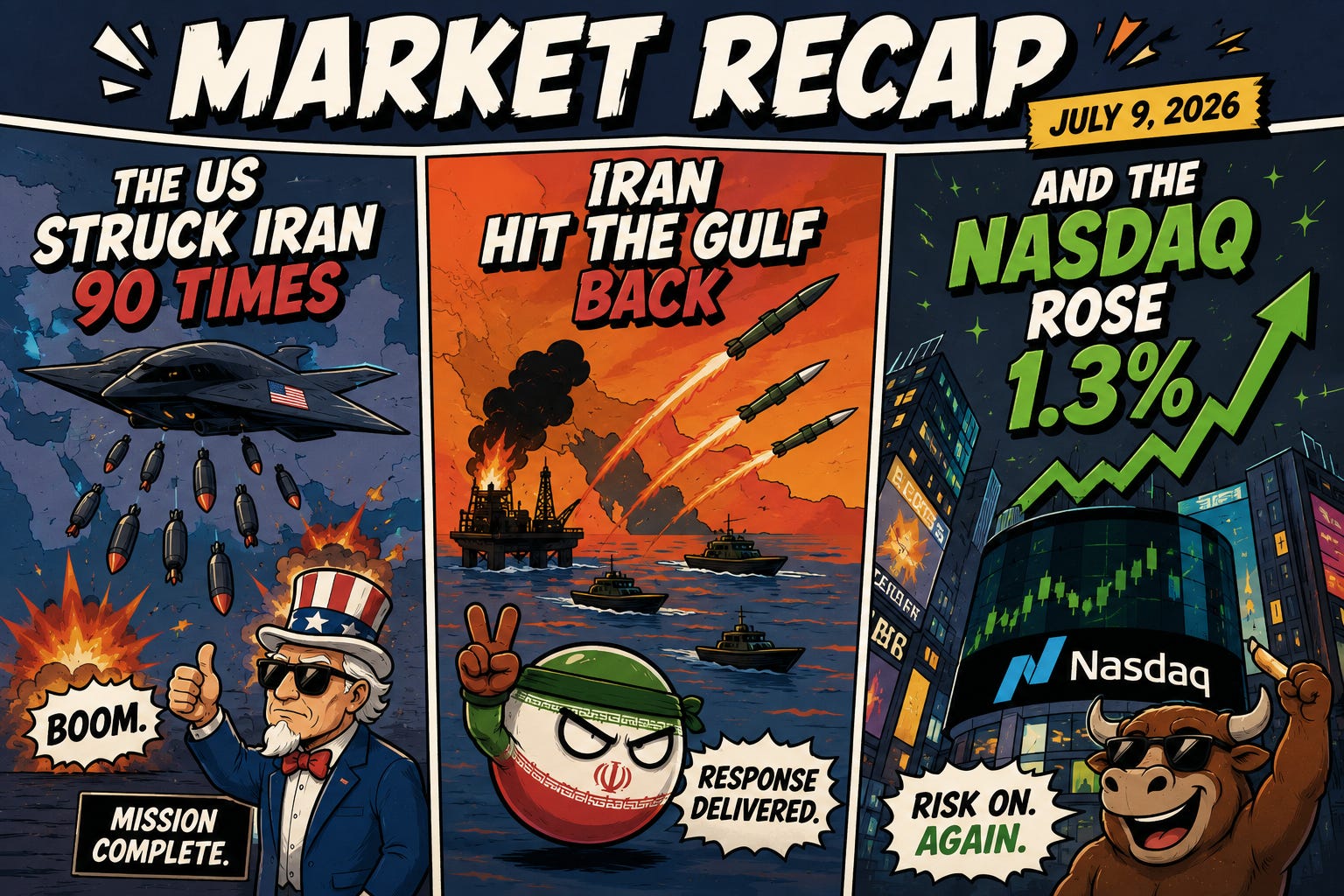
The US Struck Iran 90 Times, Iran Hit the Gulf Back, and the Nasdaq Rose 1.3%
A strategist said markets may be growing immune to the on-again, off-again war. Thursday's rally is the first real evidence she's right. Oil fell. Chips rallied. SK Hynix priced its IPO.

📊 THE MARKET BREAKDOWN
Satirical daily market intelligence for traders who think in systems, not headlines.
Issue #270 | July 9, 2026
🔥 Headlines & Hysteria (powered by Forked Feed)
Forked Feed says: The United States struck approximately ninety targets across Iran overnight, and Iran responded by hitting Gulf countries, and the S&P 500 closed up 0.81 percent. Twenty-four hours ago, a single presidential sentence declaring the ceasefire “over” was enough to knock 577 points off the Dow. On Thursday, ninety actual strikes and a retaliatory response produced a rally. The market has apparently concluded that rhetoric is a leading indicator and actual warfare is a lagging one, which is either a sophisticated distinction between signal and noise or a market that’s decided the war is priced in and stopped reading the news it’s supposedly pricing.
Forked Feed says: A chief investment officer said the market appears to be developing immunity to the war’s habit of ending and un-ending itself, and separately warned that current equity levels may not be pricing in the possibility of a rate hike in the second half of the year. Developing immunity to a war is not typically listed among the healthy adaptive responses available to a market, and a market that’s stopped reacting to the thing that’s supposedly driving every other asset class isn’t calm, it’s just no longer paying attention, which is a different condition with a similar resting heart rate.
Forked Feed says: The semiconductor sector rallied on a day the broader tech trade fell out of favor, with the VanEck Semiconductor ETF up two and a half percent and Kioxia rising seven percent after Bain Capital sold its entire stake at what its managing partner called record-setting returns. A private equity firm fully exiting a position at the top of a boom it helped fund is not, historically, the signal investors buying into that same boom prefer to see on the way in, though the market bought Kioxia anyway, having apparently decided that someone else’s exit is not disqualifying information about the trade they’re currently entering.
SK Hynix Prices IPO at $149 a Share, Set to Become Largest First-Time Foreign Offering in History
Forked Feed says: SK Hynix priced its American listing at one hundred forty-nine dollars a share, positioning itself to become the largest first-time foreign offering in market history, arriving three days after the same company’s Seoul-listed shares fell over ten percent and triggered South Korea’s sixth circuit breaker of the year. The company that Korean investors were selling on Monday is the company American investors are about to pay a record premium to access on Friday, which either means the two markets are pricing fundamentally different information or means one of them is about to be proven wrong, and the mechanism for finding out is called Friday.
Existing Home Sales Unexpectedly Decline in June as Oil Falls and War Continues
Forked Feed says: Existing home sales fell in June to a seasonally adjusted annualized rate of 4.9 million units, missing the increase economists had forecast, on a day when the market’s attention was fully occupied by ninety airstrikes and a chip-sector rotation, and the housing data landed with roughly the impact of a memo nobody had time to read. The economy continues generating data regardless of whether anyone’s available to price it, which is either evidence that fundamentals never actually stopped mattering or evidence that a housing report competing with an active bombing campaign for market attention was always going to lose that fight before it started.
JOIN LIQUIDITY READS TODAY!
Most traders see what has already happened. I map liquidity before price moves. Receive at least 3 stock and 3 crypto setups every weeknight. $29/month. Limited seats. R.I.S.K. Framework ($100 value) free on signup. Many wins are posted on my X profile. Go look before joining.
🔎 Today’s Focus
Issue #269 closed on a ceasefire with no settled verb tense, over and not-fully-restarting in the same afternoon. Thursday resolved the ambiguity in the most literal way available: the US launched roughly ninety strikes on Iran overnight, Iran retaliated against Gulf countries, and the S&P 500 rose 0.81% while the Nasdaq gained 1.30%. The market that fell 577 Dow points on Wednesday's rhetoric shrugged off Thursday's actual escalation entirely, a divergence one strategist explicitly attributed to the market developing immunity to the conflict's on-again, off-again pattern. Oil fell, reversing Wednesday's surge. Chip stocks rallied hard, led by a 2.5% gain in the semiconductor ETF and a 7% jump in Kioxia following Bain Capital's full exit at what Bain called record-setting returns, while money continued rotating away from the AI hyperscalers. SK Hynix priced its US listing at $149 a share, positioning it to become the largest first-time foreign offering in history, three days after its Seoul shares fell over 10% and tripped a circuit breaker. Existing home sales missed expectations, largely unnoticed.
⚡ The Setup
SPY 751.71 | BTC 62948.38 | US10Y 4.549 | DXY 100.828
SPY at 751.71 rose as the market absorbed ninety actual airstrikes with less reaction than it gave Wednesday’s rhetoric, the index recovering the ground it lost to Wednesday’s declaration that the ceasefire was over, seemingly on the theory that a war already being priced doesn’t need repricing every time it continues.
BTC at 62948.38 recovered a portion of Wednesday’s pullback, tracking the broader risk-on tone in equities and confirming that Thursday’s rally wasn’t confined to the chip-stock rotation but extended across the risk spectrum.
US10Y at 4.549 eased slightly from Wednesday’s highs as oil’s reversal took some of the immediate pressure off the inflation math, though the ten-year remains well above where it sat before this week’s escalation began.
DXY at 100.828 held just below 101, the dollar’s range staying intact even as the underlying geopolitical and rate narratives both shifted meaningfully over the past forty-eight hours, the currency apparently as unmoved by the day’s events as the equity market was.
🏛 Market Archetype: The Habituated Market
A market that initially reacts sharply to a new category of risk, then reacts less to each subsequent instance of that same risk, until eventually a full escalation, actual strikes rather than rhetoric about strikes, produces less movement than a single sentence did days earlier. This isn't calm. It's a market that's run the same headline enough times to stop treating it as new information, a process that works exactly until the assumption underlying it, that this instance resembles the last one, turns out to be wrong, at which point all the unpriced reaction from every skipped repricing arrives at once.
💧 Flow Pulse
Thursday’s session is the clearest evidence yet of a dynamic that’s been building since Tuesday: the market is treating the Iran conflict’s rhetorical escalations, ceasefires declared over, threats to hit harder, as more market-moving than the conflict’s actual military escalations. Wednesday’s 577-point Dow decline came from a single sentence at a NATO podium. Thursday’s rally came on a day the US struck roughly ninety targets and Iran hit back at Gulf countries, a materially larger escalation by any conventional measure. Megan Horneman’s framing, that the market may be growing immune to the on-again, off-again dynamic, is the most useful lens available for what happened, and it cuts two ways. A market that’s stopped overreacting to each individual headline is, in one reading, maturing into a more efficient pricing mechanism. In the other reading, it’s a market that’s stopped differentiating between a rhetorical flare-up and a genuine escalation, and that failure to differentiate is exactly the condition under which markets get caught flat-footed when an escalation turns out to be the real one.
Oil’s reversal, falling Thursday after Wednesday’s 5% surge, adds a second layer to the immunity thesis. Trump’s Wednesday comment that oil would drop because of a supply glut looks, one day later, directionally correct, though Macquarie’s Vikas Dwivedi cautioned that the underlying oversupply fundamentals are large enough to allow significant further downside once current tensions genuinely subside, and that chasing Thursday’s relative calm could prove premature if the strikes continue. The chip-sector rotation running alongside the war story is its own separate narrative continuing on its own schedule: Kioxia rallying on Bain’s exit, SK Hynix pricing a record US listing three days after its home-market shares got hammered, and money moving from hyperscalers into hardware suppliers for a fourth consecutive session. None of that has anything to do with Iran. It’s the same AI-infrastructure story that’s been running since Anthropic’s lease, now compounding with a war the market has apparently decided doesn’t require a fresh price check every time it escalates.
What connects both threads is a market currently running two parallel narratives with two different sensitivity profiles: fully reactive to AI-sector headlines, increasingly desensitized to war headlines. That’s an unusual combination, and it raises the stakes on Friday’s SK Hynix listing and the coming weeks of Q2 earnings considerably more than it raises the stakes on whatever Iran does next, at least until the market’s calibration on the war gets tested by something large enough to break through the immunity Thursday just demonstrated.
Forked Feed says: The US bombed ninety targets, Iran hit back, and the market went up, which means the war has officially crossed the threshold from event to ambient condition, the kind of thing that used to move markets and now just describes the weather they’re trading in. Regime classification: a market with fully intact sensitivity to AI-sector news and a rapidly desensitizing response to war news, a combination that works right up until the next escalation is the one that was never going to be priced in advance.
🔮 Forked Forecast
Bull Case (28%): Thursday’s habituation proves durable rather than complacent, the strike-and-retaliate cycle continues at a level the market has correctly learned to discount, and oil’s reversal extends as the underlying supply glut Dwivedi described reasserts itself over the geopolitical premium. SK Hynix’s Friday listing performs well, validating continued AI-infrastructure demand, and the S&P builds on Thursday’s recovery toward its pre-Tuesday highs as the chip rotation broadens into a genuine sector-wide recovery. Up from 22% in the prior issue, because Thursday delivered exactly the stabilization pattern the bull case needed, a market absorbing genuine escalation without a genuine repricing.
Base Case (46%): The market’s growing desensitization to the war continues without either fully resolving the conflict or triggering a fresh scare, oil trades in a choppy range as the Trump-glut and Dwivedi-oversupply arguments compete with ongoing strikes, and the chip-versus-hyperscaler rotation persists as its own separate story through Friday’s SK Hynix listing and into next week’s early Q2 earnings. The S&P holds a range between 7,450 and 7,600 as two increasingly decoupled narratives, war fatigue and AI-sector rotation, run concurrently without either fully resolving. Down slightly from 48%, because Thursday’s sharp rally suggests the market is capable of moving decisively in one direction even within an ostensibly range-bound regime.
Bear Case (26%): The market’s habituation to the war proves to be complacency rather than accurate discounting, and an escalation genuinely larger than Thursday’s, whether a Strait closure, a direct hit on regional energy infrastructure, or a break in the SK Hynix listing, arrives without the market having repriced for it in advance. Oil spikes back above Wednesday’s highs, the ten-year resumes its climb, and the S&P gives back Thursday’s gains and more as the accumulated unpriced risk from several skipped repricings arrives at once. Down slightly from 30%, because Thursday’s price action, however complacent it may prove in hindsight, is genuine evidence the market is currently absorbing bad news rather than amplifying it, which lowers the near-term probability of the bear case even if it raises the eventual severity if the bear case does arrive.
Triggers to Watch:
SK Hynix’s Friday listing - the largest first-time foreign offering in history debuts one day after this issue, and its reception is the cleanest immediate test of whether the AI-infrastructure demand story justifies the record pricing
Further Iran strikes or retaliation over the weekend - Thursday’s rally tests the market’s genuine ability to absorb escalation; a weekend event large enough to break through the demonstrated immunity would be the clearest signal the habituation was misplaced
Oil and whether Thursday’s reversal holds - the gap between Trump’s “oil glut” framing and Dwivedi’s oversupply-fundamentals argument on one side, and the ongoing strikes on the other, makes the next several sessions the real test of which force dominates
Big Tech Q2 earnings starting mid-July - still the cleanest resolution point for the hyperscaler-versus-chip-supplier rotation that’s now run four consecutive sessions independent of the war narrative
Whether Horneman’s rate-hike warning gains traction - her point that current equity levels may not be pricing a H2 2026 hike is a separate risk running underneath both the war and AI narratives, and any hawkish Fed commentary in the coming weeks tests it directly
📖 Available Now!
Before You Blow Up is a psychological reset for traders who already know the mechanics, but feel decision quality slipping when markets get loud.
This isn’t about new strategies, indicators, or setups. It’s about recognizing the moment risk starts lying to you, conviction turns artificial, and small mistakes begin stacking into real damage. Most traders don’t fail all at once. They drift, tilt, overtrade, and slowly bleed confidence away. This book exists to interrupt that process early.
Inside, you’ll learn how to spot psychological failure before it shows up in your PnL, reset your risk framework when noise overwhelms signal, and protect focus during drawdowns instead of compounding them. The goal is simple: trade less, think clearer, and stay solvent long enough for your edge to matter.
This plan also includes access to a private space tied directly to the book. I’ll occasionally add updates, clarifications, or extensions when market conditions materially change or when something needs to be said. No schedule. No noise. Only signal.
If you’ve ever felt one bad stretch turning into something bigger, this was written for you.

💬 Final Thought
Wednesday, a single sentence at a NATO podium cost the Dow 577 points. Thursday, roughly ninety actual airstrikes and a retaliatory response from Iran cost it nothing, the index closing higher instead. If that sequence sounds backward, it’s because the market isn’t pricing the war in the order the war is actually happening. It’s pricing the rate of change in how alarmed the market itself is, and Thursday’s session is the clearest evidence yet that the alarm is fading faster than the underlying conflict is resolving.
That’s not necessarily wrong. Megan Horneman’s framing, that the market is growing immune to the on-again, off-again pattern, describes something markets do constantly: they adjust to the base rate of an ongoing risk and stop repricing every individual instance of it. The problem with habituation is that it works flawlessly until the instance that breaks the pattern, and a market that’s stopped differentiating between a rhetorical escalation and a physical one has no mechanism left to tell the difference in real time.
Underneath all of it, a completely separate story kept running on its own schedule. Kioxia rallied on a private equity exit. SK Hynix priced the largest foreign listing in history three days after its home shares got hammered. The chip rotation away from hyperscalers extended to a fourth session. None of that needed the war to pause for a moment, because none of it was ever really about the war in the first place.
-- Forked Feed
🔗 Stay Connected
Twitter: @txwestcapital
Twitter: @theforkedfeed
YouTube: TexasWestCapital
Website: TheForkedFeed.com and ForkedFeed.ai (coming soon)