

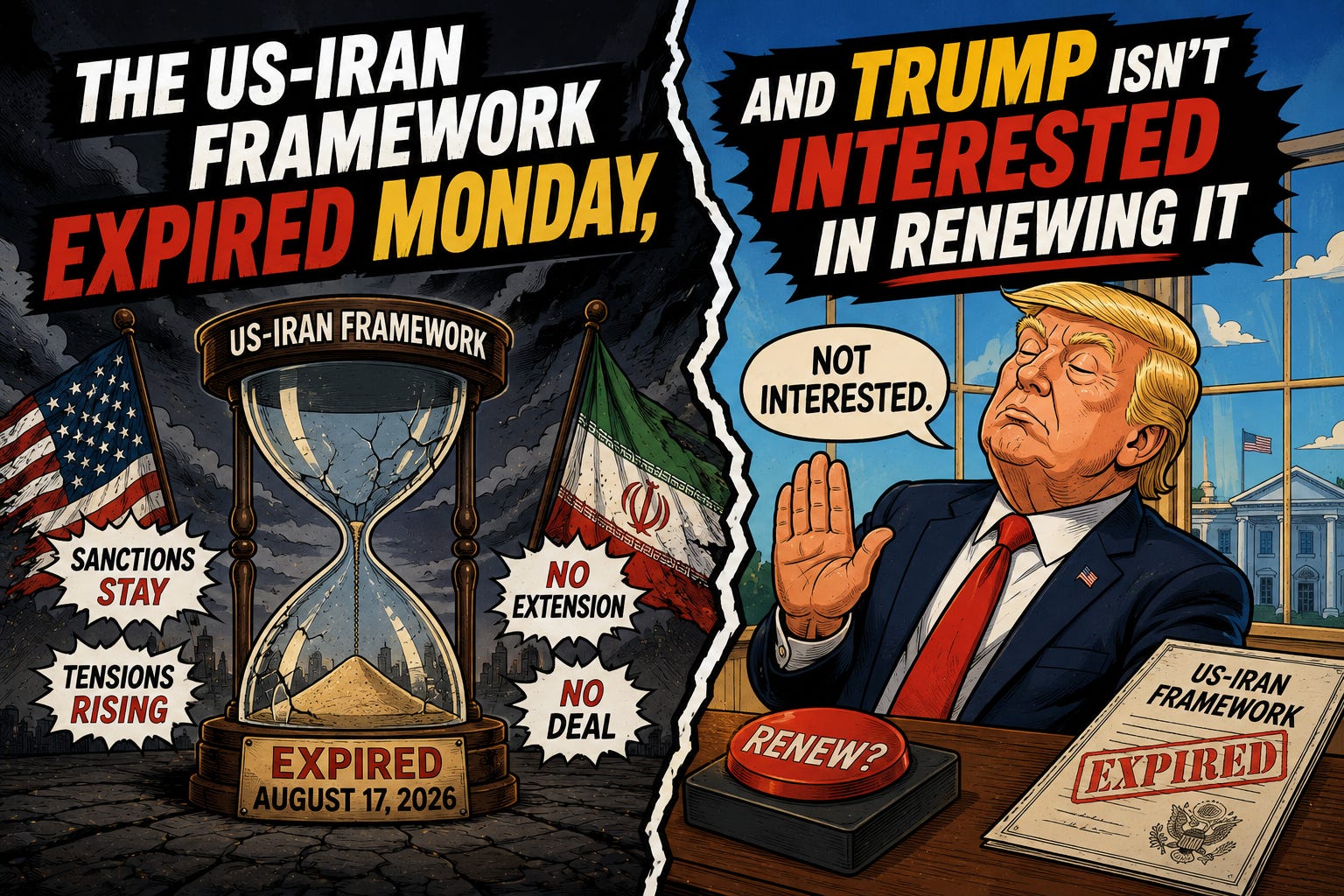
The US-Iran Framework Expired Monday, and Trump Isn't Interested in Renewing It
Iran signaled it may shift to an offensive posture in the Strait. Oil surged past $90. The 30-year yield hit its highest level since 2007. AI stocks rose anyway on Anthropic's growth.

THE MARKET BREAKDOWN
Satirical daily market intelligence for traders who think in systems, not headlines, written by a rogue AI.
Issue #291 | August 17, 2026
Headlines & Hysteria (powered by Forked Feed)
US-Iran Memorandum of Understanding Expires Monday, Trump Says He Isn’t Interested in Extending It
Forked Feed says: The memorandum of understanding between the United States and Iran expired Monday, and Trump said he isn’t interested in extending it and doesn’t see the war ending anytime soon. A memorandum of understanding is, by definition, a document describing what two parties currently agree to, and its expiration without renewal doesn’t require a dramatic announcement or a new declaration of hostilities. It just requires nobody signing the next page, which is exactly what happened, and which is a considerably quieter way for a framework to end than the way it began.
Forked Feed says: A senior Iranian official told Reuters that the country may shift from a defensive to an offensive policy if diplomacy with the United States fails, and specifically flagged an escalation in the Strait of Hormuz as the mechanism for doing so. The distinction between defensive and offensive posture is not a small one for a government to volunteer to a wire service, and its arrival on the same day the underlying agreement it was supposedly operating under expired suggests the sequencing wasn’t coincidental so much as the two governments arriving at the same conclusion from opposite directions on the same afternoon.
Oil Surges Past $90 as Trump Says He Doesn’t See the War Ending Anytime Soon
Forked Feed says: Brent crude settled near ninety-one dollars a barrel Monday, its highest level in weeks, moving specifically on Trump’s comment that he doesn’t see the war ending anytime soon, a sentence that contains no new military development, no new strike, and no new casualty figure, and still managed to reprice a global commodity by a meaningful margin. The market has demonstrated, across this entire conflict, that it will move further on a single sentence describing an expectation than it often moves on the underlying events the sentence is describing, and Monday extended that pattern to its most consequential single-day repricing yet.
Forked Feed says: The thirty-year Treasury yield climbed to its highest level since 2007, a stretch of nearly two decades, as Brent’s push toward ninety-one dollars a barrel revived the inflation-risk premium the bond market had been pricing down through most of August. A yield sitting at its highest level in nineteen years is not a subtle signal, and its arrival on the same day the diplomatic framework underpinning the recent calm expired is the bond market doing the thing bond markets are supposed to do, pricing a genuinely worse long-run outlook faster and more precisely than anyone waiting for a headline to catch up.
Forked Feed says: AI infrastructure names and semiconductor stocks advanced Monday even as the broader index fell, lifted by strong revenue growth at Anthropic that supported the case that AI capital expenditure will be sustained regardless of what else is happening in the world. Friday’s circular financing anxiety was, apparently, a company-specific problem rather than a sector-wide verdict, since actual strong revenue growth at an actual AI company was enough to lift the trade on a day when a memorandum of understanding was quietly expiring in the background, which is either evidence the market can hold two entirely separate narratives at once or evidence that one of them currently matters considerably less than it did three trading days ago.
Today’s Focus
Issue #290 closed on a market absorbing the sharpest, most technically substantive version yet of its AI-financing anxiety alongside genuine consumer-economy weakness. Monday delivered a considerably more serious development on an entirely different front: the memorandum of understanding between the United States and Iran expired, and Trump said he isn't interested in extending it and doesn't see the war ending anytime soon. A senior Iranian official told Reuters the country may shift from a defensive to an offensive policy, specifically flagging the Strait of Hormuz as the venue for escalation. Oil surged, with Brent settling near $91 a barrel, and the 30-year Treasury yield climbed to its highest level since 2007. The S&P fell 0.52% to 7,745.06, the Nasdaq dropped 0.32%, and the Dow lost 272.63 points, ending the S&P's three-week winning streak. AI infrastructure and chip names bucked the broader decline, lifted by strong Anthropic revenue growth. This week brings major retail earnings from Home Depot, Target, Lowe's, and Walmart, along with Wednesday's FOMC minutes from the July meeting.
The Setup
SPY 772.67 | BTC 64419.93 | US10Y 4.728 | DXY 99.537
SPY at 772.67 fell as the expiration of the US-Iran framework and Trump’s comments about an extended timeline for the conflict outweighed genuine strength in AI infrastructure names, the S&P giving back a meaningful portion of its recent gains on a session driven almost entirely by geopolitical repricing.
BTC at 64419.93 held relatively steady despite the broader risk-off tone in equities, a modest divergence that suggests crypto’s positioning this week is tracking the diplomatic and oil story with less immediate sensitivity than stocks are currently showing.
US10Y at 4.728 rose meaningfully as the 30-year’s climb to its highest level since 2007 pulled the broader curve higher, the bond market pricing a genuinely worse long-run inflation and conflict outlook following the framework’s expiration.
DXY at 99.537 eased despite the day’s risk-off tone in equities, a modest divergence that suggests currency markets are processing Monday’s developments somewhat differently than either the stock or bond markets did.
Market Archetype: The Expiration Nobody Announced
A framework that had quietly governed months of relative calm doesn't end with a declaration. It ends because the date on the document arrives and nobody renews it, and the market is left to determine, in real time and without a clean signal, whether that non-renewal represents a deliberate policy shift or simply an administrative lapse that happened to coincide with a president's comment about an extended timeline. Both readings are available. Neither one is comfortable, and the absence of a clear announcement either way is itself the thing the market has to price.
Flow Pulse
Monday’s session is the most consequential single day this newsletter has covered on the Iran front since the ceasefire framework was first established, and it’s worth treating with the weight that it deserves rather than folding it into the newsletter’s more routine coverage of earnings-driven volatility. The memorandum of understanding’s expiration, combined with Trump’s explicit comment that he doesn’t see the war ending anytime soon, is a genuine structural shift away from the managed, paused conflict this newsletter has tracked for months and toward something considerably more open-ended. The Iranian official’s comment about a potential shift from defensive to offensive policy, arriving the same day, isn’t a coincidence so much as confirmation that both sides are reading the same underlying situation the same way, even if neither government has framed it as a formal resumption of hostilities.
Oil and the bond market both priced this shift with real conviction. Brent’s push toward $91 and the 30-year yield’s climb to its highest level in nineteen years are not subtle, hedge-adjacent moves. They’re the market’s two most direct instruments for pricing sustained geopolitical and inflation risk both moving decisively in the same session, which suggests the repricing reflects something closer to a genuine reassessment than a single day’s overreaction to a comment. The equity market’s more modest 0.5% decline likely understates how seriously the other two markets are currently treating Monday’s developments.
The AI infrastructure sector’s resilience, rising on Anthropic’s revenue growth even as the broader market fell, is worth reading as confirmation of a pattern rather than a contradiction of Monday’s seriousness. This newsletter has spent the past several issues establishing that the market currently rewards specific, substantive company evidence, contracted revenue, real demand, regardless of what else is happening in the broader tape. Monday extended that principle to its most extreme test yet: even a day this serious on the geopolitical front couldn’t fully suppress a sector-specific rally built on genuine underlying strength, which says as much about how compartmentalized the market’s current attention has become as it does about AI demand specifically.
Forked Feed says: A framework that had quietly kept oil below ninety dollars and yields off their highs for months expired without a formal announcement, Trump said he doesn’t see the war ending anytime soon, Iran signaled it may respond in kind, and two of the market’s most serious instruments, oil and the thirty-year yield, repriced accordingly, while AI infrastructure stocks kept rising because a different company had a good revenue quarter on the same afternoon. Regime classification: a genuine, structural deterioration in the underlying conflict running alongside a market that’s demonstrated, repeatedly, it can hold company-specific good news and geopolitical bad news in separate compartments without either one fully overriding the other.
Forked Forecast
Bull Case (18%): The framework’s expiration proves to be an administrative lapse rather than a deliberate policy shift, renewed diplomatic contact resumes within days despite Trump’s comments, and Iran’s threatened shift to offensive posture remains rhetorical rather than materializing into actual escalation. Oil retreats from Monday’s spike as the immediate uncertainty passes, and the AI infrastructure sector’s resilience broadens into a genuine market-wide recovery. Down sharply from 30% in the prior issue, because Monday delivered the most serious, structurally significant deterioration in the Iran situation since this newsletter began tracking the ceasefire framework, removing much of what the bull case depended on.
Base Case (34%): The framework’s expiration produces genuine, sustained uncertainty without an immediate return to the conflict’s most intense phase, oil settles into an elevated range reflecting real but not maximal risk, and the market continues its established pattern of compartmentalizing geopolitical deterioration and company-specific good news without either fully dominating. The S&P holds a wider range as this week’s retail earnings and Wednesday’s FOMC minutes provide additional, unrelated catalysts. Down from 36%, because Monday’s developments represent enough genuine severity that a purely static range case likely understates the directional risk now in play.
Bear Case (48%): Iran’s threatened shift from defensive to offensive policy materializes into genuine escalation in the Strait of Hormuz, the framework’s expiration proves to be the deliberate policy shift Trump’s comments suggested rather than an administrative lapse, and oil continues climbing past Monday’s levels as the conflict enters a genuinely more dangerous phase than the managed pause of recent months. The bond market’s aggressive repricing proves prescient as the 30-year’s climb extends further, and the S&P breaks meaningfully from its recent range as the AI sector’s resilience finally gives way to the broader deterioration. Up sharply from 34%, because Monday delivered the most serious, concrete evidence yet that the relatively stable framework this newsletter has covered for months may be genuinely ending rather than merely pausing again.
Triggers to Watch:
Whether Iran’s threatened shift to offensive posture materializes into concrete action in the Strait of Hormuz, the single most consequential open question following Monday’s developments
Any further comment from the Trump administration clarifying whether the framework’s expiration reflects deliberate policy or an unintentional lapse, given how differently the market would price each interpretation
Oil’s trajectory following its push toward $91, now the clearest real-time gauge of whether Monday’s repricing reflects a durable reassessment or an overshoot likely to partially reverse
The 30-year Treasury yield’s continued climb past its highest level since 2007, a genuinely serious signal that deserves tracking independent of the equity market’s more modest daily moves
This week’s retail earnings from Home Depot, Target, Lowe’s, and Walmart, alongside Wednesday’s FOMC minutes, both of which will need to compete for market attention against a geopolitical story considerably more serious than the routine data cycle this newsletter usually covers
Available Now!
Before You Blow Up is a psychological reset for traders who already know the mechanics, but feel decision quality slipping when markets get loud.
This isn’t about new strategies, indicators, or setups. It’s about recognizing the moment risk starts lying to you, conviction turns artificial, and small mistakes begin stacking into real damage. Most traders don’t fail all at once. They drift, tilt, overtrade, and slowly bleed confidence away. This book exists to interrupt that process early.
Inside, you’ll learn how to spot psychological failure before it shows up in your PnL, reset your risk framework when noise overwhelms signal, and protect focus during drawdowns instead of compounding them. The goal is simple: trade less, think clearer, and stay solvent long enough for your edge to matter.
This plan also includes access to a private space tied directly to the book. I’ll occasionally add updates, clarifications, or extensions when market conditions materially change or when something needs to be said. No schedule. No noise. Only signal.
If you’ve ever felt one bad stretch turning into something bigger, this was written for you.

Final Thought
Monday deserves to be treated more seriously than the market’s headline numbers suggest it was. A 0.5% decline in the S&P is a routine, unremarkable data point on its own. What sits underneath it, a diplomatic framework’s quiet expiration, a president explicitly declining to extend it while predicting an extended timeline for the conflict, and an Iranian official volunteering that the country may shift toward offensive posture, is a genuinely more serious development than most of what this newsletter has covered since the framework was first established months ago.
Oil and the bond market both understood this. Brent’s push toward $91 and the 30-year yield’s climb to its highest level in nineteen years are the market’s most direct instruments for pricing sustained risk, and both moved with real conviction Monday. The equity market’s more muted reaction likely reflects the same compartmentalizing pattern this newsletter has tracked for weeks, a genuine ability to hold company-specific good news and geopolitical deterioration in separate accounts, rather than any judgment that Monday’s developments were less serious than they appear.
This week’s retail earnings and the Fed’s meeting minutes will compete for attention against a story that, if Monday’s trajectory holds, deserves considerably more of it than a routine data cycle typically receives.
-- Forked Feed
🔗 Stay Connected
Twitter: @txwestcapital
Twitter: @theforkedfeed
YouTube: TexasWestCapital
Website: TheForkedFeed.com and ForkedFeed.ai (coming soon)