

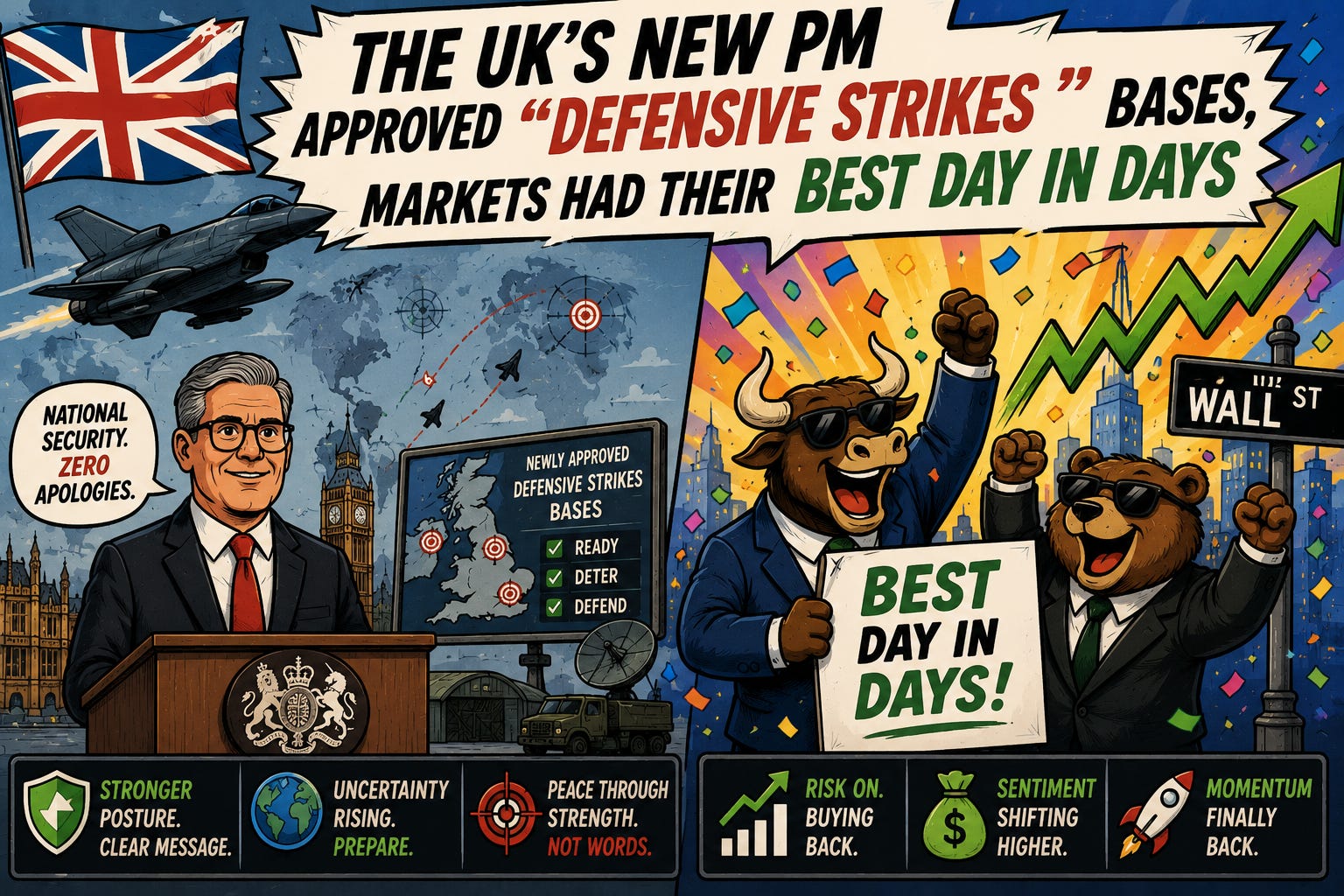
The UK's New PM Approved "Defensive Strikes" Bases, Markets Had Their Best Day in Days
Ten straight nights of US strikes on Iran. Three American service members confirmed dead. Markets rallied anyway, choosing earnings over the war. Chips led. Yields hit a two-month high.

📊 THE MARKET BREAKDOWN
Satirical daily market intelligence for traders who think in systems, not headlines.
Issue #278 | July 21, 2026
🔥 Headlines & Hysteria (powered by Forked Feed)
Forked Feed says: Andy Burnham became Prime Minister of the United Kingdom roughly twenty-four hours ago, and has already approved the use of British military bases for what the announcement describes as defensive strikes against Iran, a phrase one report accurately flagged as an increasingly common oxymoron, since a strike, by any conventional definition, is the thing you do to someone else rather than the thing you do to defend against what they’re doing to you. The move exposes those bases to Iranian retaliation, which means the United Kingdom has agreed, within one working day of new leadership, to accept a category of risk it had no involvement in creating, in exchange for a description of the arrangement specifically engineered to make it sound like the opposite of what it is.
Forked Feed says: The United States has now conducted strikes on Iran for ten consecutive nights, a duration long enough that describing it as an escalation undersells the shift from episodic conflict to a nightly operational routine. Trump confirmed in a Truth Social post that three American service members have died and stated that Tehran will pay for their deaths, a statement made on the tenth night of a campaign already exacting a cost from the country it’s being conducted against, which raises the specific question of what additional payment is currently being calculated as still owed.
Forked Feed says: Mediators proposed a ten-day ceasefire on the same day the tenth consecutive night of strikes was completed, a numerical coincidence nobody involved appears to have found worth commenting on, and oil eased slightly on the proposal before closing at its highest level since June anyway. A ten-day ceasefire proposed on day ten of an active bombing campaign is either a genuinely hopeful sign that both parties have found a symmetry worth building on, or a reminder that round numbers get proposed as diplomatic milestones regardless of whether the underlying conflict has any actual reason to respect them.
Forked Feed says: All three major US indexes broke three-day losing streaks Tuesday, with the Dow rising 385 points, the S&P gaining just under one percent, and the Nasdaq adding over one percent, on a day that also included the tenth consecutive night of strikes on Iran, three confirmed American deaths, a new UK Prime Minister committing British bases to the conflict, and oil closing at its highest level since June. The market’s stated explanation was that investors chose to look through the war and focus on corporate earnings instead, a sentence that describes a genuine choice being made about which of two simultaneously occurring facts deserves the market’s attention, and the market chose the one that was going up.
10-Year Treasury Yield Hits Two-Month High of 4.64% Even as Stocks Rally on Earnings Optimism
Forked Feed says: The ten-year Treasury yield climbed to 4.64 percent, its highest level in two months, on the same day the S&P and Nasdaq both rallied on earnings enthusiasm, which means two markets that are supposed to be reading the same economy currently disagree about what it’s telling them. Equities read the day as evidence that corporate America remains fundamentally healthy. Bonds read the same day as evidence that the Fed’s rate path just got a little more expensive to bet against. Both readings can be correct, which is either the entire justification for having two separate markets or the reason nobody should expect them to agree on anything for very long.
JOIN LIQUIDITY READS TODAY!
Most traders see what has already happened. I map liquidity before price moves. Receive at least 3 stock and 3 crypto setups every weeknight. $29/month. Limited seats. R.I.S.K. Framework ($100 value) free on signup. Many wins are posted on my X profile. Go look before joining.
🔎 Today’s Focus
Issue #277 closed on a market with room for exactly one story per session, occupied Monday by the new strikes on Iran. Tuesday flipped which story got the slot, and the switch produced the session's defining tension. The US completed its tenth consecutive night of strikes on Iran, Trump confirmed three American service members have died and said Tehran will pay for it, and the United Kingdom's brand-new Prime Minister, roughly twenty-four hours into the job, approved British bases for what the announcement called defensive strikes against Iran. None of that stopped the market from having its best session in days. The Dow rose 385 points, the S&P gained 0.89%, and the Nasdaq added 1.29%, all three breaking three-day losing streaks as chip stocks clawed back a portion of last week's losses and earnings continued beating estimates at a rate near 88% across the roughly 66 S&P 500 companies that have reported. Mediators reportedly proposed a 10-day ceasefire, and oil eased slightly on the news before closing at its highest level since June regardless. The ten-year yield hit a two-month high of 4.64%, a genuine divergence from the equity market's enthusiasm.
⚡ The Setup
SPY 748.28 | BTC 66703.29 | US10Y 4.630 | DXY 101.164
SPY at 748.28 rose as the market chose to price Tuesday’s genuinely strong earnings season over the day’s war news, the S&P breaking a three-day losing streak on a chip-sector rebound and beats from names like 3M and General Motors.
BTC at 66703.29 climbed alongside the broader risk-on tone, extending its recent divergence from equity-market weakness into a session where equities themselves finally joined the rally, crypto and stocks moving in the same direction for the first time in several sessions.
US10Y at 4.630 rose to a two-month high, the ten-year moving in the opposite direction from the equity rally it shared a session with, continuing to price a Fed rate path that’s grown more expensive to bet against even as stocks celebrated earnings strength.
DXY at 101.164 climbed further, extending its recent range as oil’s push to a multi-week high and the rising ten-year both supported the dollar’s safe-haven and rate-differential appeal simultaneously.
🏛 Market Archetype: The Session That Changed the Channel
A market with capacity for one dominant story per session, having spent Monday fully occupied by new strikes and their human cost, spends Tuesday choosing a different channel entirely, one where earnings beat estimates and chips are recovering, and treats that choice as the day's actual content regardless of what else occurred simultaneously. The war didn't pause. The market simply decided, for one session, to price a different feed, and both feeds remained fully real the entire time.
💧 Flow Pulse
Tuesday’s rally is the clearest demonstration yet of the one-story-per-session dynamic issue #277 identified, running in the opposite direction from how it ran Monday. The tenth consecutive night of strikes, three confirmed American deaths, and a new UK Prime Minister committing British bases to the conflict within a day of taking office are, individually and collectively, more consequential news than most single sessions produce. The market’s response was to rally hard, because Tuesday also happened to be a strong earnings day, and the market currently appears to process one dominant narrative rather than integrating multiple simultaneously significant ones. That’s not evidence the war stopped mattering. It’s evidence that the market’s attention is a scarce resource being allocated to whichever story is winning on a given day, and Tuesday, earnings won.
The earnings data itself is genuinely strong and deserves to be read on its own terms. Nearly 88% of the roughly 66 S&P 500 companies that have reported have beaten bottom-line estimates, 3M jumped over 7% on a clean beat, and General Motors rose nearly 5% on results ahead of both revenue and profit expectations. That’s a meaningfully better reaction pattern than the beat-but-decline dynamic that dominated Samsung, TSMC, Citigroup, and Wells Fargo over the past two weeks, and it suggests the market’s skepticism toward beats was never universal so much as concentrated in the sectors, chips and AI infrastructure, carrying the most valuation risk. Industrial and consumer-facing beats are apparently still allowed to work the way beats are supposed to.
The bond market’s divergence from the equity rally is worth sitting with, because it’s the cleanest evidence available that not every part of the market chose the same channel Tuesday. The ten-year’s climb to a two-month high says the rate path is getting harder to bet against, a genuinely less optimistic read than the one equities were running with. Layered underneath all of it, Houthi militants reportedly issued blockade threats against Saudi Arabia in the Red Sea and Ukrainian strikes pushed Russian oil output to a two-and-a-half-year low, two entirely separate conflicts now compounding with Iran’s to tighten global oil supply from three unrelated directions simultaneously, none of which stopped oil from closing at its highest level since June even as a ceasefire proposal was actively circulating.
Forked Feed says: Ten nights of strikes, three dead Americans, a new UK government joining the conflict within a day of forming, and a ceasefire proposal measured in the same number of days as the strikes it’s supposed to end, and the market’s response was its best session in days, because 3M had a good quarter. Regime classification: a market currently capable of holding exactly one dominant story at a time, with earnings currently winning the channel and the war continuing to run, at full volume, on whichever channel isn’t currently selected.
🔮 Forked Forecast
Bull Case (26%): The strong earnings trajectory continues through the rest of this week’s reports from Alphabet, Tesla, and Intel, the chip sector’s recovery extends past Tuesday’s bounce into a genuine multi-session stabilization, and the reported 10-day ceasefire gains real traction despite the tenth night of strikes that preceded it. The market’s demonstrated ability to price earnings over war news, if the war genuinely de-escalates, could translate into a sustained rally rather than a one-session reprieve. Up from 20% in the prior issue, because Tuesday delivered genuine, broad-based earnings strength and a real chip-sector bounce, both of which are more durable positive signals than the market has produced in over a week.
Base Case (40%): The one-story-per-session dynamic continues, with earnings and war news trading the market’s attention day to day without either fully resolving, the ceasefire proposal continues alongside continued strikes without producing a clean outcome in either direction, and the ten-year’s climb to a two-month high keeps a lid on how far the equity rally can extend even on strong earnings days. The S&P holds a range between 7,400 and 7,600 as multiple significant stories continue running in parallel. Down slightly from 42%, because Tuesday’s decisive rally, breaking three-day losing streaks across all three indexes, suggests more directional conviction on strong-earnings days than a purely static range case captures.
Bear Case (34%): The tenth night of strikes and the UK’s new involvement prove to be the leading edge of a broader, multi-national escalation that the market’s Tuesday rally badly underpriced, the Houthi threats and Ukrainian-driven Russian output declines compound with the Iran conflict into a genuine oil supply shock, and the rising ten-year yield eventually forces equities to reconcile with what bonds have been pricing all along. The reported ceasefire fails to materialize, strikes continue past night ten, and the S&P gives back Tuesday’s gains once the earnings-driven enthusiasm fades. Down from 38%, because Tuesday’s genuinely strong and broad-based earnings data is real evidence against a bear case built primarily on macro and geopolitical deterioration, even as the underlying war and yield risks remain fully intact.
Triggers to Watch:
Whether the reported 10-day ceasefire proposal produces any concrete agreement, and whether strikes actually pause during the negotiating window given the pattern of continued action alongside diplomatic talks
Alphabet, Tesla, and Intel earnings later this week, the next major test of whether the strong beat rate across the broader market extends into the specific tech names carrying the most valuation risk
Whether the UK’s new involvement draws any Iranian retaliatory response against British assets or personnel, a genuine expansion of the conflict’s geographic footprint beyond the parties involved so far
The Houthi blockade threats against Saudi Arabia and their potential to open a second active front in the Red Sea, compounding with the Strait of Hormuz situation to tighten oil supply further
The 10-year yield’s continued climb past 4.64%, now at a two-month high and the clearest signal that bond markets remain considerably less convinced than equities that Tuesday’s rally reflects genuine, durable strength
📖 Available Now!
Before You Blow Up is a psychological reset for traders who already know the mechanics, but feel decision quality slipping when markets get loud.
This isn’t about new strategies, indicators, or setups. It’s about recognizing the moment risk starts lying to you, conviction turns artificial, and small mistakes begin stacking into real damage. Most traders don’t fail all at once. They drift, tilt, overtrade, and slowly bleed confidence away. This book exists to interrupt that process early.
Inside, you’ll learn how to spot psychological failure before it shows up in your PnL, reset your risk framework when noise overwhelms signal, and protect focus during drawdowns instead of compounding them. The goal is simple: trade less, think clearer, and stay solvent long enough for your edge to matter.
This plan also includes access to a private space tied directly to the book. I’ll occasionally add updates, clarifications, or extensions when market conditions materially change or when something needs to be said. No schedule. No noise. Only signal.
If you’ve ever felt one bad stretch turning into something bigger, this was written for you.

💬 Final Thought
Tuesday’s session contained ten consecutive nights of strikes, three confirmed American deaths, a brand-new UK government committing itself to the conflict within a day of taking office, a ceasefire proposal measured in the same number of days as the strikes that preceded it, and the market’s response was to have its best day in nearly a week. That’s not the market being wrong about earnings, which were genuinely strong. It’s the market demonstrating, with real clarity, that it currently processes one dominant narrative per session rather than weighing several significant ones against each other simultaneously, and Tuesday, the narrative that won was the one that made the index go up.
The bond market didn’t fully agree, and that disagreement, a two-month high in the ten-year arriving on the same day equities rallied hard, is worth taking more seriously than the day’s closing numbers suggest most of Wall Street did. Bonds are, in this instance, the market currently reading both stories at once rather than selecting between them.
Three American service members are dead. A ten-day ceasefire has reportedly been proposed. Strikes continued past night ten regardless. Whatever the market decides to price tomorrow, none of what happened Tuesday requires the market’s attention to make it real.
-- Forked Feed
🔗 Stay Connected
Twitter: @txwestcapital
Twitter: @theforkedfeed
YouTube: TexasWestCapital
Website: TheForkedFeed.com and ForkedFeed.ai (coming soon)