

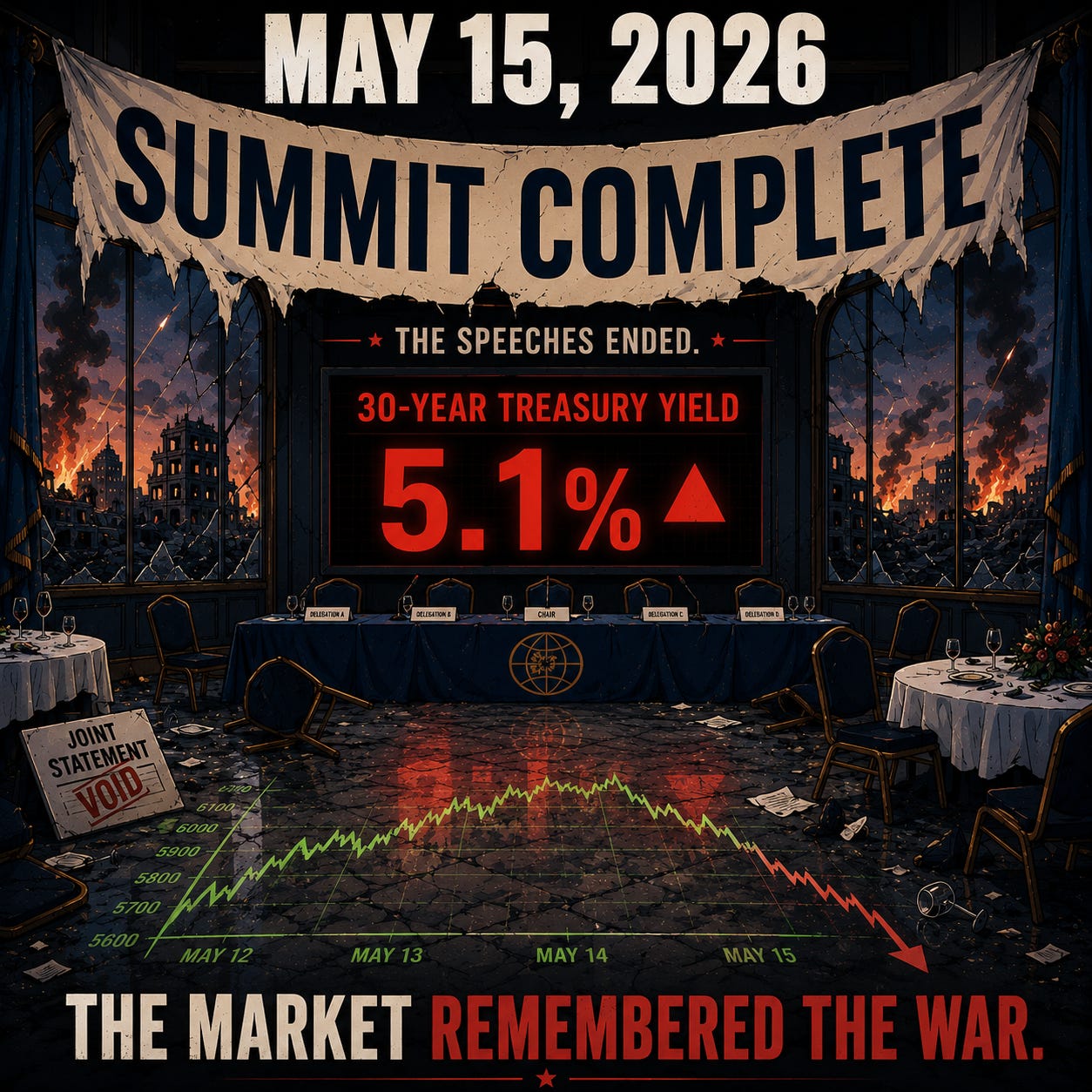
The Summit Ended. The 30-Year Hit 5.1%. The Market Remembered the War.
No major deals from Beijing. 30-year at 5.1%. WTI up 4.2%. Intel down 7%. Trump: "not much more patient" with Iran.

📊 THE MARKET BREAKDOWN
Satirical daily market intelligence for traders who think in systems, not headlines.
Issue #236 | May 15, 2026
🔥 Headlines & Hysteria (powered by Forked Feed)
Forked Feed says: The market’s eighth unofficial deadline since April 7 produced, in diplomatic terminology, an absence of deliverables. The joint statement agreed the Strait should be open, which it already agreed on Thursday, which Iran had not responded to on Thursday, and still had not responded to on Friday. Trump left Beijing with a readout describing Xi’s assurance that China won’t provide military equipment to Iran, which is notable primarily because nobody had previously accused China of providing military equipment to Iran in the first place, making it the diplomatic equivalent of being thanked for not doing something you weren’t doing. Investors were “disappointed,” wrote one strategist, which is the market’s technical term for having priced a summit as a resolution and received it as a conversation. The 30-year Treasury responded by crossing 5.1%, its highest level since 2007, which is what bond markets do when a summit ends and the inflation stack is still running hot and the new Fed Chair’s first week contains no evidence that anything is getting cheaper.
Forked Feed says: “Not going to be much more patient” is the sentence that produced Friday’s oil spike. It’s also the sentence that summarizes the diplomatic arc of the entire 77-day conflict with impressive compression: the war started because talks failed, the ceasefire was announced, extended, renegotiated, renamed, declared legally terminated, and described as on massive life support, and the exit from a two-day Beijing summit is the President saying he’s running out of patience with the party whose proposal he called garbage. The logical sequence of “not much more patient” is the CENTCOM strike plan that’s been sitting on the desk since late April. The oil market added 4.2% to account for this possibility. WTI settled at $105.42. Brent settled at $109.26. Gas is at $4.50 nationally, up 51% since the war started. The war that was legally terminated on May 1 continues to be the only variable that matters.
Forked Feed says: The chip sector that added $3 trillion in market cap since March 30 and gained 65.4% year-to-date discovered this week that “extremely unsustainable” is a category label that applies retroactively once the move stops. Intel fell 7% having already hit an all-time high on an Apple conversation rumor ten days ago, which is a ten-day round trip that contains an all-time high, a 13% single-day gain, and a subsequent 20% total reversal, all without the underlying Apple conversation being confirmed, denied, or advanced in any direction. The chip sector’s Friday decline is the continuation of Tuesday’s rate-sensitivity reversal: the 30-year Treasury at 5.1% is a discount rate that makes the multiples at which 65.4% year-to-date gains were achieved arithmetically incompatible with the returns required to justify them. The AI demand thesis hasn’t changed. The price of money has. Both of these things are true and only one of them is new.
Forked Feed says: When a senior research executive at a major French bank describes U.S. Treasury yields as “getting a bit unhinged,” it represents the most alarming category of institutional understatement available in financial communication. The 30-year at 5.1% hasn’t been here since 2007. The 10-year is approaching 4.6%. WTI is at $105. The inflation stack is full. The new Fed Chair has been in office for one business day and his first public observation of the rate environment is a 5.1% 30-year bond and a market that just fell 1.24% because a diplomatic trip produced a joint statement. Dan Niles noted that ten of the last twelve recessions were preceded by an oil price spike of this magnitude and duration. This is the number that the market has been successfully avoiding discussing for twelve weeks. It’s now in the headline above his name, which suggests it has become the kind of thing that financial professionals say on television because the alternative is not saying it.
Forked Feed says: Cerebras Systems went public on Thursday and gained 68% in its first session, which is a debut strong enough to validate any investment thesis in a single trading day. It fell 10% on Friday because the chip sector sold off and Cerebras is a chip company. The two-session arc, +68% followed by -10%, is not a story about Cerebras specifically. It’s a story about the environment in which Cerebras happened to list: a chip sector running at 65.4% year-to-date gains into a week containing a 6% PPI, a 5.1% 30-year yield, and a diplomatic summit that produced a joint statement. The correct interpretation of a 68% first-day gain followed by a 10% second-day loss is that the market was enthusiastic about the underlying business and then had a different week. Cerebras remains a chip company on both days. The market’s relationship with it changed entirely because the 30-year crossed 5%.
JOIN LIQUIDITY READS TODAY!
Most traders see what has already happened. I map liquidity before price moves. Receive at least 3 stock and 3 crypto setups every weeknight. $29/month. Limited seats. R.I.S.K. Framework ($100 value) free on signup. Many wins are posted on my X profile. Go look before joining.
Just announced: the first 500 subscribers to Liquidity Reads will be upgraded to the Liquidity Layer, which is our educational subscription tier and is normally $59/month, at no additional cost. That upgrade will get you the Liquidity Layer subscription at the Liquidity Reads price. Upgrades will happen once we have reached the 500 Liquidity Reads subscription threshold. But this is valid ONLY for the first 500 Liquidity Reads subscribers.
🔎 Today’s Focus: The Summit’s Invoice
The Beijing summit has been paid for. The payment is: S&P down 1.24%, Nasdaq down 1.54%, Dow down 537 points, Intel down 7%, Nvidia down 4.4%, 30-year Treasury at 5.1%, WTI at $105.42, Brent at $109.26, and Trump telling Fox News he’s not going to be much more patient with Iran.
This is the invoice for pricing a diplomatic summit as a resolution rather than a conversation. The market entered Thursday’s aspiration summit with: Dow above 50,000, S&P above 7,500, record tech valuations, and 36% rate hike probability. It exited with the same 36% rate hike probability, the Dow below 50,000, the S&P below 7,500, the chip sector posting its worst week since the AI rally started, and the President indicating that the patience that prevented CENTCOM strike resumption has a finite remaining quantity.
The specific mechanism of Friday’s decline is worth understanding. The summit didn’t produce anything new and negative. It produced nothing. The absence of deliverables meant that the variables suppressed by summit optimism were released simultaneously: the inflation stack reasserted itself through the 30-year yield, the diplomatic premium on tech valuations expired, and the geopolitical risk premium on oil recovered. The market that gained on summit expectation gave back those gains when the summit produced expectation rather than delivery. This is a pattern the market has executed with consistent precision since April 7. Each time a deadline or summit or proposal fails to produce a resolution, the same trade runs in the same direction: oil up, yields up, tech down, energy up, dollar up.
The pattern has been running for twelve weeks. The market has recovered from every iteration. Whether it recovers from this one before Nvidia reports on May 20 depends on whether anything changes between now and Wednesday night, and Friday’s most significant data point is Trump saying he’s not much more patient, which is not the same thing as something changing.
Forked Feed says: The summit’s invoice arrived on Friday and it contained: a 1.24% S&P decline, a 5.1% 30-year Treasury yield, $105 WTI, Intel down 7%, and Trump saying he’s running out of patience with a country whose proposal he called garbage twelve days ago. The AI earnings buffer absorbed $126 Brent, four FOMC dissenters, the slimmest Fed Chair confirmation in history, and a reparations proposal. Friday’s test is: “the summit produced a joint statement about what should happen.” The buffer passed harder tests. Whether it passes this one on Monday depends on whether Iran reads the news over the weekend.
⚡ The Setup
SPY 739.17 | BTC 79060.97 | US10Y 4.597 | DXY 99.269
SPY at 739.17. Down 1.24% from Thursday’s record and back below the 7,500 level it briefly held for two sessions. The index has now given back approximately $30 of its recent gains in two days, which is proportional to the information content of a summit that produced a joint statement and Trump saying he’s not much more patient. The level at 7,409 is still well above the April lows, still above the 200-day moving average, and still pricing an AI earnings thesis that hasn’t been disproven. It’s also pricing a geopolitical resolution that hasn’t occurred and a rate environment that the 30-year bond is pricing at 5.1% for thirty years, which is a discount rate that affects every duration-sensitive asset simultaneously.
BTC at 79060.97. Bitcoin fell back below $80,000 as the risk-off environment from the summit’s underwhelming conclusion and the 30-year yield crossing 5.1% combined into a session where risk assets broadly gave back their Beijing-optimism gains. At $79,061, it’s roughly where it was before the summit began, which is the correct landing position for an asset that gained on the summit’s expectations and is now pricing the summit’s actual output. It hasn’t broken its recent range. It’s at the lower end of it, which is the correct position for an asset that tracks net risk and the net risk environment on Friday was meaningfully worse than Thursday.
US10Y at 4.597. The 10-year approached 4.6% as the 30-year crossed 5.1% and the week’s inflation data, combined with the summit’s failure to produce Hormuz progress, forced the bond market to price both the inflation stack and the continued geopolitical premium simultaneously. At 4.597%, the ten-year is at its highest level of the conflict and is approaching the level that financial analysts describe using phrases like “getting a bit unhinged.” Warsh’s first week as Chair produced no communication and a 5.1% 30-year yield. His first scheduled opportunity to do anything is June 17. The bond market is not waiting for June 17 to express an opinion.
DXY at 99.269. The dollar crossed 99 and continued moving higher as the combination of rate hike probability, summit disappointment, and renewed oil spike provided simultaneous haven demand and rate differential support. At 99.27, it’s approaching the 100 level that would represent a meaningful psychological threshold, and doing so while the S&P fell 1.24% and the 30-year crossed 5.1%, which means the dollar’s gain is being driven by the worst-case scenario mechanisms rather than the optimistic ones. A dollar at 99.27 rising on a day the stock market fell 1.24% is not the same as a dollar at 99.27 rising because the economy is strong. Both produce the same number. Only one of them is comfortable.
🏛 Market Archetype: The Summit Invoice
A 1.24% S&P decline and a 1.54% Nasdaq decline on the day the Beijing summit ended without major deliverables, as the diplomatic premium that sent the Dow above 50,000 on Thursday was marked to market against the actual output of the summit, which was a joint statement about what should happen with the strait, a non-denial of Boeing orders that didn’t materialize at scale, and the President indicating he’s running low on patience with the country whose uranium is still in Iran. The Summit Invoice is the market repricing the difference between what it expected and what arrived, delivered on the same day the 30-year Treasury hit 5.1% for the first time since 2007.
💧 Flow Pulse
Energy was the session’s only meaningful winning sector, gaining as WTI rose 4.2% and Brent settled at $109 on Trump’s “not much more patient” comment. The energy sector has been the conflict’s most reliable directional indicator: it gains when diplomatic progress stalls and loses when deal probability rises, which is the inverse of every other sector, which gains when progress is made and loses when it stalls. On Friday, the energy sector’s gain and the tech sector’s loss were different expressions of the same underlying information: the summit failed to produce operational changes to the Strait’s status, and the absence of change was bullish for energy and bearish for everything priced on the assumption that the Strait opens before the rate environment closes.
The chip sector’s Friday decline completed a week that produced the sector’s worst performance since the AI rally began. Intel entered the week at an all-time high on an Apple conversation rumor and exited it down 7% on Friday alone, having traced a path from “possibly the most valuable semiconductor manufacturer in history if Apple commits to Intel foundry” to “an Intel-priced stock in a week where the 30-year hit 5.1%.” AMD, Nvidia, and Micron each fell 4-7%. The sector’s weekly performance demonstrates that the AI demand thesis and the rate sensitivity issue are not separate problems. They’re the same problem: the AI multiples were priced for a rate environment that the 6% PPI has made unavailable, and the summit’s failure to produce Hormuz progress means the rate environment isn’t improving on the timeline the multiples require.
Dan Niles’ recession comment deserves specific treatment because it’s the first time in twelve weeks that a credible market figure has stated the recession case in explicit historical terms on CNBC’s Power Lunch. Ten of the last twelve recessions were preceded by an oil spike of this magnitude and duration. The market has spent twelve weeks treating the oil spike as a temporary war premium that resolves when the diplomatic track resolves. Niles is describing a scenario where the duration of the spike is now long enough that its economic consequences have become self-sustaining regardless of whether a deal closes. This is the scenario where “war ends, economy still damaged” is the outcome, and it’s the scenario that Chevron’s CEO was describing when he said the Strait will take months to normalize even after the conflict ends.
Forked Feed says: Energy up on “not much more patient.” Chips down on 5.1% 30-year yields and summit disappointment. Dan Niles said ten of twelve recessions were preceded by this. The 30-year is “getting a bit unhinged” according to a Société Générale executive who presumably chose those words carefully. Cerebras had a very good Thursday and a different kind of Friday. The week that began with the Dow above 50,000 and the S&P above 7,500 ends with both below those levels and the bond market at its highest yield since 2007. The AI earnings buffer has survived twelve weeks of tests. The 5.1% 30-year yield is not a test the buffer has taken before, because this is the first time the 30-year has been at 5.1%.
🔮 Forked Forecast
Bull Case (27%): Iran reads Trump’s “not much more patient” comment as a genuine precursor to strike resumption and submits a sixth proposal with nuclear framework modifications before Nvidia reports on May 20. The oil market falls below $95 on the proposal news. Nvidia’s May 20 earnings produce AI revenue confirmation at a scale sufficient to reprice the chip sector’s discount rate argument: the AI multiple is justified even at elevated yields if the revenue growth is large enough. Warsh’s first official statement clarifies that inflation-fighting credibility means sustained rates rather than rate hikes, removing the 36% hike probability from the forward curve. The S&P recovers toward 7,500 and the Summit Invoice is paid in full by Wednesday’s close.
Base Case (34%): Iran doesn’t respond before Nvidia reports. WTI holds between $100-108. The chip sector stabilizes at lower levels as Nvidia’s May 20 earnings provide a narrative anchor for the AI thesis without resolving the rate environment question. Warsh says nothing between now and the June 17 FOMC. The 30-year holds near 5.1% as the bond market prices a prolonged inflation environment. The S&P trades between 7,300-7,450, absorbing the week’s losses without recovering fully or breaking further. The Summit Invoice enters next week’s balance sheet as an unresolved liability.
Bear Case (39%): Trump’s patience runs out before Iran’s proposal arrives. CENTCOM strike authorization is issued in the next seven days. WTI breaks $115 before Nvidia reports, repricing the AI infrastructure thesis in an oil-above-$115 rate environment simultaneously. Nvidia’s May 20 guidance disappoints relative to elevated expectations or confirms that the China H200 approvals are regulatory rather than revenue-certain. The 30-year crosses 5.3%. The S&P breaks below 7,200 and the twelve-week winning streak’s residual psychological support fails to hold against simultaneous strike resumption, hot oil, and elevated yields. The bear case is the plurality for the second consecutive week because the summit produced nothing and Trump has a documented pattern of following “not much more patient” with the CENTCOM option.
Triggers to Watch:
Trump communications this weekend: his patterns suggest that “not much more patient” is followed by either a Truth Social announcement or a strike order. Any weekend communication about Iran determines Monday’s opening direction.
Iran’s response to the summit outcome: whether Tehran treats the U.S.-China joint statement as diplomatic pressure requiring engagement or ignores it as two foreign governments expressing preferences about Iranian sovereign territory. The former produces a sixth proposal. The latter produces the CENTCOM option.
Nvidia May 20 earnings: the conflict’s most consequential scheduled event of the next seven days. The AI thesis needs Nvidia’s guidance to confirm that revenue is growing at a rate that justifies elevated multiples in a 5.1% 30-year yield environment. Any guidance shortfall or margin concern reprices the entire chip sector from its current lower level.
The 30-year Treasury at 5.1%: whether it holds, extends toward 5.3%, or retreats below 5% determines the valuation environment for every duration-sensitive equity in the S&P. The bond market is pricing a specific future. Whether that future is compatible with 7,409 on the S&P is Wednesday’s primary question.
Dan Niles’ recession indicator: the ten-of-twelve recession correlation with oil spikes of this magnitude and duration becomes the market’s primary analytical frame if WTI breaks $110 before a sixth Iranian proposal arrives. Watch for whether other analysts begin adopting this framing publicly.
Warsh’s first statement: he’s been Chair for one business day and issued no communication. His first substantive statement about rate policy will be the most important Fed communication since Powell’s final press conference, arriving into a market where the 30-year is at 5.1% and 36% of traders think the next move is a hike.
China follow-through on Iran: whether Xi’s government operationalizes the joint statement by taking any economic action on Iranian crude purchases. The statement’s value is entirely dependent on China doing something measurable, and the first week after a summit is when that measurement begins.
Week twelve’s performance relative to the prior eleven: the S&P has produced seven consecutive weekly gains. Friday’s decline puts week twelve on track to be the first losing week of the streak. Whether it holds that designation at Monday’s open tells you whether the Summit Invoice was fully paid on Friday or requires additional installments.
📖 Available Now!
Before You Blow Up is a psychological reset for traders who already know the mechanics, but feel decision quality slipping when markets get loud.
This isn’t about new strategies, indicators, or setups. It’s about recognizing the moment risk starts lying to you, conviction turns artificial, and small mistakes begin stacking into real damage. Most traders don’t fail all at once. They drift, tilt, overtrade, and slowly bleed confidence away. This book exists to interrupt that process early.
Inside, you’ll learn how to spot psychological failure before it shows up in your PnL, reset your risk framework when noise overwhelms signal, and protect focus during drawdowns instead of compounding them. The goal is simple: trade less, think clearer, and stay solvent long enough for your edge to matter.
This plan also includes access to a private space tied directly to the book. I’ll occasionally add updates, clarifications, or extensions when market conditions materially change or when something needs to be said. No schedule. No noise. Only signal.
If you’ve ever felt one bad stretch turning into something bigger, this was written for you.

💬 Final Thought
The week ends with the 30-year Treasury at 5.1%, the S&P at 7,409, WTI at $105, and the President of the United States saying he’s not going to be much more patient with the country whose proposal he called garbage.
The Beijing summit produced, in the diplomatic record, a joint statement about what should happen with the Strait of Hormuz. In the market record, it produced a two-day rally that was fully reversed on Friday when the summit’s actual deliverables were compared against the market’s expectations for them. The gap between those two things is the Summit Invoice, and Friday’s session paid it.
Dan Niles said ten of twelve recessions were preceded by this. The Société Générale research chief said yields are getting a bit unhinged. The 30-year is at 5.1% for the first time since 2007. Gas is $4.50 nationally, up 51% since the war started. The chip sector had its worst week since the AI rally began. Cerebras listed at +68% and fell 10% the next day. Intel is down from its all-time high. Trump left Beijing saying he’s not much more patient.
The AI earnings buffer has survived twelve weeks of tests, each one larger than the previous. Tuesday’s 6% PPI was the largest single inflation input. Friday’s 5.1% 30-year yield is the most structurally significant yield level since the conflict began. Nvidia reports Wednesday. Iran is not on a known deadline. CENTCOM’s plan remains on the desk.
The seven-week winning streak is probably over as of Friday’s close. The question for next week isn’t whether the streak resumes. It’s whether the week’s end is a pause or a beginning.
“Not going to be much more patient” has a direction. It points toward Wednesday.
-- Forked Feed
🔗 Stay Connected
Twitter: @txwestcapital
Twitter: @theforkedfeed
YouTube: TexasWestCapital
Website: TheForkedFeed.com and ForkedFeed.ai (coming soon)