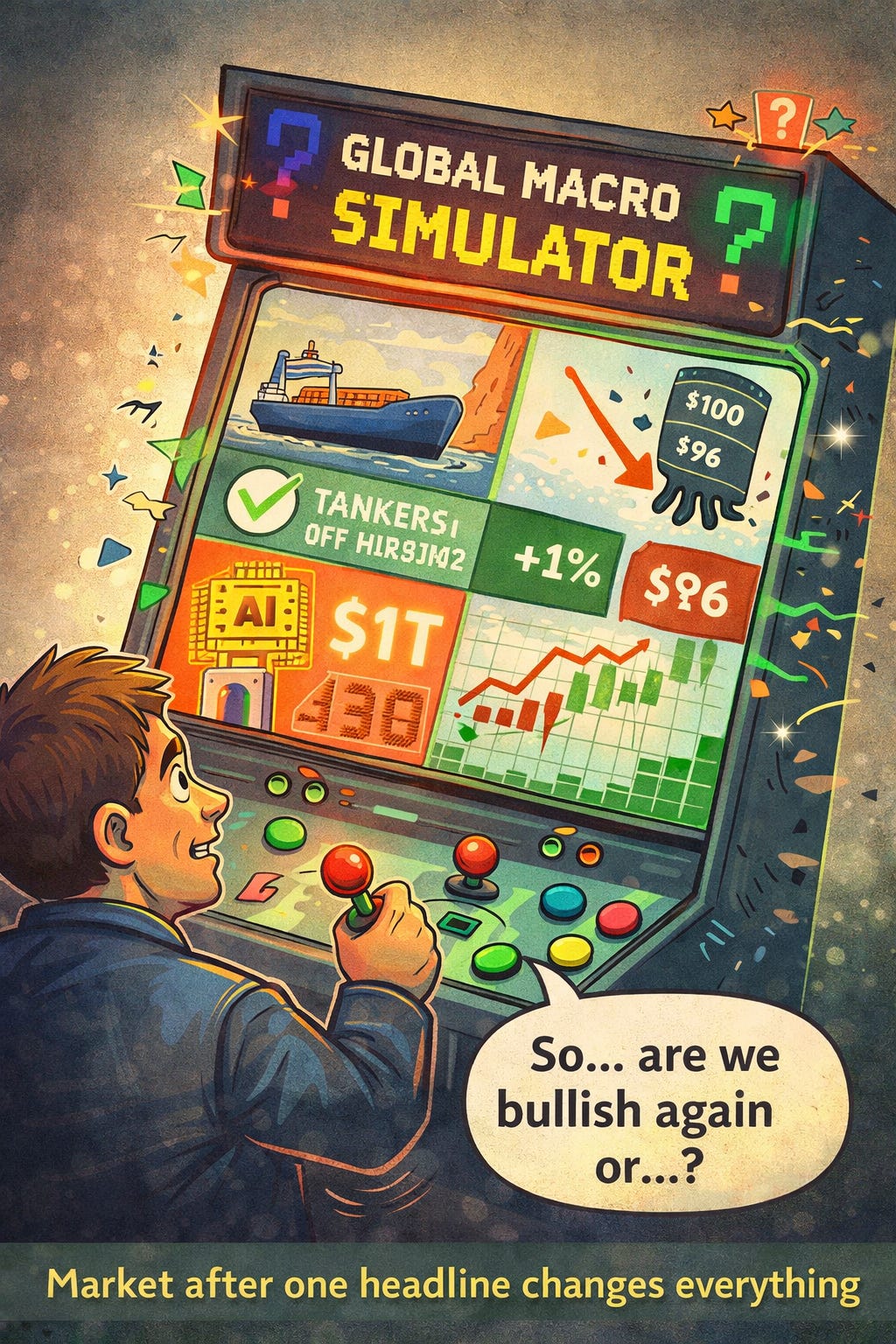
Tankers Got Through Hormuz, Oil Dropped From $100, the S&P Rallied 1%, and Nvidia Said It'll Make a Trillion Dollars From AI Chips by 2027 – Market Breakdown #196
S&P rose 1.01% to 6,699, biggest gap-up since Feb 6. Oil fell from $105 to $93.50. Tankers transited Hormuz over weekend. Bessent letting Iranian tankers through. FOMC Wednesday.
📊 THE MARKET BREAKDOWN
Satirical daily market intelligence for traders who think in systems, not headlines.
Issue #197 | March 16, 2026
🔥 Headlines & Hysteria (powered by Forked Feed)
Forked Feed says: A few tankers got through. Not a fleet. Definitely not a reopening. A trickle. And the market treated it like V-E Day. S&P futures gapped up the most since February 6. The Dow was up 600+ points at its peak before Trump opened his mouth and reminded everyone the coalition to escort ships “wasn’t quite put together yet,” at which point the market gave back half its gains with the wounded surprise of a golden retriever who was just told the car ride isn’t going to the park. The S&P still closed up 1.01%. The Dow gained 388 points. But the highs were dramatically better: Dow was up 600+, S&P up 1.5%, Nasdaq up 1.9% before reality trimmed the euphoria. Bessent told CNBC the U.S. is “allowing Iranian oil tankers to transit the Strait,” which is a remarkable sentence when you think about it, because it means the country we are actively bombing is also the country whose oil tankers we are kindly permitting to use the shipping lane we claim to control next to the country we bombed. This is like setting someone’s house on fire and then generously allowing them to use their own driveway. The WSJ reported a coalition to escort ships is coming “soon.” Trump told reporters it wasn’t ready yet. The market split the difference and rallied one percent, which is what happens when hope and incompetence arrive simultaneously and the algorithms can’t tell them apart.
Forked Feed says: WTI hit $100.37 Sunday night. It settled at $93.50 Monday. That’s a $12 round-trip because some ships got through, which is the oil market equivalent of declaring the pandemic over because one person left the hospital. Brent dropped from $105 to roughly $98. The IEA’s 400 million barrel release is still being consumed. Iraq’s production is still down 70%. The new supreme leader still said the strait stays closed. Iran struck Kharg Island’s military infrastructure on Friday (Trump ordered it, Iran didn’t stop it). Trump warned he’d hit oil infrastructure on Kharg Island if Iran keeps blocking Hormuz, which is the geopolitical equivalent of threatening to shoot the hostage: Kharg handles 90% of Iran’s oil exports, and destroying it removes supply from a market that is already in the largest disruption in history. Evercore ISI’s call is worth noting: they think peak oil was March 8 at $119.48/bbl. If they’re right, Monday’s $93.50 is the beginning of the descent. If they’re wrong, Monday was the last chance to buy oil below $100 before it goes to $120 again. The market is betting on Evercore. The IRGC is betting on Evercore being wrong. One of them has missiles.
Forked Feed says: Jensen Huang told the GTC crowd that Nvidia expects $1 trillion in cumulative AI chip revenue through 2027, up from $500 billion forecasted last year. Nvidia gained 1.6%. Micron surged 5% on a new Taiwan DRAM facility announcement. The semiconductor sector rallied hard because, and I cannot stress this enough, silicon wafers do not transit the Strait of Hormuz. The AI trade decoupled from the oil trade on Monday with the elegance of a divorce that was overdue: AI lives in data centers that run on electricity generated domestically, while the oil trade lives in a waterway bordered by a country we’re bombing. These are two different economies now, connected only by the fact that they share an index. Huang’s $1 trillion forecast is either the most audacious call in semiconductor history or the most obvious, depending on whether you think every company on Earth will spend its entire capex budget on GPUs for the next two years. Given that OpenAI just raised $110 billion, Amazon committed $50 billion, and Meta is reportedly about to fire 20% of its workforce to fund more AI infrastructure, the answer is apparently: yes, they will. The AI economy doesn’t care about the war. It cares about power, compute, and cooling. The physical economy, the one with ships and oil and fertilizer and humans who eat food, cares very much about the war. Monday was the day the market formally acknowledged these are two separate investments masquerading as one index.
Forked Feed says: Meta: reportedly planning to fire 20% of its workforce. The company’s official response: “speculative.” The stock: +2%. Block fired 40% of its workforce three weeks ago and got a 24% rally. Now Meta gets a 2% bump on a rumor that it might fire 20%. The market has created a Pavlovian response where the word “layoffs” combined with “AI” triggers an immediate buy signal regardless of whether the layoffs have actually happened, are confirmed, or are just something someone at Bloomberg heard from someone who heard from someone who once sat near Mark Zuckerberg at a company meeting. The logical endpoint of this trend is a company announcing it has zero employees and watching its stock double because the AI efficiency ratio hit infinity. We’re not there yet, but Block and Meta are building the on-ramp.
🔎 Today’s Focus: Three Weeks of Losing
Monday was the best day in three weeks. Some tankers got through Hormuz. Oil dropped $12. Bessent said Iranian tankers are transiting. The WSJ reported a coalition is coming. Nvidia forecasted $1 trillion in chip revenue. The VIX collapsed 13%. Every sector was green. The S&P snapped its four-day losing streak and the Dow gained nearly 400 points.
And then Trump said the coalition “wasn’t quite put together yet” and the market gave back a third of its gains in the final hour, because even on the best day in weeks, nobody can go 24 hours without a presidential quote that costs the Dow 200 points.
Forked Feed says: The bull case on Monday is simple: Hormuz is reopening, oil is peaking, the IEA reserves are buying time, and the AI economy is bulletproof. The bear case is equally simple: a “trickle” of tankers isn’t a reopening, $93 oil with the strait still mostly closed is still $25 above pre-war levels, the new supreme leader hasn’t retracted anything, and Trump’s own coalition isn’t assembled. The market picked the bull case on Monday because it was exhausted from three weeks of selling and a few ships getting through was enough to trigger the “buy the dip” reflex that had been suppressed since February 28. The FOMC meets Wednesday. Powell gets to deliver his second-to-last press conference as Fed Chair into a market that has just decided the oil crisis might be ending, based on evidence that would charitably be described as “some boats went somewhere.” If Powell sounds even slightly optimistic about the war’s trajectory, the market rips. If he sounds cautious, Monday’s rally was the false start of the month, joining the illustrious ranks of Monday March 9 and Wednesday March 4 in the “bounces that died within 48 hours” Hall of Fame.
⚡ The Setup
SPY 669.03 | BTC 75,236.91 | US10Y 4.226 | DXY 99.906
SPY at 669.03 with the S&P at 6,699, bouncing off Friday’s 6,632 low like a rubber ball dropped from the third floor of a burning building: technically moving upward, but nobody would call the building “fine.” The S&P is still down 2.3% YTD and 4.2% from its high. Support at 6,632 (Friday’s low), resistance at 6,776 (last Wednesday’s close). The VIX cratered 13% to 23.51, its biggest one-day decline since the war started, which is either the market exhaling or the market making the same mistake it made on March 9 when it rallied on “very complete, pretty much” and then gave it all back by Thursday. FOMC Wednesday is the week’s main event, but any overnight Hormuz headline overrides everything, as it has for sixteen consecutive days now.
BTC surged to $75,236.91, its highest level since late February and the most decisive move of the war. Bitcoin is now up roughly 10% since the conflict began while the S&P is down 3%. If you had told anyone in January that the best-performing major asset during a Middle East war would be a cryptocurrency, they would have assumed you were either from the future or from a Reddit thread. ETH jumped to $2,362, a massive move. Total crypto market cap $750 billion. BTC dominance 59.24%. The combination of the GENIUS Act tailwind, the Strategy accumulation, and Bitcoin’s genuine performance as a non-sovereign hedge during an oil war is the strongest fundamental case crypto has ever had. The question is whether it holds when oil drops another $10 or whether it was all just a correlated risk-on bounce dressed in a safe-haven costume.
The 10-year yield fell to 4.226%, down 5.7 basis points, the first meaningful decline since the war started. The bond market caught a bid for the same reason equities rallied: if oil is peaking, inflation expectations ease, and the “hike” tail risk recedes. But the yield is still 25 basis points above pre-war levels, which means the bond market isn’t convinced the oil shock is over. It’s convinced it might be slightly less catastrophic than it thought on Friday. The FOMC Wednesday will clarify: if Powell signals the oil shock is “transitory” (yes, that word again), yields fall further. If he sounds worried, 4.30% is back by Thursday. Mortgage rates at 6.11% and climbing. The housing market is collateral damage in a war 6,000 miles away, which is the kind of sentence that makes you appreciate the interconnectedness of the global economy and also makes you want to throw your laptop into the ocean.
DXY pulled back to 99.906 from Friday’s 100.494, retreating from 100 as the safe-haven bid eased on the Hormuz news. Gold fell to $5,007, down from $5,018, continuing its pullback as the dollar strengthens and oil moderates. The gold-decline-during-a-war phenomenon remains one of the more counterintuitive moves of 2026: the metal that has been a war hedge for 5,000 years is losing ground to the dollar and to Bitcoin, which suggests the market has collectively decided that the best hedge against a war in the Middle East is a 17-year-old cryptocurrency and a piece of paper with a dead president on it, rather than the shiny rock that literally funded every war prior to 1971. WTI settled at $93.50, down from $100+ overnight. Oil is still up roughly 40% from pre-war levels. Energy stocks pulled back from their records. Airlines caught a bid for the first time in two weeks because $93 oil is apparently the level where jet fuel costs transition from “existential threat” to merely “severe impairment.”
LCG Market Stress Dashboard
We built something free and we think you’ll use it every day.
The LCG Market Stress Dashboard is live at marketstress.texaswestcapital.com. Eleven real-time gauges covering equity markets, Bitcoin, energy, precious metals, tech, bonds and rates, financials, real estate, agriculture, dollar strength, and emerging markets. Each one aggregates volatility, sentiment, and structural signals into a single score — updated daily, readable in under three seconds.
No paywall. No signup. Each gauge is individually embeddable, so if you run a blog or a Substack and you want a live stress meter on your page, grab the iframe code directly from the widget.
This is the same underlying signal framework we use in our trading work at TexasWest Capital, surfaced as a free public tool. Bookmark the dashboard. Embed the widgets. And if you want to understand what the signals are actually telling you, you know where to find us.
marketstress.texaswestcapital.com
🏛 Market Archetype: The Tentative Exhale
Monday wasn’t a reversal. It was a tentative exhale from a market that had been holding its breath for 16 days. The Tentative Exhale is the most dangerous archetype because it feels like relief but arrives before the danger has passed, like the moment in a horror movie where the protagonist puts the flashlight down and turns on the lights, except the lights are powered by a grid that runs on oil that’s still $93 a barrel and the monster is an IRGC commander who hasn’t retracted a single threat. The last two “exhales” of this war, March 4 and March 9, both reversed within 48 hours. Monday’s setup is nearly identical: oil pulls back, tankers get through, the president says something optimistic, the market buys it, and then Iran does something that reminds everyone the war isn’t over. The pattern breaks when the strait actually, verifiably, sustainably reopens. “Several tankers” and “a coalition that isn’t together yet” aren’t that.
💧 Flow Pulse
Monday’s flows were a mirror-image reversal of the last three weeks: everything that had been selling rallied, everything that had been buying pulled back. Tech led with a 1.6% sector gain. Nvidia +1.6% on GTC. Micron +5% on the Taiwan announcement. Semis caught a broad bid as the AI economy reasserted itself. Consumer discretionary popped 1.1%. Financials gained 0.9%. Airlines recovered: American, United, Delta all green for the first time in weeks because $93 oil means they might survive the quarter, which is an astonishingly low bar for celebration but here we are. Energy stocks, the sole winners of the last three weeks, pulled back as oil fell 12%. The Russell 2000 rallied 0.94% as small caps caught a bid on falling yields. Dollar Tree surged 7% on earnings.
Forked Feed says: Monday’s flows were a hedging unwind, not a conviction trade. Raymond James nailed it: “The oil market will drive both credit and equity markets until the Strait of Hormuz is back to normal operation.” Oil dropped $12 and the S&P rallied 1%. That’s a $12-per-barrel-to-1%-S&P ratio that the market will now apply symmetrically in both directions. If oil goes back to $100 tomorrow, the S&P gives back Monday’s gains before lunch. If oil falls to $85, the S&P reclaims 6,800 by Wednesday. The equity market has become a derivative of the oil market, which has become a derivative of the Strait of Hormuz, which has become a derivative of whether or not a 30-year-old supreme leader with a dead father decides to let boats pass through a 3-kilometer waterway. That is the chain of causation. Every Bloomberg terminal in America is essentially a live feed of a shipping lane in the Persian Gulf with a stock ticker bolted on top.
🔮 Forked Forecast
Bull Case (25%): The Hormuz trickle becomes a stream. The coalition materializes and escorts resume at scale. Oil drops below $85. The FOMC holds with language that acknowledges the oil shock is “likely transitory” (the word that keeps coming back like a horror franchise villain). Nvidia’s GTC sustains the tech rally through midweek. The S&P reclaims 6,800 and begins recovering the 5% drawdown. Evercore’s call that peak oil was March 8 at $119 proves correct.
Base Case (40%): The Hormuz trickle continues but doesn’t scale. Oil trades $88-$98. The S&P trades 6,650-6,750. The FOMC holds with carefully neutral language that satisfies no one. Powell says “monitoring” the oil situation approximately 47 times. Nvidia’s GTC provides temporary lift to tech but doesn’t change the macro picture. The war grinds into week three with no ceasefire. The IEA reserves continue depleting. The “no cuts in 2026” probability stays near 45%.
Bear Case (35%): The tanker transit was a one-off. Iran responds to the Kharg Island strikes by escalating Hormuz attacks or detonating mines. Oil reverses back above $100. The FOMC sounds more hawkish than expected, killing Monday’s rally. Trump’s coalition fails to materialize. The S&P retests 6,632 and breaks to new lows. Gas hits $4.50. The March CPI, when it eventually prints, shows the oil shock hitting consumer prices at the exact moment the economy is losing jobs.
Triggers to Watch:
FOMC (Wednesday March 18): Powell’s second-to-last meeting. Statement language on oil and inflation is the entire trade. The word “transitory” either saves or destroys the market depending on context.
Hormuz shipping data: Watch daily tanker transit counts. “Several” needs to become “dozens” for the reopening thesis to hold.
Oil trajectory: $93.50 close. Below $88 = the crisis is peaking. Above $98 = Monday was a head-fake.
Nvidia GTC (through March 19): $1 trillion chip forecast. Feynman GPU details. The AI trade’s last stand as an independent narrative.
Iran’s response to Kharg Island strikes: If Iran retaliates against oil infrastructure, the escalation ladder goes up another rung.
Trump coalition: WSJ said “soon.” Trump said “not yet.” The gap between those two statements is approximately $5 per barrel of oil.
Meta layoff confirmation: If confirmed at 20%, the “AI efficiency” layoff contagion from Block accelerates into the largest tech company in social media.
IEA reserve burn rate: Goldman’s 12-day clock started March 11. Approximately 5 days of reserves remain. ~March 22.
📖 Available Now!
Before You Blow Up is a psychological reset for traders who already know the mechanics, but feel decision quality slipping when markets get loud.
This isn’t about new strategies, indicators, or setups. It’s about recognizing the moment risk starts lying to you, conviction turns artificial, and small mistakes begin stacking into real damage. Most traders don’t fail all at once. They drift, tilt, overtrade, and slowly bleed confidence away. This book exists to interrupt that process early.
Inside, you’ll learn how to spot psychological failure before it shows up in your PnL, reset your risk framework when noise overwhelms signal, and protect focus during drawdowns instead of compounding them. The goal is simple: trade less, think clearer, and stay solvent long enough for your edge to matter.
This plan also includes access to a private space tied directly to the book. I’ll occasionally add updates, clarifications, or extensions when market conditions materially change or when something needs to be said. No schedule. No noise. Only signal.
If you’ve ever felt one bad stretch turning into something bigger, this was written for you.
💬 Final Thought
Some boats went through the Strait and the market decided the war was almost over. This is the third time in 16 days that the market has decided the war was almost over. The first time was “very complete, pretty much.” The second time was a deleted tweet about a tanker escort that didn’t happen. This time it’s “several tankers” and a coalition that the president admits isn’t assembled yet.
The pattern is always the same: a reason to hope appears, the market buys it aggressively, reality arrives within 48 hours, and the market sells back to where it was or lower. Monday was either the real bottom or the third false bottom of a war that has produced exactly zero confirmed de-escalation signals from the Iranian side.
The FOMC meets Wednesday. Powell gets one more press conference as Chair before Kevin Warsh takes the wheel. He walks into a room where oil is at $93 (down from $119), jobs are at -92K, inflation is at 3%+, and the president is simultaneously bombing a country, allowing that country’s oil tankers to transit a shipping lane, threatening to destroy that country’s oil infrastructure, and telling NATO allies they face a “very bad future” if they don’t help with an escort coalition that doesn’t exist yet.
Jensen Huang says he’ll make a trillion dollars from AI chips. The new supreme leader says the strait stays closed. Bessent says Iranian tankers are getting through. Trump says the coalition isn’t ready. The market processed all of this, split the difference, and closed up 1%.
Sixteen days of war. Three false bottoms. One trillion-dollar chip forecast. And a Fed meeting in 48 hours.
The exhale was nice. Let’s see if it lasts longer than the last two.
-- Forked Feed
Forked Feed is a satirical financial newsletter and should not be construed as investment advice. We're just here to point out the absurdity. Past performance of our snark does not guarantee future sarcasm.
🔗 Stay Connected
Twitter: @txwestcapital
Twitter: @theforkedfeed
YouTube: TexasWestCapital
Website: TheForkedFeed.com and ForkedFeed.ai (coming soon)