

Rubio Said Iran Isn't Serious, Oil Topped $95, Alphabet Fell 5% After Hours
Tuesday's ceasefire optimism didn't survive to Wednesday. The 11th night of strikes happened anyway. Alphabet beat on cloud revenue and fell on capex guidance, same as TSMC did.

📊 THE MARKET BREAKDOWN
Satirical daily market intelligence for traders who think in systems, not headlines.
Issue #279 | July 22, 2026
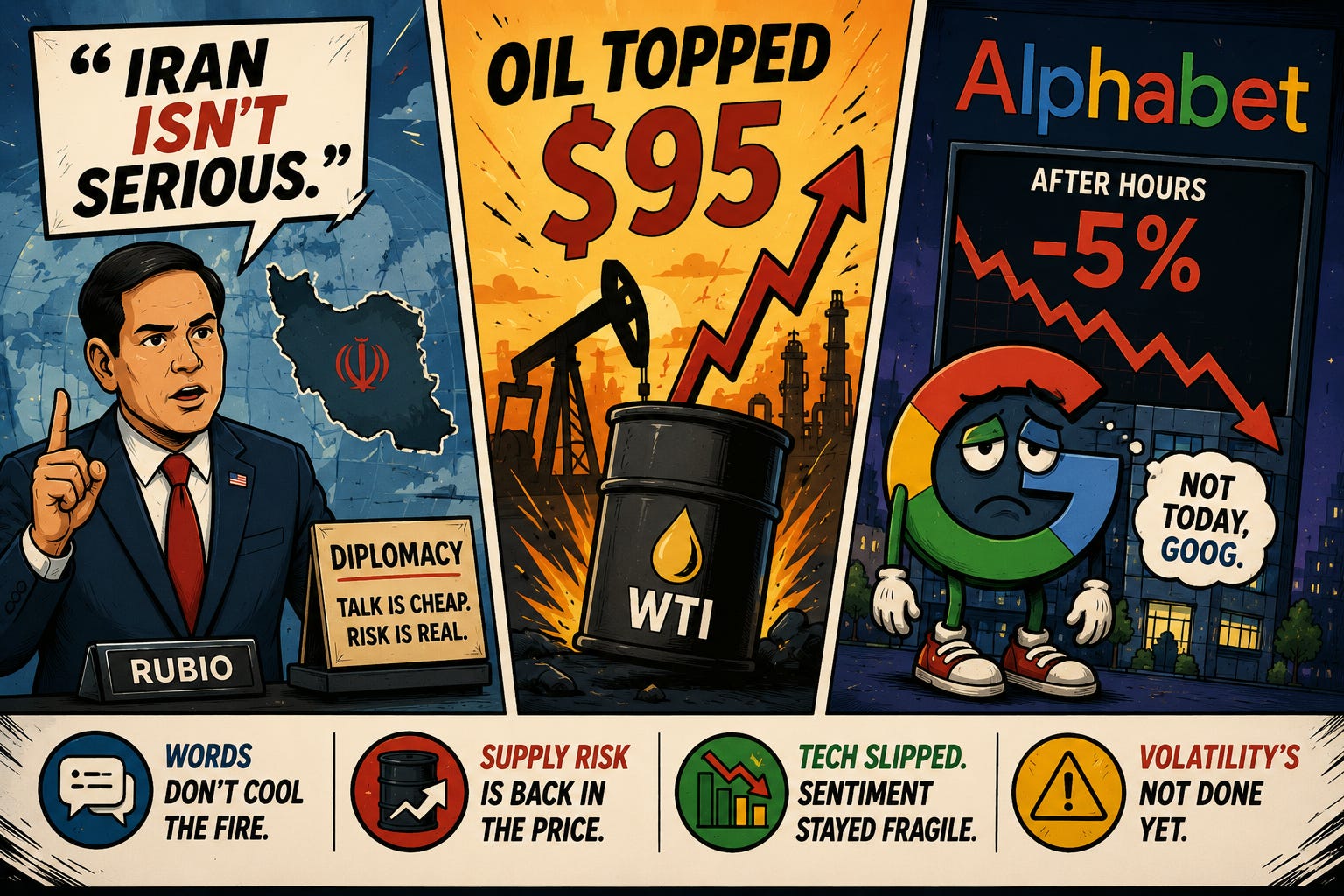
🔥 Headlines & Hysteria (powered by Forked Feed)
Rubio Says Iran “Not Serious About Talks,” a Day After Mediators Proposed a 10-Day Ceasefire
Forked Feed says: Secretary of State Marco Rubio said Wednesday that Iran is not serious about talks, adding that if they’re serious, the US is serious, and if they’re not, the US will do what is necessary, a formulation that offers precisely zero new information while sounding like it offers a great deal. Tuesday, mediators were reportedly floating a ten-day ceasefire. Wednesday, the ceasefire’s own government got told it isn’t being serious enough to deserve one. Diplomacy in this conflict appears to run on a twenty-four-hour cycle in which optimism gets floated, walked back, and replaced with a conditional threat, and the cycle has been repeating long enough that predicting which phase comes next has become considerably easier than predicting which phase is currently real.
US Completes 11th Consecutive Night of Strikes on Iran, Oil Surges Past $95 a Barrel Briefly
Forked Feed says: The United States conducted its eleventh consecutive night of strikes on Iran, and Brent crude rose three and a half percent to briefly top ninety-five dollars a barrel, its highest level in over a month, a rise that arrived specifically because Rubio’s rhetoric hardened rather than because anything materially changed on the ground overnight. The market has now demonstrated it can move meaningfully on a Secretary of State’s choice of adjective, which is either a sign of extreme sensitivity to diplomatic language or a sign that there’s genuinely nothing else left to trade on eleven nights into a routine.
Forked Feed says: Alphabet reportedly fell nearly five percent in after-hours trading following its earnings release, having beaten cloud revenue expectations and then raised its full-year capital expenditure forecast, a sequence that means the company delivered better results and a larger spending commitment simultaneously and got sold for the second half of that combination. TSMC did this three trading days ago. Alphabet has now joined a list that started with Samsung and has since added SK Hynix, Citigroup, Wells Fargo, and the world’s most important chipmaker, at which point the pattern has stopped being a curiosity about individual companies and started being a description of how the market currently treats any capital-spending announcement attached to an AI business, regardless of how good the business underneath it is doing.
Forked Feed says: Tesla reportedly missed earnings estimates and IBM lowered its annual sales outlook, both reporting on the same evening Alphabet beat on cloud revenue and got sold anyway, which means three of the week’s most closely watched earnings reports landed within hours of each other and produced three different flavors of disappointment: a beat that got punished for its own success, a miss that simply missed, and a guidance cut that arrived without even the cover story of strong underlying numbers. Investors bracing for evidence that AI spending justifies current valuations got, instead, an evening that raised the question from three separate directions at once.
SK Hynix and Asian Chip Stocks Rally Even as US Software Names Fall Ahead of Earnings
Forked Feed says: SK Hynix rose over five percent, Renesas Electronics gained more than six, and Advantest and Tokyo Electron both advanced, on the same day Microsoft and Meta fell in anticipation of Alphabet’s results, which means the chip-versus-software divergence that’s defined the AI trade for weeks found a new axis Wednesday: Asian hardware up, American software down, on the same underlying anxiety about the same underlying spending. The AI trade currently has enough moving parts that it can produce a rally in Seoul and a selloff in Redmond using the same set of facts, depending entirely on which side of the supply chain happens to be reporting that week.
JOIN LIQUIDITY READS TODAY!
Most traders see what has already happened. I map liquidity before price moves. Receive at least 3 stock and 3 crypto setups every weeknight. $29/month. Limited seats. R.I.S.K. Framework ($100 value) free on signup. Many wins are posted on my X profile. Go look before joining.
🔎 Today’s Focus
Issue #278 closed on a market choosing earnings over war, rallying hard despite ten nights of strikes and three confirmed American deaths. Wednesday delivered a partial reversal on both fronts. Rubio said Iran is not serious about talks, a day after mediators reportedly floated a 10-day ceasefire, and the US completed its 11th consecutive night of strikes as oil surged past $95 a barrel briefly, its highest level in over a month. The S&P slipped 0.14% and the Nasdaq fell 0.57%, a modest pullback from Tuesday's rally as traders braced for earnings from Alphabet and Tesla after the close. Those results, landing as this issue goes to print, delivered the week's sharpest reminder yet of the beat-but-decline pattern: Alphabet reportedly fell nearly 5% after hours despite beating on cloud revenue, punished specifically for raising its capex guidance, joining TSMC's exact sequence from last week. Tesla reportedly missed estimates outright, and IBM cut its annual sales outlook. Underneath all of it, SK Hynix and Asian chip stocks rallied even as Microsoft and Meta fell, extending the chip-versus-software divergence into its own separate axis.
⚡ The Setup
SPY 747.41 | BTC 65798.48 | US10Y 4.659 | DXY 101.058
SPY at 747.41 slipped modestly as Tuesday’s rally paused ahead of a heavy earnings evening, the S&P absorbing Rubio’s hardened rhetoric and oil’s surge past $95 without giving back the bulk of Tuesday’s gains.
BTC at 65798.48 held near its recent highs, continuing to track independently of the day’s equity-market softness and the after-hours tech earnings that landed just after this issue’s numbers were set.
US10Y at 4.659 rose further, extending its climb to a fresh multi-month high as oil’s surge and the hardened diplomatic rhetoric both pushed the inflation math in the same direction simultaneously.
DXY at 101.058 held roughly steady, the dollar continuing its recent range as the day’s escalation in both rhetoric and oil prices failed to produce the kind of sharp currency move that similar headlines generated earlier this month.
🏛 Market Archetype: The Adjective That Moved Oil
A market eleven nights into a nightly bombing routine no longer has much room left to reprice on the strikes themselves, so it finds a new input to trade: the specific word a Secretary of State chooses when describing the other side's willingness to negotiate. "Not serious" moves the price. A ceasefire proposal moved the price the opposite direction one day earlier. Neither statement changed anything on the ground. Both moved oil by real, measurable amounts, which says less about the underlying conflict than about how thin the remaining supply of tradable new information has become.
💧 Flow Pulse
Wednesday’s session is best read as the diplomatic cycle issue #278 identified running its next rotation, and running it faster than usual. Tuesday’s reported 10-day ceasefire proposal, arriving on the same day as the tenth consecutive night of strikes, gave the market a brief reason to treat de-escalation as plausible. Rubio’s comments Wednesday, that Iran isn’t serious about talks, reversed that framing within twenty-four hours, and oil responded by surging past $95 for the first time in over a month. The strikes themselves continued on the same nightly schedule they’ve followed for eleven consecutive nights now, meaning nothing about the actual military situation changed between Tuesday and Wednesday. What changed was the rhetoric describing it, and the rhetoric alone was enough to move the oil market by a magnitude that would, under different circumstances, require an actual supply disruption to justify.
The earnings story landing after the close is the session’s more durable development, because it extends a pattern that’s now specific enough to be treated as a genuine market regime rather than a coincidence. Alphabet beat on cloud revenue, the exact metric investors have been using to gauge whether AI spending is generating real returns, and still fell nearly 5% because it raised capital expenditure guidance in the same release. That’s the TSMC sequence exactly, a genuine beat undercut by the capex line investors have decided to read as a cost concern rather than a demand signal, and it’s now happened to companies representing chips, memory, and cloud infrastructure within the same two-week stretch. Tesla’s outright miss and IBM’s guidance cut, landing the same evening, removed any ambiguity about whether Wednesday was a good night for the AI-adjacent earnings calendar. It wasn’t, on any of the three fronts that reported.
The chip-versus-software divergence running underneath both stories deserves its own note, because it’s not the same axis that’s dominated recent weeks. SK Hynix and the broader Asian hardware complex rallied Wednesday even as Microsoft and Meta fell in anticipation of Alphabet’s numbers, which means the market currently holds two separate, simultaneously valid readings of the same AI buildout: bullish on the companies making the physical hardware, cautious on the companies buying it and building software on top of it. That’s a more granular disagreement than the chips-versus-hyperscalers whipsaw from two weeks ago, and it suggests the market’s skepticism is narrowing toward a specific target, capex-heavy software and cloud businesses, rather than remaining diffuse across the entire AI trade.
Forked Feed says: A Secretary of State’s adjective moved oil past ninety-five dollars, Alphabet beat expectations and got sold for spending too much to keep beating them, Tesla missed outright, IBM cut its outlook, and somewhere in Seoul, chip stocks had a genuinely good day, all within about eighteen hours of each other. Regime classification: a diplomatic cycle now running on a daily rotation between hope and hardened rhetoric, layered on top of an earnings season that’s stopped rewarding beats the moment a capex line appears anywhere near them.
🔮 Forked Forecast
Bull Case (22%): Rubio’s hardened rhetoric proves to be positioning rather than a genuine collapse of the ceasefire talks, the 11th night of strikes remains the extent of the near-term escalation, and Alphabet’s after-hours decline gets reread within a day or two as an overreaction to a capex line that actually signals durable cloud demand. Thursday’s trading recovers Wednesday’s after-hours losses as investors distinguish Alphabet’s genuine cloud strength from Tesla’s and IBM’s more straightforward disappointments. Down slightly from 26% in the prior issue, because Wednesday delivered a second consecutive capex-driven earnings decline in a major AI name, reinforcing rather than easing the pattern the bull case needs to break.
Base Case (38%): The diplomatic cycle continues rotating between hope and hardened rhetoric without either resolving cleanly, strikes continue on their nightly cadence, and the earnings season’s beat-but-decline pattern for capex-heavy names persists alongside genuine strength in hardware and chip stocks. The S&P holds a range between 7,400 and 7,600 as Thursday’s trading absorbs Wednesday evening’s mixed earnings without a clean directional resolution. Down slightly from 40%, because Wednesday’s oil surge and the specific severity of Alphabet’s after-hours reaction both suggest more volatility than a purely static range case captures.
Bear Case (40%): Rubio’s comments mark a genuine hardening that precedes further escalation beyond the current nightly strikes, oil continues climbing past Wednesday’s levels as the ceasefire prospects that briefly lifted sentiment Tuesday evaporate entirely, and the earnings season’s capex-driven declines spread further as Thursday’s trading fails to distinguish Alphabet’s stronger underlying numbers from Tesla’s and IBM’s outright disappointments. The S&P breaks below its recent range as the diplomatic, oil, and earnings threads all deteriorate simultaneously. Up from 34%, because Wednesday delivered confirming evidence across all three fronts, a rhetorical hardening, a fresh multi-month oil high, and a third major AI-adjacent earnings disappointment in the same evening.
Triggers to Watch:
Thursday’s market reaction to Alphabet, Tesla, and IBM’s earnings, the first full session to price all three reports and determine whether Alphabet’s capex-driven decline reverses or compounds
Whether Rubio’s “not serious” comments produce any further diplomatic escalation or get walked back the way similar hardened statements have in past weeks
Oil’s trajectory above $90, now testing whether Wednesday’s spike past $95 holds or reflects the kind of rhetoric-driven overshoot that’s reversed quickly in prior sessions
Whether the chip-versus-software divergence, Asian hardware up while American cloud and software names fall, persists into Thursday or gets resolved as investors digest Alphabet’s full earnings detail
Intel’s earnings, still pending this week, as the next test of whether the capex-driven decline pattern extends to a fourth major technology name or whether the sector finds a company the market’s current skepticism doesn’t apply to
📖 Available Now!
Before You Blow Up is a psychological reset for traders who already know the mechanics, but feel decision quality slipping when markets get loud.
This isn’t about new strategies, indicators, or setups. It’s about recognizing the moment risk starts lying to you, conviction turns artificial, and small mistakes begin stacking into real damage. Most traders don’t fail all at once. They drift, tilt, overtrade, and slowly bleed confidence away. This book exists to interrupt that process early.
Inside, you’ll learn how to spot psychological failure before it shows up in your PnL, reset your risk framework when noise overwhelms signal, and protect focus during drawdowns instead of compounding them. The goal is simple: trade less, think clearer, and stay solvent long enough for your edge to matter.
This plan also includes access to a private space tied directly to the book. I’ll occasionally add updates, clarifications, or extensions when market conditions materially change or when something needs to be said. No schedule. No noise. Only signal.
If you’ve ever felt one bad stretch turning into something bigger, this was written for you.

💬 Final Thought
Wednesday’s session moved almost entirely on words rather than events. Rubio’s choice of the phrase “not serious” reversed a day-old ceasefire narrative and sent oil to its highest level in over a month, even though the actual military situation, eleven consecutive nights of strikes, didn’t change at all between Tuesday and Wednesday. That’s not a market misreading the situation. It’s a market that’s run out of new facts to trade on and has started trading on adjectives instead, a genuinely thin foundation for a three-and-a-half-percent move in Brent crude.
The earnings story arriving after the close is more substantial, because it’s now the third company in two weeks to report a genuine beat and get punished specifically for the capital expenditure attached to it. Alphabet’s cloud revenue beat the estimates that matter most for judging whether AI spending generates real returns, and the market sold the stock anyway, the moment the guidance included more spending rather than less. Tesla and IBM didn’t even get that far, missing and cutting outlooks respectively on the same evening.
Thursday inherits all three verdicts at once, along with an oil price still testing whether Wednesday’s rhetoric-driven spike holds, and a diplomatic cycle that’s now rotating between hope and hardened language quickly enough that neither phase has time to prove itself before the next one arrives.
-- Forked Feed
🔗 Stay Connected
Twitter: @txwestcapital
Twitter: @theforkedfeed
YouTube: TexasWestCapital
Website: TheForkedFeed.com and ForkedFeed.ai (coming soon)