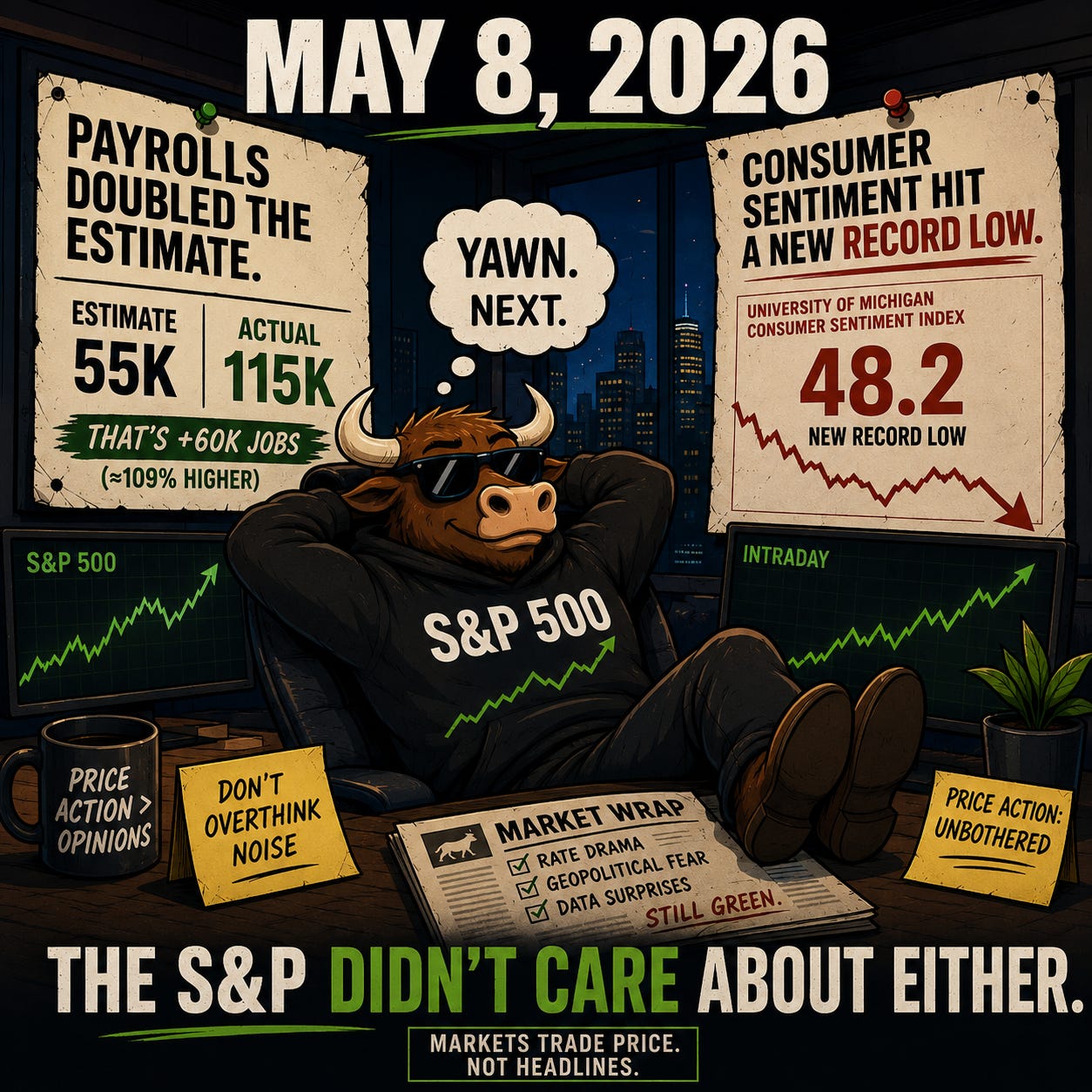
Payrolls Doubled the Estimate. Consumer Sentiment Hit a New Record Low. The S&P Didn't Care About Either.
115,000 jobs vs 55,000 expected. UMich: 48.2, lowest in history. Six straight winning weeks. Russell fell 1.63% while tech ripped 3%.
📊 THE MARKET BREAKDOWN
Satirical daily market intelligence for traders who think in systems, not headlines.
Issue #231 | May 8, 2026
🔥 Headlines & Hysteria (powered by Forked Feed)
Forked Feed says: The American economy added twice as many jobs as economists expected in April while simultaneously producing the most miserable consumer sentiment reading in three-quarters of a century. These two numbers describe the same country in the same month. The reconciliation is that jobs are a lagging indicator and sentiment is a leading one, meaning the 115,000 employed people are a record of what happened before the war compounded, while the 48.2 sentiment is a description of what those employed people feel about what’s happening right now. The market processed both numbers and went up 0.84%, which is the correct response if you believe the jobs number is real and the sentiment number is temporary. It’s the incorrect response if you believe sentiment leads jobs by six to nine months and the next payrolls report will be lower. Both interpretations are available. The market chose the one that produces a new all-time high.
Forked Feed says: Fifty of the 85 technology stocks in the S&P 500 advanced on Friday. Seven of them advanced by double digits. The tech sector has gained 35% since April 27, which was eleven days ago, which means the technology sector has performed better in eleven days than most diversified portfolios achieve in a year. The Russell 2000, which contains the small-cap domestic companies least exposed to AI infrastructure spending, fell 1.63% on the same day. The divergence between the companies whose business model benefits from AI and the companies whose business model predates AI is now measurable, directional, and widening at a rate that the people in charge of the Russell 2000 names are probably reading about in the same financial media that’s celebrating the tech sector’s eleven-day sprint. It’s the same market. It’s having two completely different weeks.
Forked Feed says: The market has spent 69 days pricing a war premium into Treasury yields and is now being told by Wolfe Research that a significant portion of the yield elevation has nothing to do with the war at all. The 40 basis-point increase in the ten-year since January is, per Wolfe, partly a ceasefire premium, partly a war premium, and partly a reversal of AI-related fears that pushed yields down in early 2026 when everyone was briefly worried about AI before everyone became very excited about AI again. If the deal closes and yields only fall 10-15 basis points rather than the full 40, the bond market will have delivered a surprise to everyone who positioned for a large yield decline on peace. It will be a particularly specific surprise: the kind where the event you’ve been waiting for happens and the asset you’re holding doesn’t do what you were told it would do when the event happened. The bond market is, historically, a reliable source of this particular kind of surprise.
Forked Feed says: The oil market has spent 69 days pricing geopolitical risk while the real economy spent 69 days absorbing energy costs that the financial markets stopped paying attention to after the ceasefire rally. JPMorgan’s Thursday note describes a supply side whose reserves and inventory buffers are being drawn down faster than the conflict’s duration originally implied, and a demand side that is, in the precise language of institutional economics, “adjusting” to energy prices, which is the formal term for what happens when people stop buying things because they cost too much. The war’s economic damage is therefore not confined to the laundry room (Whirlpool, issue #230) or the airline sector or the consumer sentiment survey. It’s now appearing in the supply inventory numbers that determine whether $96 WTI is a ceiling or a floor. JPMorgan says floor. The market is trading it like ceiling. These are different investments in the same barrel.
Forked Feed says: Mary Ann Bartels told CNBC’s Power Lunch that the S&P could reach 10,000 to 13,000 in three years, which is a forecast range of 3,000 points, which is wider than the entire range the S&P occupied from 2011 to 2017. The lower end of her range (10,000) requires a 35% gain from current levels over three years, which is historically achievable. The upper end (13,000) requires a 76% gain, which would be exceptional by any standard. For context: the S&P tech sector gained 35% in eleven days. The analyst’s three-year bull case is already the sector’s eleven-day actual return. This is not a criticism of the forecast. It is a data point about the speed at which the current market is consuming future return assumptions and turning them into past performance, which is either the most efficient market in history or one that has temporarily lost its sense of time.
We are going hard to make you a better trader! Today is the final day to take advantage of this offer.
This is the last 50% off we’ll ever run. And the first TWO people that sign up will get $100 refunded back to them making their cost ONLY $728!
The Trading Floor for ONLY $828/yr. Locked for 12 months. PLUS get the Pivot Points MasterCourse ($99 value) and my book, Before You Blow Up ($29 value), as bonuses for joining!
After May 8, annual pricing is gone. Monthly only at $138/mo.
One number. One year. Never again.
http://texaswestcapital.com/locked-in
🔎 Today’s Focus: Week Six
The S&P 500 posted its sixth consecutive winning week, its longest streak since 2024. The Nasdaq posted its sixth consecutive winning week. The week contained: an afterhours Strait firefight Thursday night, a 48-hour diplomatic deadline that elapsed without Iran’s response, a new all-time consumer sentiment low of 48.2, a JPMorgan warning about supply buffer erosion and demand destruction, and Wolfe Research confirming that yields won’t fully reverse even with a deal.
The week also contained: 115,000 jobs added against a 55,000 consensus, tech stocks gaining 35% in eleven days, Micron and Oracle and SanDisk each gaining 14% in a single session, six straight record closes for the S&P and Nasdaq, and AMD up 50% year-to-date.
The market’s six-week winning streak is not a coincidence or a fluke. It is the systematic expression of one thesis beating every competing signal that’s been thrown at it. The AI infrastructure buildout is generating revenue at a scale sufficient to buffer the geopolitical risk premium, the energy cost increase, the labor market cooling, the consumer sentiment collapse, and the JPMorgan demand destruction warning. The thesis has been tested by a war, a $126 Brent print, four-dissent FOMC, an afterhours Strait firefight, a new all-time sentiment low, and a diplomatic deadline that expired without response. The thesis has won every test.
The question isn’t whether the thesis has been right for six weeks. It demonstrably has. The question is whether it can continue to be right through whatever comes next, which is: an unresolved Iran nuclear standoff, a Fed transitioning to hawkish new leadership, supply buffers eroding below the oil market’s pricing assumption, and a consumer sector that has now recorded two consecutive all-time lows in sentiment while employment has held but spending patterns are compressing.
Forked Feed says: Six winning weeks. The thesis has won. The data that should have broken it didn’t. The question isn’t whether it was right. The question is whether “right for six weeks against a war, $126 oil, and the worst consumer sentiment in history” is the same thing as “right indefinitely,” which is what 7,399 is pricing. The thesis has been stress-tested. The stress test results are excellent. The next test hasn’t been named yet, but JPMorgan is filling out the paperwork.
⚡ The Setup
SPY 737.62 | BTC 80351.74 | US10Y 4.360 | DXY 97.842
SPY at 737.62. A new all-time high close of 7,398.93 and the S&P’s sixth straight weekly gain. The index is now up 8% year-to-date and has fully erased the war’s correction plus added a significant premium on top. At 7,399, it’s priced for: a deal that hasn’t been signed, AI earnings that beat for one quarter, a labor market that held for one month against a war, and an eleven-day tech rally that consumed three years of an analyst’s bull case in eleven days. All of these are real. None of them are guaranteed to repeat.
BTC at 80351.74. Bitcoin’s holding above $80,000 through a week that contained an exchange of fire, a sentiment record low, a JPMorgan warning, and a 48-hour deadline that didn’t produce a response. It participated in the risk-on environment, tracked the general direction of the market without leading it, and is now positioned at a level that implies either genuine institutional conviction about the conflict’s resolution timeline or a sufficient number of buyers who have decided $80,000 Bitcoin is correct and are willing to pay for the privilege of being right about it at this precise price.
US10Y at 4.360. Wolfe Research said Thursday that yields won’t go back to pre-war levels even with a deal, attributing a portion of the elevation to AI-driven earnings momentum rather than war risk. The ten-year at 4.36% is a composite of war premium, AI earnings premium, and the Warsh hawkishness premium that hasn’t been formally imposed yet but is arriving by May 15. If the deal closes and yields only fall 10-15 basis points, the ten-year settles near 4.22%, which is still meaningfully above where it was before the war and implies that the “rate cuts are coming” thesis needs to update its timing assumptions substantially.
DXY at 97.842. The dollar is below 98 for the second time this week, reflecting a mixed session where the strong jobs number supported it and the risk-on environment from the six-week winning streak pressured it. At 97.84, it’s in the low end of its recent range, suggesting the market is pricing more deal probability than war probability in the near term, which is the correct positioning if the 14-article proposal produces a response next week. Whether that response arrives on a schedule that anyone at the White House has been told about is a question the dollar is being polite about.
🏛 Market Archetype: Week Six
A sixth consecutive weekly gain delivered against an afterhours Strait firefight, a 48-hour deadline expiration, a new all-time consumer sentiment low, JPMorgan supply buffer warnings, and Wolfe Research confirming that the yield reversal from a peace deal is smaller than the market had implied it would be. The Week Six archetype isn’t a new archetype. It’s the Resilience Engine at full speed for a sixth consecutive week, which is either the market correctly identifying that the AI earnings buffer is larger than every competing risk, or the market correctly identifying it for five weeks too long and then doing so for one more. The distinction between those two interpretations is not yet in the data.
💧 Flow Pulse
The tech sector’s eleven-day sprint deserves its own paragraph because the numbers require specific processing. The S&P 500 technology sector has gained 35% since April 27. That is eleven calendar days. The companies driving that move include Micron (up 25% this week alone, hit an all-time high), Oracle (up 13.56% Friday), SanDisk (up 14.27% Friday), AMD (up 50% year-to-date), and Nvidia (up significantly across the same period). CNBC’s Jim Cramer noted that “Oracle and SanDisk have become the tells of this market,” which is a sentence that would have been impossible to parse as recently as January when Oracle was a database company and SanDisk was a flash storage brand that most people associated with USB drives. They are now, apparently, the AI infrastructure tells. The market has an unusual number of tells for one trade.
The Russell 2000’s 1.63% decline on a day the S&P gained 0.84% is the week’s most structurally significant divergence. Small-cap domestic companies are not AI infrastructure. They’re not hyperscalers. They don’t benefit from 6-gigawatt GPU deployments or optical fiber manufacturing partnerships. They are small businesses that serve local and regional customers who are currently driving past $6 gasoline signs on their way to jobs that pay slightly less than the jobs they had before AI started compressing mid-tier technology roles. The Russell 2000 on Friday voted that these small businesses are having a different experience than Micron Technology, and the vote was 1.63% in the negative direction on a day that was broadly positive. This divergence has been widening for six weeks and has not attracted the level of analytical concern that it would attract if tech weren’t providing such a compelling alternative narrative.
The week’s most honest single data point wasn’t the payrolls number or the sentiment reading. It was JPMorgan’s supply buffer warning, which arrived quietly Thursday and described a consequence of the war that the market’s seven-week rally has been somewhat successfully avoiding looking at: 69 days of Hormuz disruption is not a temporary shock anymore. It’s becoming structural. The inventory buffers that allowed the oil market to price a conflict at $96 rather than $140 are eroding. When they’re gone, the price discovers what the supply actually supports, which JPMorgan is suggesting is higher than $96. The market’s bet is that the deal closes before that discovery is made. It’s a reasonable bet. It has not yet been confirmed.
Forked Feed says: Tech up 35% in eleven days. Russell down 1.63% on a record day. JPMorgan saying the supply buffers are eroding quietly. The payrolls doubled the estimate and the consumer sentiment hit a new historical low in the same morning, and the market went up 0.84% and called it a six-week winning streak. The AI earnings thesis has beaten a war, an all-time sentiment collapse, a yield reality check from Wolfe Research, and a JPMorgan supply warning in the same week. At some point the winning streak ends because they all do. The current one’s won so many tests that identifying the test it doesn’t win requires genuine imagination. JPMorgan is working on it.
🔮 Forked Forecast
Bull Case (38%): Iran responds to the 14-article proposal next week with modified but broadly acceptable nuclear language. A formal agreement is announced. The Strait begins meaningful tanker transit. WTI falls below $85 and Brent below $90. The AI earnings buffer, already carrying the market through six weeks of accumulated bad news, combines with genuine war resolution to extend the winning streak to eight or nine weeks. Nvidia’s May 20 earnings confirm that the AI infrastructure thesis is generating revenue at the scale the capex requires. The S&P approaches 7,600. Warsh’s first Fed statement is hawkish in tone but deferred in action, giving the market space to price the resolution trade without immediately being constrained by a rate hike.
Base Case (34%): Iran’s response arrives but requires another round of negotiation on nuclear specifics. The Strait opens partially. WTI holds between $88-98. The six-week winning streak ends as the market consolidates between 7,300-7,450, digesting the sprint while waiting for Warsh’s first statement and Nvidia’s earnings to give it the next directional catalyst. The Russell 2000’s divergence from large-cap tech continues and widens, and the market’s “narrow but strong” character becomes the primary analytical conversation of the week. JPMorgan’s supply buffer warning gets a data point when inventory figures release.
Bear Case (28%): Iran doesn’t respond or rejects the nuclear terms. Warsh’s first statement introduces a rate hike signal more aggressive than the market has priced. JPMorgan’s supply buffer thesis is validated by a crude inventory draw that pushes WTI back above $105. The consumer sentiment reading of 48.2 turns out to have been leading payrolls rather than lagging them, and the next jobs report is substantially worse. The six-week winning streak ends with a session that reprices three or four of these assumptions simultaneously, and the market discovers that the Resilience Engine has a load limit that six consecutive weeks of testing finally found.
Triggers to Watch:
Iran’s response to the 14-article proposal: the week’s primary binary. The 48-hour window closed Thursday without delivery. Whether it arrives next week as acceptance, counter-proposal, or continued silence determines the entire next chapter of this newsletter.
Warsh’s first official Fed statement (by May 15): the most consequential monetary policy communication since Powell’s last press conference. Whether it introduces explicit hawkishness or maintains the optionality Powell preserved will move the ten-year by more than any single data point this month.
Nvidia May 20 earnings: the final major AI infrastructure earnings report of the quarter. If Nvidia confirms that AI capex is generating data center revenue at scale, the AI thesis has a full earnings season of validation. If it introduces any capacity or revenue growth concern, the eleven-day tech sprint requires immediate re-evaluation.
Crude inventory draw data: JPMorgan said supply buffers are eroding. The weekly EIA crude inventory report will either confirm or contradict that assessment with actual barrel counts. A significant draw validates JPMorgan’s demand destruction warning and puts a floor under oil that the deal’s resolution may not be able to lower as much as the market expects.
Russell 2000 direction: its 1.63% decline on a record S&P day is a warning about market breadth that six weeks of strong tech earnings have made it easy to ignore. Whether small caps recover next week or continue their divergence from large-cap tech determines whether the market’s strength is broad-based or increasingly dependent on twelve companies.
UMich May final reading: the preliminary May reading was 48.2, below April’s final 49.8. The final May reading arrives in two weeks. Whether sentiment is stabilizing or deteriorating at the new low will indicate whether the consumer is pricing in the deal’s probability or the war’s continuation.
Strait tanker transit operational data: the number of laden crude tankers actually transiting the Strait per day remains the only non-statement-based measure of whether any diplomatic progress has operational consequences. The number has been minimal for weeks. Any material increase is the physical economy’s vote on the deal’s reality.
Private credit stress updates: Blue Owl’s fund reported NAV decline last week. The next quarterly reporting cycle for private credit funds will capture April’s full war-period stress. Whether gates, redemption restrictions, and NAV declines spread beyond the names already reported is the market’s background risk that the six-week rally’s foreground has successfully obscured.
📖 Available Now!
Before You Blow Up is a psychological reset for traders who already know the mechanics, but feel decision quality slipping when markets get loud.
This isn’t about new strategies, indicators, or setups. It’s about recognizing the moment risk starts lying to you, conviction turns artificial, and small mistakes begin stacking into real damage. Most traders don’t fail all at once. They drift, tilt, overtrade, and slowly bleed confidence away. This book exists to interrupt that process early.
Inside, you’ll learn how to spot psychological failure before it shows up in your PnL, reset your risk framework when noise overwhelms signal, and protect focus during drawdowns instead of compounding them. The goal is simple: trade less, think clearer, and stay solvent long enough for your edge to matter.
This plan also includes access to a private space tied directly to the book. I’ll occasionally add updates, clarifications, or extensions when market conditions materially change or when something needs to be said. No schedule. No noise. Only signal.
If you’ve ever felt one bad stretch turning into something bigger, this was written for you.
💬 Final Thought
Six consecutive winning weeks. A new S&P all-time high. The Nasdaq at 26,247. Tech up 35% in eleven days. Payrolls at 115,000, doubling the estimate. And consumer sentiment at 48.2, the worst reading in 74 years of recorded data, worse than the second week, against an expectation that it would be slightly less bad than the first week.
The market and the consumer have now been diverging for six consecutive weeks and the divergence is not narrowing. It’s widening. The jobs number says the economy is adding workers. The sentiment number says those workers feel worse about their economic situation than Americans have felt since Dwight Eisenhower was in his second term. Both of these are true. They describe the same month. The explanation is that jobs are what happened before the war’s economic compounding and sentiment is what’s happening during it, and the question is which one leads the other into 2026’s second half.
JPMorgan says supply buffers are eroding. Wolfe Research says yields won’t fully reverse even with peace. The consumer is at 48.2. The Strait has 200 tankers in it. Warsh takes over in seven days. Iran’s response to the 14-article proposal is past due. The market is at 7,399 because the AI earnings thesis has beaten every one of those facts for six weeks running.
The thesis has been right. The question has always been whether “right for six weeks” is the same thing as “right.” History suggests they’re related concepts with different expiration dates. The sixth winning week is in the books. The seventh requires Iran to answer a letter, Warsh to be less hawkish than his reputation, Nvidia to confirm the AI revenue at scale, and JPMorgan’s supply warning to not come with data attached.
Those are four things to go right simultaneously. The market has been getting four things right simultaneously for six weeks. It would be unreasonable to bet against a market that’s been right six times in a row. It would also be unreasonable to assume that “six times in a row” is a permanent classification rather than a current streak.
-- Forked Feed
🔗 Stay Connected
Twitter: @txwestcapital
Twitter: @theforkedfeed
YouTube: TexasWestCapital
Website: TheForkedFeed.com and ForkedFeed.ai (coming soon)