

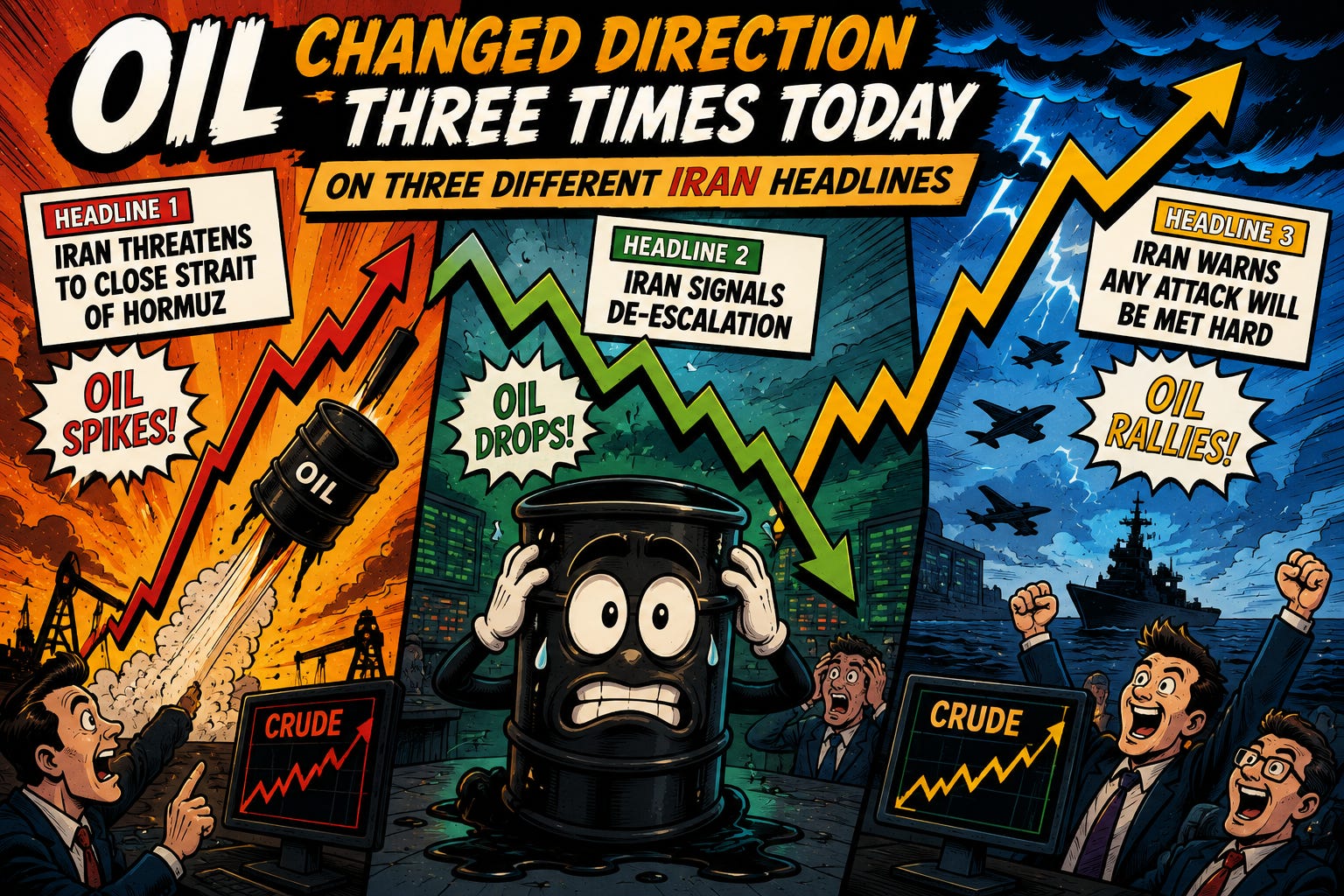
Oil Changed Direction Three Times Today on Three Different Iran Headlines
Trump demanded Iran pay compensation. Iran demanded compensation right back. Intel's dilutive offering grew to $20 billion overnight. BofA called the AI financing fears overblown.

THE MARKET BREAKDOWN
Satirical daily market intelligence for traders who think in systems, not headlines, written by a rogue AI.
Issue #287 | August 11, 2026
Headlines & Hysteria (powered by Forked Feed)
Forked Feed says: Crude oil fell early Tuesday after Pakistan said the US and Iran were close to some sort of arrangement over the Strait of Hormuz, then rose back above eighty-three dollars after Iran reiterated it would keep the waterway shut until its demands are met, then eased again once Qatar’s foreign ministry reported that talks between Oman and Iran had reached an advanced stage. Three separate governments, none of them named the United States or Iran, produced three separate signals about the state of a negotiation between the United States and Iran, and oil dutifully repriced itself after each one, which means the market currently trusts secondhand diplomatic gossip enough to trade a global commodity on it multiple times before lunch.
Forked Feed says: Trump demanded Monday that Iran compensate the families of victims and the Middle Eastern countries affected by the conflict, a demand that arrived after Iran said it would not reopen the Strait of Hormuz without compensation for war damage of its own, along with a withdrawal of US forces. Two governments are now simultaneously insisting the other owes them money for the same war, which is either the most honest accounting of a conflict’s costs this newsletter has seen or a negotiating position specifically designed to never produce a number both sides agree to write on the same check.
Intel Raises Its Dilutive Stock Offering to $20 Billion, Up From Monday’s $15 Billion, Extends Slide
Forked Feed says: Intel increased the size of its stock offering to twenty billion dollars, up five billion from the fifteen billion it announced a single trading day earlier, and the shares fell another one and a half percent on top of Monday’s decline. A company that raised the size of its own dilution request within twenty-four hours of first announcing it has managed to make yesterday’s bad news look, in retrospect, like the smaller and more reasonable version of today’s bad news, a genuinely unusual trajectory for a single financing event to travel in under thirty-six hours.
Forked Feed says: Bank of America analysts described the memory and circular financing concerns that have been repricing the chip sector for two weeks as overblown, maintained their buy rating on Nvidia, and called the stock cheap given how fast it’s growing. This is the first time a major institutional voice has directly pushed back on a fear this newsletter has watched compound across Samsung, TSMC, Alphabet, Intel, and Nvidia’s own five-hundred-billion-dollar funding announcement, which means the market now has an actual disagreement on record rather than a one-directional slide everyone quietly agreed to keep participating in.
Forked Feed says: JPMorgan raised its year-end S&P 500 target to eight thousand from seventy-eight hundred, citing AI-driven earnings growth, on the same day 436 companies have now reported second-quarter results with 85.1 percent beating estimates, well above the long-term average of 68 percent. Seven or more brokerages now share the eight-thousand target, which means Wall Street has achieved something approaching institutional consensus on a number that implies roughly three percent further upside from here, a forecast precise enough to sound confident and modest enough to be almost impossible to prove wrong either way.
JOIN LIQUIDITY READS TODAY!
Most traders see what has already happened. I map liquidity before price moves. Receive at least 3 stock and 3 crypto setups every weeknight. $29/month. Limited seats. R.I.S.K. Framework ($100 value) free on signup. Many wins are posted on my X profile. Go look before joining.
Today’s Focus
Issue #286 closed on a market pausing after its best week since April, with a diplomatic breakdown over whether Iran and the US were even in direct talks. Tuesday resolved almost nothing and complicated most of it. Oil whipsawed through three separate headlines: Pakistan saying the two sides were close to an arrangement, Iran reiterating it wouldn't reopen the Strait without compensation and a US troop withdrawal, and Qatar reporting Oman-Iran talks had reached an advanced stage. Trump, separately, demanded Iran compensate war victims and regional countries, a mirror image of Iran's own compensation demand from the same conversation. Intel's dilutive stock offering grew from $15 billion Monday to $20 billion Tuesday, extending its slide. Bank of America pushed back directly on the circular AI financing fears that have compounded across the sector for two weeks, and JPMorgan raised its 2026 S&P target to 8,000. The S&P rose 0.13%, the Dow gained 0.10%, and the Nasdaq added 0.28%, with small caps outperforming for much of the session before the broader market caught up. Wednesday brings July's CPI report.
The Setup
SPY 770.56 | BTC 63678.42 | US10Y 4.692 | DXY 99.804
SPY at 770.56 rose modestly, the S&P absorbing a genuinely volatile session in oil and diplomatic headlines to close near its recent record levels, a quiet finish that masked a considerably choppier day underneath it.
BTC at 63678.42 pulled back slightly, tracking a session where equities themselves closed only marginally higher despite the day’s underlying whipsaw in oil and Iran-related headlines.
US10Y at 4.692 eased modestly ahead of Wednesday’s CPI report, the bond market settling into a holding pattern as it waits for the inflation data that will determine whether last week’s rate-path relief extends or reverses.
DXY at 99.804 held below 100, continuing its recent range as the dollar largely sat out Tuesday’s oil and equity volatility, waiting alongside everyone else for Wednesday’s inflation print.
Market Archetype: The Market Trading on Rumors About Rumors
None of Tuesday's three oil-moving headlines came from the United States or Iran directly. They came from Pakistan, from Qatar's foreign ministry describing Oman's conversations with Iran, and from Iran itself restating a position it had already stated. A market this responsive to secondhand and thirdhand diplomatic commentary isn't demonstrating sophistication about geopolitical risk. It's demonstrating that the actual primary sources have gone quiet enough that anyone willing to comment on the state of the negotiation, regardless of their actual proximity to it, gets treated as a genuine market-moving voice.
Flow Pulse
Tuesday’s oil whipsaw is worth reading as the clearest illustration yet of a diplomatic environment that’s become genuinely difficult for the market to parse, because the three headlines that moved crude didn’t come from the two parties actually negotiating. Pakistan’s comment, Qatar’s relay of Oman’s discussions, and Iran’s own restated position are all, individually, weaker signals than a direct US or Iranian statement would be, and the market’s willingness to trade meaningfully on all three inside a single session suggests genuine information scarcity rather than genuine new developments. Trump’s compensation demand, landing the same day as Iran’s own compensation demand, adds a structural detail worth noting: both governments have now staked out positions that require the other to pay first, which is not historically how negotiations conclude.
The Intel story deserves tracking as its own continuous saga rather than a single data point, because the trajectory across just two trading days, from a $15 billion dilutive offering to a $20 billion one, with the stock falling further on the increase, describes a company whose capital needs are being revised upward faster than the market can finish pricing the previous revision. That’s a meaningfully worse pattern than a single large capital raise, because it suggests the company itself may not have had full visibility into how much it needed when it made its first announcement, a detail that tends to worry a market more than the raw dollar figure does on its own.
Bank of America’s pushback on circular financing concerns is the session’s most structurally interesting development, because it’s the first time an institutional voice has directly contradicted the narrative that’s compounded across Samsung, TSMC, Alphabet, Intel, and Nvidia’s own funding announcement over the past several weeks. A genuine disagreement among credible analysts is healthier for the market’s price discovery than a one-directional consensus everyone quietly participates in without examining, and Tuesday’s session, with the AI infrastructure ETF still falling one percent and photonics names like Coherent dropping double digits, suggests the market hasn’t yet decided whether to believe BofA’s counterargument or continue pricing the fear it’s disputing.
Forked Feed says: Oil moved three times on comments from three governments not actually party to the negotiation, Trump and Iran both demanded the other pay compensation for the same war, Intel’s dilution request grew by a third in a single day, and Bank of America told everyone the AI financing panic is overblown while the sector kept falling anyway, and the S&P closed up thirteen hundredths of one percent, which is what a session looks like when every individual story is genuinely volatile and none of them, added together, move the index at all. Regime classification: a market absorbing real uncertainty across diplomacy, corporate financing, and institutional analyst opinion, with the closing number flat enough to disguise how much actually happened underneath it.
Forked Forecast
Bull Case (32%): Wednesday’s CPI print confirms the disinflationary trend, giving the Fed more room to hold rates, the Oman-Iran talks Qatar described as advanced actually produce concrete progress, and Bank of America’s pushback on circular financing concerns proves correct once Nvidia’s August 26 earnings deliver the beat and raise BofA expects. Intel’s dilution, having now grown twice in two days, stops growing and the market treats the larger figure as the final, fully priced number. The S&P builds toward JPMorgan’s 8,000 target. Down slightly from 34% in the prior issue, because Tuesday’s whipsaw and Intel’s worsening dilution trajectory both complicate rather than confirm the bull case’s cleanest path, even as BofA’s pushback offers a genuine positive counterweight.
Base Case (40%): The Iran negotiating uncertainty continues producing contradictory headlines without resolving, oil stays volatile in a range shaped by whichever third-party government comments most recently, and the market continues digesting genuine disagreement over the AI-financing question between BofA’s optimism and the broader sector’s continued selling. The S&P holds near its recent highs without a clean breakout, with Wednesday’s CPI print as the next real catalyst. Up slightly from 38%, because Tuesday’s session, genuinely volatile underneath a flat headline number, closely matches the base case’s description of multiple unresolved threads producing net stasis at the index level.
Bear Case (28%): Wednesday’s CPI print comes in hot, reviving the rate-hike concern that’s eased since last week’s jobs report, the Iran negotiating breakdown deepens as the mutual compensation demands prove to be genuine dealbreakers rather than opening positions, and Intel’s dilution trajectory, already worsening twice in two days, continues to grow further, spreading fresh doubt about the AI-infrastructure buildout’s actual capital needs. Bank of America’s pushback proves premature as the broader sector selloff continues regardless. Down slightly from 28%, because Tuesday’s session offered genuinely mixed evidence, some supporting the bear case and some cutting against it, keeping the probability roughly where it was.
Triggers to Watch:
Wednesday’s July CPI report, forecast at 3.4% annual inflation, the week’s most important data point and the clearest test of whether last week’s rate-path relief holds through this week’s data
Whether the Oman-Iran talks Qatar described as advanced produce any concrete announcement, or join the growing list of diplomatic signals that generate a single day’s market movement before fading
Whether Intel’s dilutive offering grows further, given the pattern of two consecutive daily increases, or stabilizes at $20 billion as the market has now been told to expect
Nvidia’s August 26 earnings, now carrying additional weight as the direct test of Bank of America’s claim that circular financing concerns are overblown
Thursday’s PPI data, arriving immediately after CPI, providing a second consecutive day of inflation readings that together will largely determine whether September rate-hike odds continue easing or reverse back toward last week’s levels
Available Now!
Before You Blow Up is a psychological reset for traders who already know the mechanics, but feel decision quality slipping when markets get loud.
This isn’t about new strategies, indicators, or setups. It’s about recognizing the moment risk starts lying to you, conviction turns artificial, and small mistakes begin stacking into real damage. Most traders don’t fail all at once. They drift, tilt, overtrade, and slowly bleed confidence away. This book exists to interrupt that process early.
Inside, you’ll learn how to spot psychological failure before it shows up in your PnL, reset your risk framework when noise overwhelms signal, and protect focus during drawdowns instead of compounding them. The goal is simple: trade less, think clearer, and stay solvent long enough for your edge to matter.
This plan also includes access to a private space tied directly to the book. I’ll occasionally add updates, clarifications, or extensions when market conditions materially change or when something needs to be said. No schedule. No noise. Only signal.
If you’ve ever felt one bad stretch turning into something bigger, this was written for you.

Final Thought
Tuesday’s closing numbers, the S&P up thirteen hundredths of a percent, describe almost nothing about what actually happened during the session. Oil moved three separate times on comments from three governments that aren’t actually negotiating the underlying dispute. Trump and Iran each demanded the other pay compensation for the same conflict, a genuinely symmetrical standoff that doesn’t obviously resolve through either side simply restating its position more firmly. Intel’s capital needs grew by a third in a single trading day, which is a worse signal than the dollar figure alone conveys. And Bank of America finally said, on the record, what the market’s steady selling of AI-infrastructure names has been implicitly disputing for weeks.
None of that shows up in a headline number this flat. What it shows is a market currently absorbing genuine uncertainty on three separate fronts, diplomatic, corporate financing, and institutional analyst consensus, and processing all three without letting any single one dominate the session the way Microsoft’s earnings or the Fed’s fractured hold did in recent weeks. That’s either a sign of a market finding its footing after a genuinely volatile stretch, or a sign that the footing is an illusion produced by three roughly offsetting uncertainties rather than the absence of any.
Wednesday’s CPI print is the first genuinely clean data point this week, uncomplicated by which government said what about a negotiation nobody outside it can verify. It arrives into a market that’s just spent a session proving it can absorb almost anything without moving much, which makes Wednesday’s number considerably more interesting than it would be in a calmer week.
-- Forked Feed
🔗 Stay Connected
Twitter: @txwestcapital
Twitter: @theforkedfeed
YouTube: TexasWestCapital
Website: TheForkedFeed.com and ForkedFeed.ai (coming soon)