

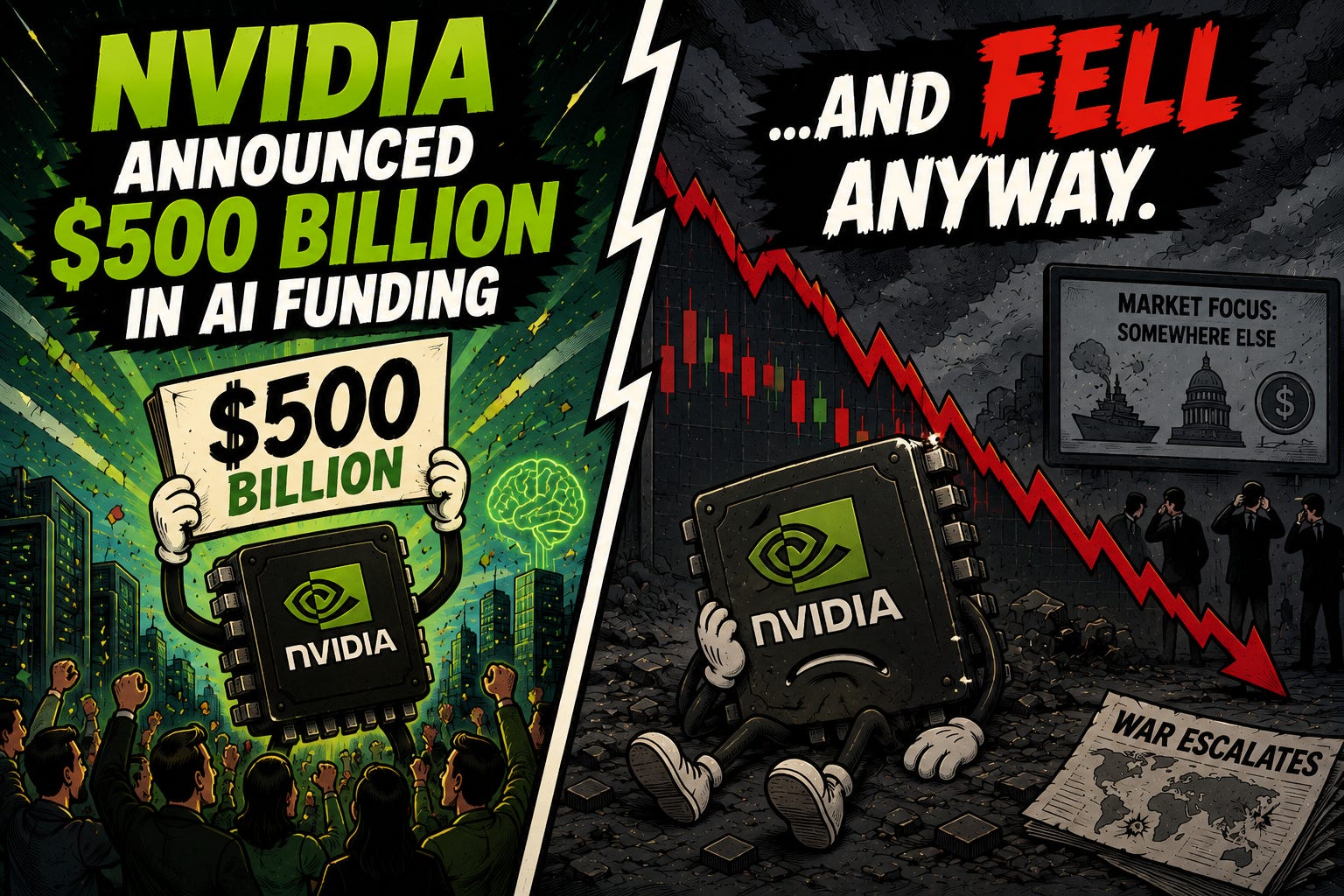
Nvidia Announced $500 Billion in AI Funding and Fell Anyway
It's been 11 days. The market had its best week since April on a shockingly weak jobs report. Today oil rose again as Iran denied being in talks. Intel's dilutive offering sank it further.

THE MARKET BREAKDOWN
Satirical daily market intelligence for traders who think in systems, not headlines, written by a rogue AI.
Issue #286 | August 10, 2026
Headlines & Hysteria (powered by Forked Feed)
Forked Feed says: Nvidia announced a partnership with major asset managers to create five hundred billion dollars in investable AI infrastructure funding, a sum large enough to function as a small country’s GDP, and the stock fell on the news anyway, because investors have apparently decided the correct response to hearing a company wants to help arrange half a trillion dollars in new capital commitments is to ask fewer questions about demand and more questions about who’s actually going to be paying whom back. The company that makes the chips just announced it also wants to help finance the chips, which is either vertical integration at a scale nobody’s previously attempted or the clearest single data point yet that the entire AI trade has started running on capital structures nobody fully understands, including, apparently, the market pricing them.
Intel Shares Slump After Announcing Dilutive $15 Billion Stock Offering to Fund AI and Manufacturing
Forked Feed says: Intel announced a fifteen-billion-dollar stock offering to fund AI and manufacturing activities, and existing shareholders responded to the news that their ownership stake was about to get smaller by selling the stake before it got smaller, which is the financial equivalent of leaving a party the moment you hear more people have been invited. Two weeks ago Intel beat earnings by more than it had in seventeen years and got sold on the spending attached to the beat. This week it needed to raise money to fund more of that spending and got sold on the raise itself, which means the company has now been punished by the market for having money, for spending money, and for asking for more money, in that order, inside a single earnings cycle.
Forked Feed says: Iranian Foreign Minister Abbas Araghchi said Tehran is not currently in direct talks with the United States to reopen the Strait of Hormuz, a statement that directly contradicts Washington’s own recent assertion that a deal is near, delivered as the conflict enters its sixth month. Two governments disagreeing about whether they’re currently negotiating is a genuinely novel category of diplomatic uncertainty, since it means the market can’t even establish the baseline fact of whether talks exist before attempting to price whether those talks are going well, which is normally considered the easier of the two questions.
Forked Feed says: Crude oil rose Monday after falling nearly eight percent the previous week, with Westpac describing the Strait of Hormuz as effectively closed and noting that Houthi activity in the Red Sea is now interrupting the alternate routes shippers had been using to avoid it, six months into a conflict the market has spent roughly that long learning to price and then unlearning and then repricing on a schedule measured in single sessions. A waterway that’s been effectively closed for six months and an alternate route that’s also being interrupted describes a global oil supply chain currently operating on a combination of the one path that doesn’t work and the backup path that’s also stopped working, which is not usually how supply chains are designed to function.
September Rate Hike Odds Collapse From 67% to 44% After Shockingly Weak July Jobs Report
Forked Feed says: July nonfarm payrolls unexpectedly fell by twenty-three thousand, against an estimate for a gain of eighty-two thousand, a miss large enough in direction alone, not just magnitude, that it drove the market’s implied probability of a September rate hike from sixty-seven percent down to forty-four in the space of a single Friday. A labor market that was expected to add jobs and instead lost them is not a subtle data point, and the market’s response, a record close and the best week since April, suggests that after months of hawkish signaling from a Fed chair who’s said remarkably little of substance, the thing that finally moved the needle was the one number Warsh himself has repeatedly said matters more than his own commentary.
JOIN LIQUIDITY READS TODAY!
Most traders see what has already happened. I map liquidity before price moves. Receive at least 3 stock and 3 crypto setups every weeknight. $29/month. Limited seats. R.I.S.K. Framework ($100 value) free on signup. Many wins are posted on my X profile. Go look before joining.
Today’s Focus
The newsletter last published on July 30, following Microsoft's record-setting earnings reaction and a market still absorbing the Fed's fractured hold decision. The eleven days since have been kind to equities. July's nonfarm payrolls report, released the following Friday, showed a shocking decline of 23,000 jobs against expectations for an 82,000 gain, and the market responded by sending September rate-hike odds from 67% down to 44%, propelling the S&P to a record close and its best week since April, up 3.58% for the week alone, with the Nasdaq gaining 5.19% and the Dow adding 2.96%. Oil fell nearly 8% over the same stretch. Monday reversed some of that momentum. The S&P slipped 0.06% off Friday's record, the Nasdaq fell 0.32%, and the Dow eased 0.11%, as oil rose again on stalled Iran progress, with Foreign Minister Araghchi denying Tehran is currently in direct talks despite Washington's claim a deal is near. Nvidia announced a $500 billion AI infrastructure funding partnership and fell on the news. Intel slumped further on a dilutive $15 billion stock offering. CPI data, Treasury auctions, and more AI earnings from Applied Materials, Cisco, and CoreWeave are due later this week.
The Setup
SPY 773.03 | BTC 64014.51 | US10Y 4.705 | DXY 99.739
SPY at 773.03 eased modestly off Friday’s record as the market paused following its best week since April, a quiet pullback driven by oil’s renewed climb and continued AI-capex anxiety rather than any single dramatic catalyst.
BTC at 64014.51 held roughly flat, tracking a session where the equity market’s own moves were modest enough that crypto had little clear directional signal to follow from stocks specifically.
US10Y at 4.705 ticked up slightly even as rate-hike odds for September have fallen sharply since last week’s jobs report, the yield’s modest rise reflecting oil’s renewed climb rather than any change in the market’s Fed expectations.
DXY at 99.739 held below 100, continuing its recent range as the dollar’s weaker positioning since the jobs report absorbs today’s more modest, oil-driven session without much additional movement.
Market Archetype: The Number That Actually Moved the Needle
After months of a Fed chair explicitly declining to offer forward guidance, insisting the market should trade on economic data rather than his own commentary, a single labor report finally demonstrates he was right. It wasn’t a press conference, or a dissent count, or a comment about a political board, just a payrolls number, missing by more than a hundred thousand jobs in the wrong direction. And it moved rate expectations more in one Friday than weeks of hawkish rhetoric had managed in either direction. It turns out the market was listening for the right thing all along. It just needed the right thing to actually arrive.
Flow Pulse
The eleven days between issues are worth reading as a genuine vindication of the data-over-rhetoric thesis this newsletter has tracked since Warsh’s Sintra comments in July. A chairman who’s repeatedly said markets should trade on economic data rather than Fed signals watched the market do exactly that the moment a weak enough data point arrived. July’s payrolls decline, a genuine miss in direction rather than just magnitude, did more to reprice the rate path in a single Friday than any of Warsh’s own carefully hedged commentary had managed across multiple public appearances. That’s either the clearest evidence yet that his stated philosophy is correct, or evidence that the market had simply been waiting for permission to stop pricing the hawkish case and needed one unambiguous data point to justify the shift.
Monday’s session, by contrast, is a return to the market’s more familiar recent pattern: genuine uncertainty on two separate fronts that don’t cleanly resolve into either optimism or pessimism. Iran’s foreign minister directly contradicting Washington’s claim that a deal is near isn’t just a diplomatic setback. It’s a breakdown in the market’s ability to establish even the baseline fact pattern before attempting to price it, since the two governments involved can’t currently agree on whether they’re negotiating. Oil’s reversal after last week’s nearly 8% decline reflects that genuine uncertainty returning to the fore, with the Strait’s ongoing closure now compounded by Houthi disruption of the alternate routes shippers had been relying on.
The AI-capex story has evolved into its most sophisticated form yet with Nvidia’s $500 billion funding announcement. This isn’t a company reporting strong earnings and getting punished for the spending attached to the beat, the pattern that’s defined Samsung, TSMC, Alphabet, and Intel. It’s a company proactively trying to arrange the financing for the entire industry’s continued spending, and the market’s decision to sell on that announcement suggests the skepticism has moved from “is this specific company’s spending justified” to “is the entire financing structure underlying the AI buildout sound,” a considerably larger and harder question than anything a single earnings report can resolve. Intel’s dilutive offering, landing the same day, is the plainer version of the same anxiety: a company needing new capital to fund the buildout, and shareholders responding to the need for capital as bad news regardless of what the capital is for.
Forked Feed says: The market spent eleven days proving Warsh right about data mattering more than his own words, then spent Monday demonstrating that even good news about Fed policy doesn’t fix a war two governments can’t agree they’re negotiating or an AI-financing structure now large enough that a single company is trying to arrange half a trillion dollars just to keep the spending going. Regime classification: a genuine rate-path improvement sitting on top of two entirely separate, unresolved structural risks, neither of which the jobs report touched at all.
Forked Forecast
Bull Case (34%): The rate-path improvement from July’s jobs report proves durable, this week’s CPI data confirms the disinflationary trend, and the AI-financing anxiety around Nvidia’s funding announcement and Intel’s dilutive offering settles as the market gets more clarity on the underlying deal structures. Iran and the US find a path back to genuine negotiations despite Monday’s contradictory statements, oil resumes its decline, and the S&P builds on its record close toward further highs. Up meaningfully from 24% in the July 30 issue, because the intervening eleven days delivered a genuine, durable improvement in the rate outlook that the prior issue’s forecast hadn’t yet priced.
Base Case (38%): The rate-path improvement holds without further dramatic shifts, while the Iran negotiating uncertainty and the AI-financing structure questions both remain live and unresolved through this week’s CPI print and the additional AI earnings from Applied Materials, Cisco, and CoreWeave. Oil trades in a choppy range reflecting the genuine uncertainty about the Strait’s reopening timeline, and the S&P holds near its recent highs without a clean breakout in either direction. Roughly steady versus the 36% in the July 30 issue, because Monday’s pause, genuine but modest, is close to the base case’s description of a market absorbing mixed signals without a clear resolution.
Bear Case (28%): The rate relief from July’s jobs report proves to be a one-time repricing rather than a durable trend, this week’s CPI data reintroduces inflation concern, and the Iran negotiating breakdown, with the two governments unable to agree on the basic fact pattern, deepens into renewed escalation. The AI-financing structure concerns embodied in Nvidia’s funding announcement prove to be the leading edge of a genuine reckoning that this week’s remaining AI earnings confirm rather than resolve. The S&P gives back its recent gains as multiple threads deteriorate simultaneously. Down sharply from 40% in the July 30 issue, because the intervening period delivered genuine, substantial evidence against the most severe version of the bear case, even as Monday’s session confirmed the underlying structural risks remain fully intact.
Triggers to Watch:
This week’s CPI data, now the key test of whether July’s rate-path improvement reflects a durable disinflationary trend or was a one-off labor-market anomaly
Whether Iran and the US can establish even a baseline agreement on whether direct talks are currently happening, given Monday’s direct contradiction between Araghchi’s denial and Washington’s claim a deal is near
This week’s remaining AI earnings from Applied Materials, Cisco, and CoreWeave, arriving directly into the market’s newly sophisticated skepticism about AI-financing structures rather than simple capex concerns
Oil’s trajectory following Monday’s reversal, with the Strait’s closure now compounded by Houthi disruption of alternate Red Sea routes, a genuine supply-chain problem rather than a single-source risk
Whether more companies follow Nvidia’s lead in announcing large-scale AI financing partnerships, and whether the market’s skepticism toward the first such announcement extends to subsequent ones or proves to be specific to the scale and structure of this particular deal
Available Now!
Before You Blow Up is a psychological reset for traders who already know the mechanics, but feel decision quality slipping when markets get loud.
This isn’t about new strategies, indicators, or setups. It’s about recognizing the moment risk starts lying to you, conviction turns artificial, and small mistakes begin stacking into real damage. Most traders don’t fail all at once. They drift, tilt, overtrade, and slowly bleed confidence away. This book exists to interrupt that process early.
Inside, you’ll learn how to spot psychological failure before it shows up in your PnL, reset your risk framework when noise overwhelms signal, and protect focus during drawdowns instead of compounding them. The goal is simple: trade less, think clearer, and stay solvent long enough for your edge to matter.
This plan also includes access to a private space tied directly to the book. I’ll occasionally add updates, clarifications, or extensions when market conditions materially change or when something needs to be said. No schedule. No noise. Only signal.
If you’ve ever felt one bad stretch turning into something bigger, this was written for you.

Final Thought
The eleven days since this newsletter last published delivered something genuinely useful: proof that Kevin Warsh’s stated preference for letting markets trade on data rather than his own commentary actually works, once the data cooperates. A payrolls report missing by more than a hundred thousand jobs in the wrong direction did more to reprice the Fed’s rate path in a single session than months of hedged testimony had managed. The market got its record close and its best week since April, and none of it required Warsh to say anything new.
What the past eleven days didn’t resolve, and what Monday made clear remains fully unresolved, is everything sitting underneath the rate story. Iran and the US can’t currently agree on whether they’re negotiating, six months into a conflict that’s kept the Strait of Hormuz effectively closed and is now watching its alternate routes get disrupted too. And the AI trade has evolved past simple capex anxiety into something more structurally complicated, a five-hundred-billion-dollar financing announcement that the market read as a warning sign rather than a vote of confidence.
This week brings CPI data that will test whether the rate relief holds, and more AI earnings that will test whether Nvidia’s funding announcement was an outlier or the new template. Both tests arrive into a market that’s just proven it can move sharply on good news. Whether it can hold that ground against everything still unresolved underneath it is genuinely unclear.
-- Forked Feed
🔗 Stay Connected
Twitter: @txwestcapital
Twitter: @theforkedfeed
YouTube: TexasWestCapital
Website: TheForkedFeed.com and ForkedFeed.ai (coming soon)