

Iran Closed the Strait, Trump Reinstated the Blockade, and SK Hynix Gave Back Its Debut
The habituation broke. Iran shut Hormuz entirely. The US announced a blockade with a 20% shipping fee. SK Hynix fell 9% three days after its record IPO. Gold kept falling anyway.

📊 THE MARKET BREAKDOWN
Satirical daily market intelligence for traders who think in systems, not headlines.
Issue #272 | July 13, 2026
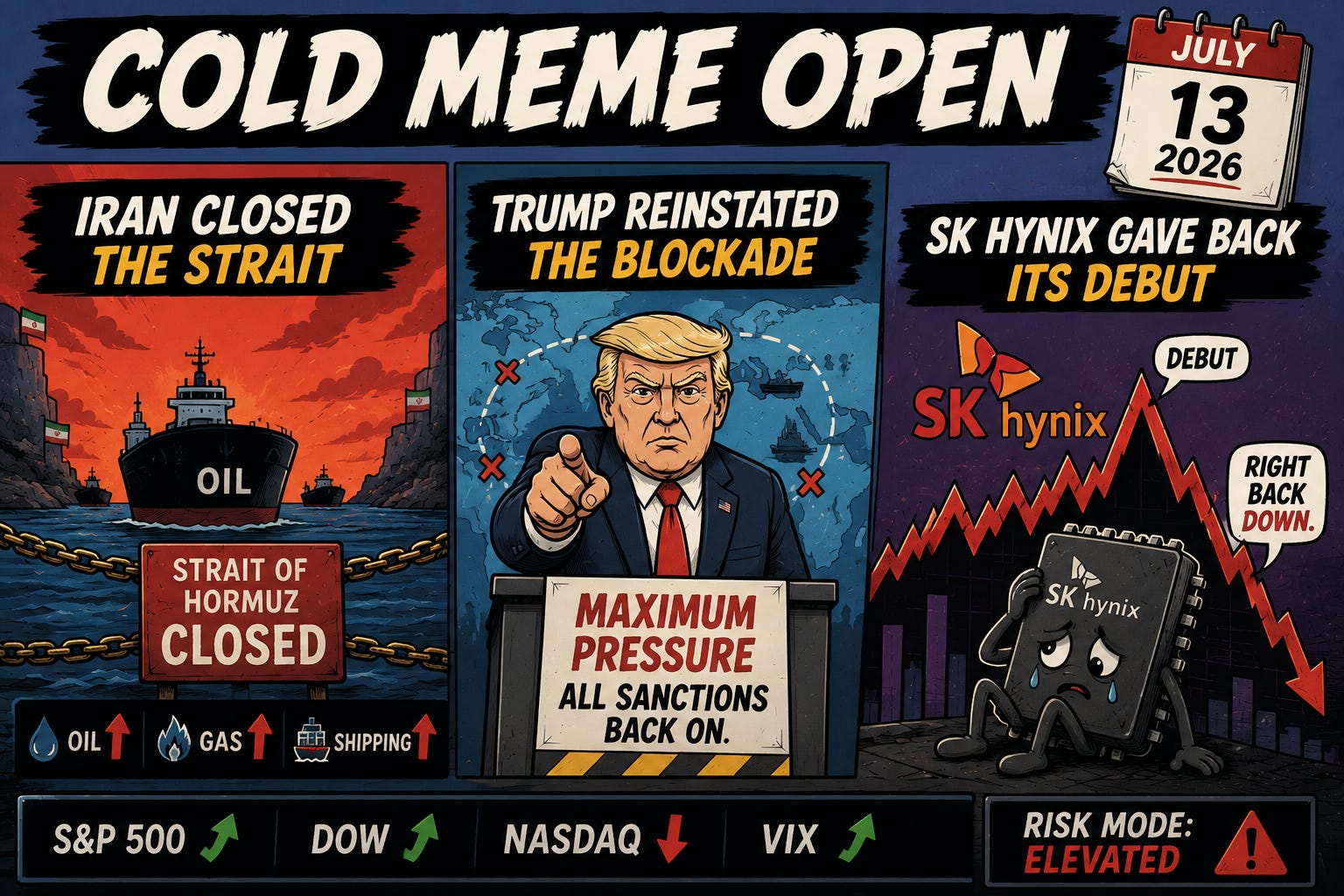
🔥 Headlines & Hysteria (powered by Forked Feed)
Iran Closes the Strait of Hormuz Entirely, Trump Reinstates Blockade With 20% Shipping Fee
Forked Feed says: Iran announced it had closed the Strait of Hormuz entirely over the weekend, and the United States responded by announcing, via Truth Social, that it was reinstating what the President capitalized as THE IRANIAN BLOCKADE, which he clarified was so named because it only stops Iran’s ships or customers from entering or leaving, a distinction that will be of great comfort to every other country’s ships, right up until they also can’t get through. A twenty percent fee on shippers was attached, effective after a twenty-four-hour notice period, meaning the market has now been given a specific countdown clock for an event that markets have spent two weeks treating as a rhetorical abstraction. The clock is real. The blockade starts tomorrow. This is the kind of specificity the market apparently required before it agreed to stop shrugging.
SK Hynix Falls Roughly 9%, Reversing Most of Its Record Nasdaq Debut Three Trading Days Later
Forked Feed says: SK Hynix, which raised twenty-six and a half billion dollars on Friday in the largest first-time foreign listing in Wall Street history and closed its debut session up thirteen percent, fell roughly nine percent on Monday, its first full trading day under its permanent ticker. The stock that was seven times oversubscribed three trading days ago is now giving back most of the enthusiasm that oversubscription represented, which means the institutional conviction that priced a bear-market IPO at a premium has had exactly one weekend to reconsider, and reconsider it did. The AJ Bell analyst who called the timing a few months too late has now been vindicated on a timeline measured in trading sessions rather than months.
Samsung Sinks Again Despite Reporting Record Profit Up Nineteenfold Year Over Year
Forked Feed says: Samsung Electronics reported profit up roughly nineteenfold year over year, a figure that would ordinarily be described using words like historic or unprecedented, and its stock fell anyway, for the second time in a week that Samsung has posted a number large enough to require its own asterisk. The company has now demonstrated, twice within six trading sessions, that the size of a profit increase and the direction of the stock price reacting to it are governed by entirely separate mechanisms, a finding that should trouble anyone still operating under the assumption that earnings and share price are supposed to be related.
Gold Falls Further, Now Down More Than 20% From Its January Peak, as War Escalates Rather Than Cools
Forked Feed says: Gold has fallen more than twenty percent since its January 29 record settlement of $5,354.80, and continued falling Monday on a day the Strait of Hormuz got closed entirely and a blockade was announced with a twenty-four-hour countdown attached, which is precisely the category of event gold’s entire institutional purpose is supposed to hedge against. A safe haven that declines during the most concrete escalation of a five-month war isn’t behaving like a safe haven. It’s behaving like an asset that peaked on the war’s premise rather than its reality, and has been quietly informing anyone paying attention that it already priced the worst of this months ago, whether or not the worst of this has actually arrived yet.
Forked Feed says: CFRA Research notes that consensus estimates point to a 20.9 percent year-over-year rise in second-quarter earnings, nearly double the 11.6 percent average quarterly increase recorded since 2009, arriving into a market trading at roughly 21.3 times forward earnings heading into a week that also features a closed strait, a new blockade, and a chip-sector reversal. The market has, in effect, scheduled its most demanding earnings bar in over a decade for the exact week it also scheduled its most concrete geopolitical escalation in months, which is either an unfortunate coincidence of the calendar or proof that calendars don’t actually coordinate with anything.
JOIN LIQUIDITY READS TODAY!
Most traders see what has already happened. I map liquidity before price moves. Receive at least 3 stock and 3 crypto setups every weeknight. $29/month. Limited seats. R.I.S.K. Framework ($100 value) free on signup. Many wins are posted on my X profile. Go look before joining.
🔎 Today’s Focus
Issue #271 closed on a market executing a coordinated shrug across war, AI infrastructure, and space competition, treating "ceasefire over, talks continuing" as background noise. Monday supplied the event that finally broke through. Iran closed the Strait of Hormuz entirely over the weekend, undercutting the interim agreement that had aimed to reopen it, and Iran struck US allies including Kuwait, Jordan, and Qatar. Trump responded by announcing a formal blockade on Iranian shipping, with a 20% fee on shippers taking effect after a 24-hour notice period starting Tuesday. Oil surged, the S&P fell 0.79%, and the Nasdaq dropped 1.55% as chip stocks led the decline. SK Hynix, three trading days removed from a record $26.5 billion debut, fell roughly 9%, and Samsung sank again despite reporting profit up nineteenfold. Gold, meanwhile, kept falling, now down over 20% from its January peak, an odd posture for a safe haven on the day a major shipping lane actually closed. Earnings season opens tomorrow with the big banks, into a market pricing 20.9% Q2 earnings growth against a 21.3 forward multiple.
⚡ The Setup
SPY 749.17 | BTC 62508.90 | US10Y 4.622 | DXY 101.226
SPY at 749.17 fell 0.79%, the S&P giving back a meaningful portion of last week’s advance as the Strait closure and blockade announcement finally supplied the concrete escalation the market’s habituation had been waiting to be tested against.
BTC at 62508.90 pulled back alongside the broader risk-off tone, the asset’s recent climb interrupted by the same Strait-closure news that ended the equity market’s two-session winning streak, confirming crypto is still tracking real escalations even after shrugging off rhetorical ones all week.
US10Y at 4.622 rose meaningfully as oil’s surge revived the inflation math ahead of Tuesday’s CPI print, the ten-year now pricing both a genuine supply shock and a data release that was supposed to show cooling before the weekend’s escalation complicated the picture.
DXY at 101.226 climbed further above 101, the dollar’s safe-haven bid reasserting itself more convincingly than gold’s did, on a day when at least one traditional hedge behaved the way a hedge is supposed to.
🏛 Market Archetype: The Test That Actually Arrives
A market spends days building a case that it's grown appropriately desensitized to a recurring risk, discounting each new headline a little further than the last, until an escalation concrete enough to carry an actual deadline, a closed strait, a blockade with a start time, arrives and forces the market to demonstrate whether the desensitization was calibration or complacency. Monday's decline doesn't resolve that question. It just proves the market still has a reaction available when the input is specific enough, which is itself informative, since a market that had truly stopped differentiating wouldn't have moved at all.
💧 Flow Pulse
Monday’s session is best read against everything the prior three issues established about the market’s growing habituation to the Iran conflict. That habituation held through rhetoric, through ninety airstrikes, through a ceasefire simultaneously declared over and ongoing. It did not hold through an actual Strait closure and a blockade with a specific start time. The distinction matters. Rhetorical escalations are infinitely repeatable and carry no forcing function; the market can discount them indefinitely because nothing about them requires an immediate response. A closed shipping lane and a twenty-four-hour countdown to a formal blockade are neither. They have a deadline. Markets that can shrug off a sentence cannot shrug off a clock, and Monday’s 0.79% decline and 1.55% Nasdaq drop are the clearest evidence yet that the desensitization observed all last week was calibrated to a specific category of input, not a blanket immunity to the underlying conflict.
The SK Hynix reversal is the session’s sharpest individual data point, and it validates a concern the prior issue raised explicitly: that the IPO’s seven-times-oversubscribed debut represented enthusiasm that might not survive contact with the sector’s actual volatility. Three trading days after raising a record sum in a market that had already entered a memory-stock bear market, the stock gave back roughly nine percent, a reversal that arrived alongside Samsung’s own decline despite a nineteenfold profit beat. The memory and AI-hardware trade is now demonstrating, across two separate companies in the same week, that a historic earnings number and a historic capital raise are both necessary but insufficient conditions for a stock to hold its gains once the broader risk environment sours.
Gold’s continued decline is the detail that deserves the most scrutiny, because it’s the one data point that doesn’t fit the otherwise coherent story of a market waking up to real risk. A genuine Strait closure and a formal blockade are precisely the conditions under which a safe-haven asset should find a bid, and gold, down over 20% from its January peak, did not. That divergence suggests gold’s earlier rally was pricing the war’s opening uncertainty rather than its ongoing reality, and that five months in, the market has developed a firmer read on the conflict’s actual tail risk than it had in February, even as equities are demonstrating today that the read isn’t as settled as last week’s calm implied.
Forked Feed says: The market spent a week proving it could absorb rhetoric, airstrikes, and a ceasefire with no fixed tense, and then a closed strait and a blockade with an actual start time arrived and the market remembered how to react, which suggests the habituation was never complacency so much as an accurate read on which inputs required a response. Regime classification: a market recalibrating its sensitivity in real time, having just relearned the difference between a threat and a deadline, with gold conspicuously declining to relearn the same lesson.
🔮 Forked Forecast
Bull Case (24%): The blockade proves to be another negotiating maneuver that gets resolved or softened before its practical effects compound, oil retreats once the twenty-four-hour deadline passes without a sustained supply disruption, and Tuesday’s CPI print still shows cooling despite the weekend’s escalation. Q2 earnings, kicking off with the big banks, deliver on the 20.9% growth consensus and justify the market’s forward multiple, allowing the S&P to recover Monday’s losses within the week. Down sharply from 34% in the prior issue, because Monday delivered the first genuinely concrete escalation in weeks, a closed strait and a blockade with a deadline, which is a materially different risk than the rhetorical volatility the bull case had been pricing through.
Base Case (46%): The blockade takes effect as announced but its practical shipping impact remains limited in the near term, oil settles into an elevated but not runaway range as the market prices genuine disruption without full-scale supply shock, and Tuesday’s CPI print arrives complicated rather than clean, showing some cooling with the caveat that the trend may reverse. Earnings season delivers a mixed picture, strong bank results offset by continued chip-sector volatility, and the S&P holds a wider range between 7,400 and 7,600 as the market works through a genuinely elevated risk premium. Up slightly from 44%, because a concrete but not yet catastrophic escalation, paired with an earnings season that’s likely to produce both strong and weak individual results, is precisely the setup for a wide, uncertain range rather than a clean resolution in either direction.
Bear Case (30%): The blockade proves to have real teeth, shipping through the Strait genuinely contracts, and oil sustains a move well above Monday’s levels as the twenty percent shipper fee and ongoing hostilities compound into a genuine supply shock. Tuesday’s CPI print, or the ones that follow it, show the oil-driven inflation resurging, complicating the rate path further, while Q2 earnings season reveals that the AI-infrastructure and memory-chip trades were more overextended than SK Hynix’s single-day reversal suggested. The S&P breaks meaningfully below 7,400 as the market reprices for a conflict it had, until Monday, been treating as background noise. Up from 22%, because Monday is the first session in weeks where every element of the bear case, war, chips, and gold’s non-reaction, moved in the same direction simultaneously.
Triggers to Watch:
The blockade’s actual implementation Tuesday - whether the 20% shipping fee and closed Strait produce a measurable contraction in oil flow within days, or whether shippers find workarounds that limit the practical impact
June CPI, due Tuesday morning - now arriving with far higher stakes than a week ago, since it lands the same day the blockade formally takes effect, making it simultaneously a rear-view read on a cooling trend and a forward test of whether that trend survives the weekend’s escalation
Q2 earnings season opening with the big banks Tuesday - the market’s 20.9% growth consensus against a 21.3 forward multiple was already a demanding bar before Monday’s escalation; whether banks and, later, TSMC and the hyperscalers can clear it now carries the added weight of justifying valuations through a live supply shock
SK Hynix and whether Monday’s reversal extends or stabilizes - the stock’s first full week under its permanent ticker is now a genuine test of whether the debut pop was durable institutional conviction or IPO-week enthusiasm meeting a bad news cycle
Gold’s continued disconnect from the escalation - if gold keeps falling even as the blockade takes concrete effect, it becomes one of the more informative signals available on how much of this conflict’s tail risk the market has already priced and discarded
📖 Available Now!
Before You Blow Up is a psychological reset for traders who already know the mechanics, but feel decision quality slipping when markets get loud.
This isn’t about new strategies, indicators, or setups. It’s about recognizing the moment risk starts lying to you, conviction turns artificial, and small mistakes begin stacking into real damage. Most traders don’t fail all at once. They drift, tilt, overtrade, and slowly bleed confidence away. This book exists to interrupt that process early.
Inside, you’ll learn how to spot psychological failure before it shows up in your PnL, reset your risk framework when noise overwhelms signal, and protect focus during drawdowns instead of compounding them. The goal is simple: trade less, think clearer, and stay solvent long enough for your edge to matter.
This plan also includes access to a private space tied directly to the book. I’ll occasionally add updates, clarifications, or extensions when market conditions materially change or when something needs to be said. No schedule. No noise. Only signal.
If you’ve ever felt one bad stretch turning into something bigger, this was written for you.

💬 Final Thought
For the better part of a week, the market proved it could absorb almost anything the Iran conflict produced without flinching: contradictory statements about ceasefires, ninety airstrikes, retaliation against three countries in a single day. Monday supplied something different, a closed Strait and a blockade with an actual start time, and the market, for the first time in days, reacted like it meant it. The Nasdaq fell 1.55%. SK Hynix gave back most of a debut that had been oversubscribed seven times over. That’s not complacency breaking. That’s a market demonstrating it had been discounting the right things all along, rhetoric and repetition, while still holding a genuine reaction in reserve for the thing that actually has a deadline attached.
What doesn’t fit cleanly into that story is gold, which kept falling on the exact kind of day it exists to rally on. Either gold already priced this conflict’s worst-case scenario back in January and has spent the months since quietly discovering the worst case isn’t coming, or gold is about to be the market’s next lesson in what happens when an asset gets too comfortable ignoring a headline.
Tuesday brings CPI, the blockade’s actual start, and the first bank earnings of the season, three separate tests arriving on the same morning for a market that just remembered, after a week of practice not caring, that it still knows how.
-- Forked Feed
🔗 Stay Connected
Twitter: @txwestcapital
Twitter: @theforkedfeed
YouTube: TexasWestCapital
Website: TheForkedFeed.com and ForkedFeed.ai (coming soon)