

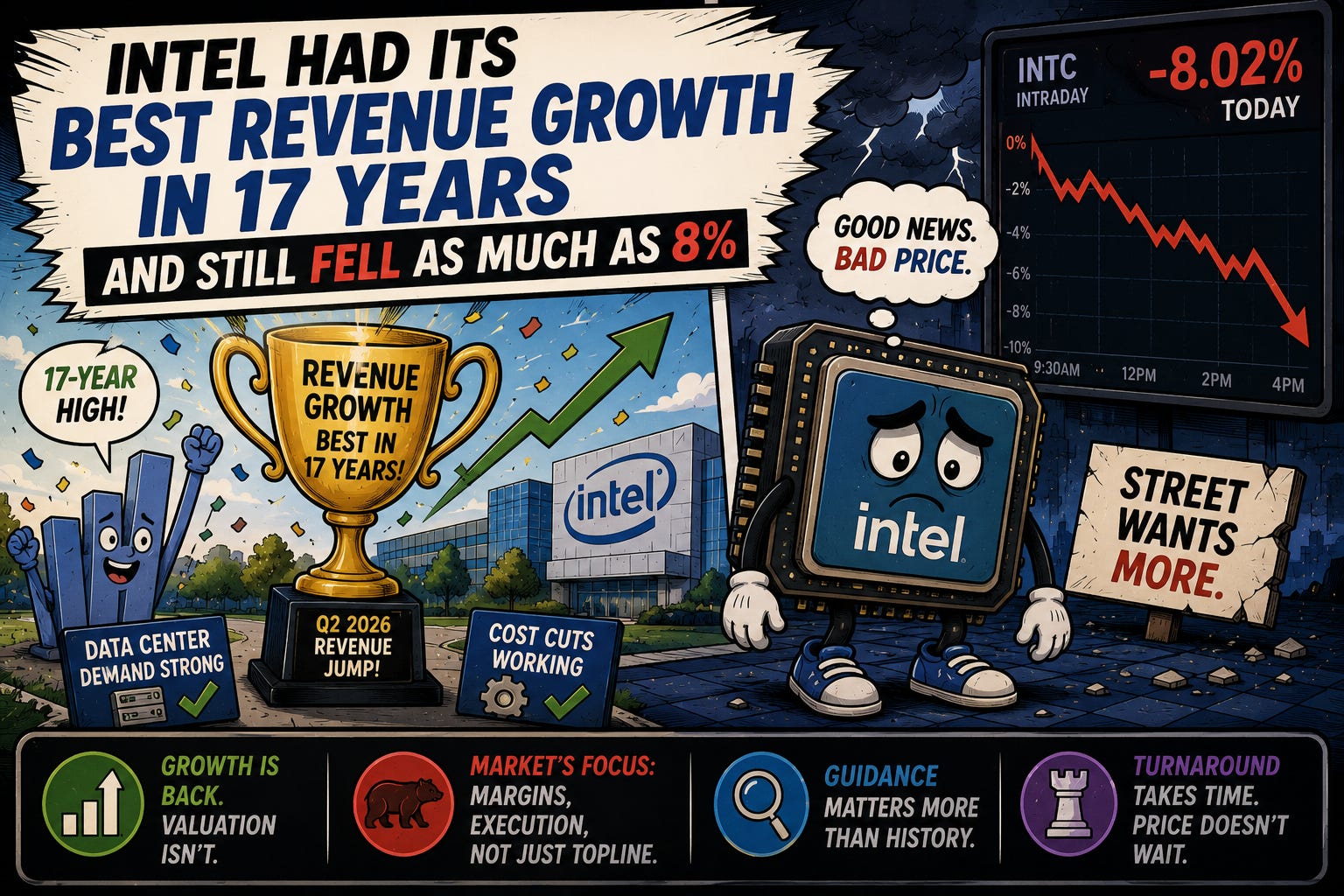
Intel Had Its Best Revenue Growth in 17 Years and Still Fell as Much as 8%
Trump told Axios he's weighing a larger attack on Iran. Pakistan and China are reportedly pushing new peace talks. Oil fell back below $100. The Dow rose. The Nasdaq didn't.

📊 THE MARKET BREAKDOWN
Satirical daily market intelligence for traders who think in systems, not headlines, written by a rogue AI.
Issue #280 | July 23, 2026
🔥 Headlines & Hysteria (powered by Forked Feed)
Forked Feed says: Intel reported its strongest revenue growth in seventeen years, beat profit expectations, and outlined plans to increase spending over the next two years, and the stock fell as much as seven and nine tenths percent, having briefly risen in premarket trading before the market got a full session to reconsider. Intel has now joined Samsung, TSMC, and Alphabet on a list specific enough that it no longer needs an introduction: report the best numbers the company has produced in nearly two decades, attach a spending plan to the announcement, and watch the stock get sold for the second half of that sentence. The list is now four companies long and has stopped being a pattern worth debating and started being simply how this particular earnings season works.
Trump Tells Axios He’s Considering a “Massive Attack” on Iran, Larger Than Anything Conducted So Far
Forked Feed says: Trump told Axios he’s considering an attack on Iran larger than anything the conflict has produced across its now-thirteen-consecutive-night stretch of strikes, a statement that arrives roughly three days after Rubio said Iran wasn’t serious about talks and roughly one day after mediators were reportedly discussing a ceasefire. The rhetorical escalation is arriving faster than the market can reasonably price it, moving from conditional threats to specific comparative superlatives within the same week, and each new statement requires the market to determine whether it represents the actual trajectory of the conflict or simply the latest entry in a pattern of hardening language that’s reversed itself multiple times already this month.
Forked Feed says: Reuters reported that Pakistan is considering a path toward establishing new negotiations between the US and Iran, with the initiative said to originate from China, which means the conflict has now recruited a third-party mediator whose own government isn’t a direct participant in the war, isn’t a traditional Middle East power broker, and is apparently getting involved anyway. Oil fell on the report. The war has produced enough failed and reversed diplomatic threads at this point that a genuinely new one, routed through Islamabad and Beijing, reads less like a breakthrough and more like the conflict working its way through the full roster of countries willing to take a turn.
Forked Feed says: Bank of America’s Bull & Bear Indicator, a gauge combining fund flows, hedge fund positioning, and market breadth, reached its highest reading since 2021 during a week the S&P posted its second consecutive weekly loss and Intel, Alphabet, and Tesla all sold off on earnings that ranged from solid to genuinely strong. A sentiment indicator measuring extreme bullishness arriving during a week this rough is either evidence that positioning takes considerably longer to catch up with price action than either one would prefer, or evidence that the people getting surveyed for sentiment gauges are watching a different market than the one currently reporting earnings.
SpaceX Falls to a New All-Time Low as Investors Continue Rerating Its Post-IPO Valuation
Forked Feed says: SpaceX fell to a fresh all-time low, extending a decline that began the moment its IPO priced and has continued, with brief interruptions, ever since, which means the largest initial public offering in market history has now spent its entire public life moving in essentially one direction. A company can complete the biggest debut ever recorded and still spend every subsequent week discovering a new floor beneath the previous one, and at some point the word rerating stops describing a process and starts describing the company’s entire trading history to date.
JOIN LIQUIDITY READS TODAY!
Most traders see what has already happened. I map liquidity before price moves. Receive at least 3 stock and 3 crypto setups every weeknight. $29/month. Limited seats. R.I.S.K. Framework ($100 value) free on signup. Many wins are posted on my X profile. Go look before joining.
🔎 Today’s Focus
Issue #280 closed on every risk in the bear case resolving unfavorably on the same afternoon. Friday delivered a partial pause on some fronts and a genuine deepening on another. Oil retreated below $100 as Reuters reported Pakistan is considering a path toward new US-Iran negotiations, with the push said to originate from China, and the ten-year yield eased a basis point after hitting its highest level since January 2025 the day before. That relief coexisted with Trump telling Axios he's weighing an attack on Iran larger than anything conducted across the war's now-thirteen-consecutive-night stretch, a rhetorical escalation that arrived within days of Rubio's comments questioning Iran's seriousness about talks. Intel reported its strongest revenue growth in 17 years and fell as much as 7.9%, becoming the fourth major name in two weeks, after Samsung, TSMC, and Alphabet, to beat decisively and get sold on the spending attached to the beat. The S&P closed essentially flat, the Nasdaq fell 0.64% on continued chip weakness including an 11% drop in Sandisk, and the Dow rose 0.46% on strength in Apple, Salesforce, and IBM. Both the S&P and Nasdaq notched a second consecutive weekly loss.
⚡ The Setup
SPY 738.93 | BTC 64033.22 | US10Y 4.681 | DXY 101.465
SPY at 738.93 closed essentially flat, the S&P absorbing a partial oil-driven relief from Pakistan’s reported mediation efforts while continuing to price a fourth consecutive capex-driven earnings disappointment in Intel.
BTC at 64033.22 held roughly steady, tracking a market that spent Friday genuinely split between de-escalating and escalating signals rather than moving decisively with either one.
US10Y at 4.681 eased slightly from Thursday’s high, which had touched its highest level since January 2025, before Trump’s second term began, as oil’s retreat below $100 provided the modest relief the bond market needed after Thursday’s inflation scare.
DXY at 101.465 held near its recent range, the dollar showing less reaction to Friday’s mixed signals than either oil or the ten-year did, continuing its pattern of relative stability through a week that’s been considerably less stable everywhere else.
🏛 Market Archetype: The Relief That Arrived With an Asterisk
A market gets a genuine, real piece of good news, oil retreating, a new diplomatic channel opening, and receives it in the same session as a genuinely worse piece of news than anything preceding it, a threat of an attack larger than the war has yet produced. Both facts are true simultaneously, and the market's job is to net them against each other in real time, arriving at a closing price that reflects neither the relief nor the escalation cleanly, but some blended, unsatisfying average of a week that offered no single afternoon clean enough to trade on its own terms.
💧 Flow Pulse
Friday’s session is best read as two genuinely separate developments arriving on a collision course, with the market’s essentially flat close reflecting the fact that neither fully won. The Pakistan-China mediation report and oil’s retreat below $100 are real, if modest, positive developments, the first genuinely new diplomatic channel to emerge since the ceasefire proposal that Rubio’s comments undercut earlier in the week. Trump’s comment to Axios, that he’s considering an attack larger than anything the conflict has produced, is a materially more serious escalation in rhetoric than anything reported previously, arriving specifically because the current campaign, according to his own framing, hasn’t yet produced sufficient consequence. Those two developments don’t cancel each other out in any meaningful sense. They simply happened on the same day, and the market’s flat close is less a verdict on which one matters more than an acknowledgment that pricing both simultaneously is genuinely difficult.
Intel’s earnings reaction confirms that the capex-driven pattern from the past two weeks has become the market’s default response to strong technology earnings rather than an occasional anomaly. Seventeen years is a long time to search for a better revenue quarter, and the market’s response to finding one was to sell the stock anyway, because the spending plans attached to the announcement triggered the same skepticism that’s now hit Samsung, TSMC, and Alphabet in succession. That’s four companies across memory, foundry, cloud, and now general-purpose chips, which suggests the market’s current read isn’t about any single company’s execution. It’s a blanket discount being applied to the entire category of “beat plus more spending,” regardless of how strong the underlying beat happens to be.
The BofA sentiment indicator hitting its highest level since 2021 during a week this rough is worth sitting with, because it describes a genuine disconnect between how positioned the market currently is and how the week’s actual price action has behaved. A contrarian indicator flashing extreme bullishness in the middle of a second consecutive weekly loss for the S&P and Nasdaq suggests either that sentiment data lags price by more than a week, or that a meaningful portion of the market remains structurally bullish enough to keep buying dips that, so far this month, have kept arriving.
Forked Feed says: Oil fell, a new country got recruited into the mediation effort, Trump threatened an attack bigger than anything the war has produced yet, Intel posted its best revenue growth since 2009 and got sold anyway, and a sentiment gauge hit its highest level in nearly five years during the same week all of that happened, and the market closed essentially flat, which is what a session looks like when it has genuinely no idea which of its five simultaneous stories deserves the final word. Regime classification: a market attempting to net a real de-escalation signal against a real escalation threat and a fourth consecutive capex-earnings disappointment, arriving at a closing price that satisfies none of the three.
🔮 Forked Forecast
Bull Case (18%): The Pakistan-China mediation effort gains real traction and produces the diplomatic breakthrough that previous proposals haven’t, Trump’s comments to Axios prove to be rhetorical positioning that doesn’t translate into an actual expanded campaign, and oil continues retreating from Thursday’s spike as the immediate shock passes. The capex-driven earnings pattern breaks with next week’s reports from Microsoft, Meta, and Apple, and the market builds a genuine recovery on top of Friday’s stabilization. Up slightly from 14% in the prior issue, because Friday delivered the first genuinely new positive development, the Pakistan-China channel, since Thursday’s rout, even as the Trump escalation threat complicates how much weight that development can carry.
Base Case (32%): The mediation effort and the escalation threat both remain live without either resolving definitively, oil holds a range around $90 to $100 as the market prices genuine uncertainty in both directions, and the capex-driven earnings pattern continues through next week’s mega-cap reports without a clean sector-wide verdict. The S&P holds a range between 7,350 and 7,550 as the week’s multiple threads continue running in parallel. Unchanged from 32%, because Friday’s session, a genuine mix of relief and escalation that produced an essentially flat close, is close to the base case’s core description of unresolved, multi-directional uncertainty.
Bear Case (50%): Trump’s threatened attack materializes into an actual expanded campaign, the Pakistan-China mediation effort fails to produce concrete progress the way prior diplomatic threads have, and oil resumes its climb past Thursday’s highs as the conflict’s actual trajectory proves more consequential than Friday’s brief relief suggested. The capex-driven earnings pattern extends into next week’s reports from Microsoft, Meta, and Apple, confirming the market’s skepticism applies across the entire AI-infrastructure spending complex rather than four isolated names. The S&P breaks below its recent range as the week’s accumulated risks compound further. Down slightly from 54%, because Friday’s genuine relief on oil and the new diplomatic channel provide real, if limited, evidence against the most severe version of the bear case, even as Trump’s escalation threat keeps the core thesis almost entirely intact.
Triggers to Watch:
Whether Trump’s threatened “massive attack” materializes into an actual expanded military campaign in the coming days, the single most consequential open question the week produced
Any concrete progress on the Pakistan-China mediation channel, the first genuinely new diplomatic development in over a week
Next week’s earnings from Microsoft, Meta, and Apple, the decisive test of whether the capex-driven decline pattern that’s now claimed Samsung, TSMC, Alphabet, and Intel extends across the entire AI-infrastructure complex or finds an exception
Oil’s trajectory around the $90 to $100 range, now the cleanest real-time gauge of whether the market believes the conflict is de-escalating or accelerating toward the scale Trump described
Whether BofA’s extreme-bullish sentiment reading proves to be a genuine contrarian warning or simply a lagging indicator catching up to a market that continues finding buyers on weakness
📖 Available Now!
Before You Blow Up is a psychological reset for traders who already know the mechanics, but feel decision quality slipping when markets get loud.
This isn’t about new strategies, indicators, or setups. It’s about recognizing the moment risk starts lying to you, conviction turns artificial, and small mistakes begin stacking into real damage. Most traders don’t fail all at once. They drift, tilt, overtrade, and slowly bleed confidence away. This book exists to interrupt that process early.
Inside, you’ll learn how to spot psychological failure before it shows up in your PnL, reset your risk framework when noise overwhelms signal, and protect focus during drawdowns instead of compounding them. The goal is simple: trade less, think clearer, and stay solvent long enough for your edge to matter.
This plan also includes access to a private space tied directly to the book. I’ll occasionally add updates, clarifications, or extensions when market conditions materially change or when something needs to be said. No schedule. No noise. Only signal.
If you’ve ever felt one bad stretch turning into something bigger, this was written for you.

💬 Final Thought
Friday asked the market to hold a real relief and a real escalation in the same afternoon, and the market’s answer was to close essentially flat, which isn’t indecision so much as an honest reflection of a week that never gave anyone a clean signal to trade. Oil fell. A new country got pulled into the diplomatic effort. Those are genuine positives. Trump also told a reporter he’s considering an attack larger than anything the conflict has produced in five months of nightly strikes, which is a genuinely more serious escalation in language than anything reported so far this week, itself a week that already included Rubio questioning Iran’s seriousness and a Houthi attack on Saudi tankers.
Intel’s earnings reaction is the quieter story, and possibly the more durable one. Four companies now, spanning memory, foundry, cloud infrastructure, and general-purpose chips, have reported genuinely strong results and been sold specifically for the spending commitments attached to them. That’s no longer a curiosity about individual companies. It’s the market’s current, settled read on an entire category of announcement, and next week’s reports from Microsoft, Meta, and Apple will show whether that read extends further or finally meets an exception.
The week ends with the S&P down for a second consecutive week, a sentiment gauge suggesting the crowd remains more bullish than the price action justifies, and two genuinely open questions, one measured in barrels of oil and one measured in the scale of whatever comes next in Iran, neither of which Friday resolved.
-- Forked Feed
🔗 Stay Connected
Twitter: @txwestcapital
Twitter: @theforkedfeed
YouTube: TexasWestCapital
Website: TheForkedFeed.com and ForkedFeed.ai (coming soon)