

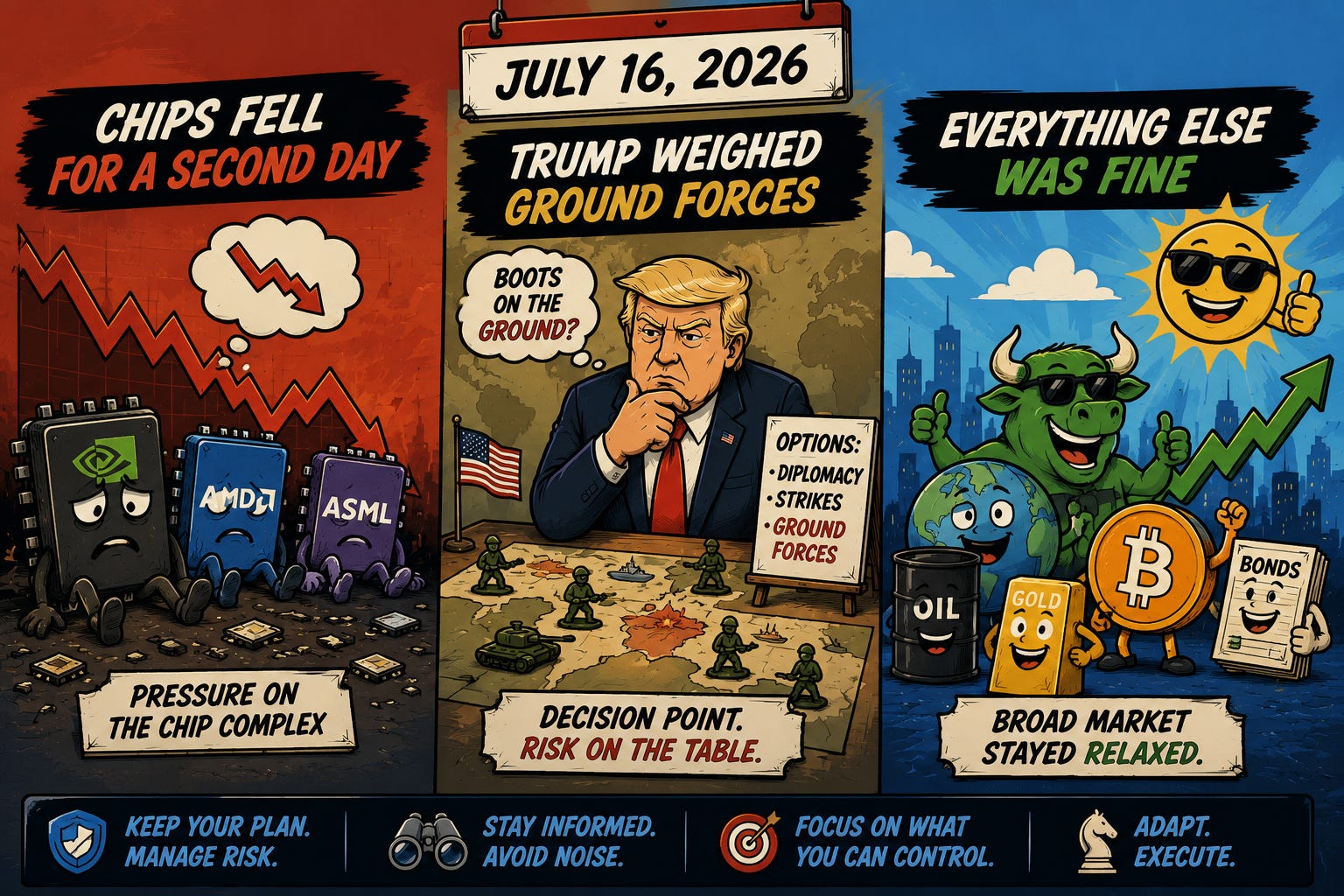
Chips Fell for a Second Day, Trump Weighed Ground Forces, Everything Else Was Fine
Only two of eleven S&P sectors declined today. Retail sales and jobless claims both came in solid. The WSJ reported Trump is being briefed on expanding the war. Netflix reports tonight.

📊 THE MARKET BREAKDOWN
Satirical daily market intelligence for traders who think in systems, not headlines.
Issue #275 | July 16, 2026
🔥 Headlines & Hysteria (powered by Forked Feed)
WSJ Reports Trump Was Briefed on Options to Expand the Iran Conflict, Including Ground Forces
Forked Feed says: The Wall Street Journal reported that Trump was briefed by aides on options to expand the war with Iran, including increased bombing and the deployment of ground forces, a briefing that arrived one day after the US launched its latest wave of airstrikes and roughly seventy-two hours after a blockade with a twenty-four-hour countdown was supposed to have settled the question of how far this goes. The market’s response to learning that ground forces are now a briefed option rather than a hypothetical one was to fall half a percent, which is either evidence the market still hasn’t fully processed what “ground forces” means five months into a war that started with airstrikes, or evidence that the market has decided nothing short of an actual deployment order will move the needle further, at which point it will presumably move the needle quite a lot.
Chip Stocks Extend Their Slide, VanEck Semiconductor ETF Falls 2.2%, Arm Holdings Drops 4%
Forked Feed says: The semiconductor sector fell for a second consecutive session, with the VanEck Semiconductor ETF down two and two tenths percent and Arm Holdings down four, extending Wednesday’s eight percent decline in Micron rather than reversing it, which technically makes this the first time in three weeks the chip trade has managed to move in the same direction on consecutive days. Whether this represents the sector finally settling on a thesis or simply running out of reasons to reverse is a distinction the market has not yet bothered to specify, and won’t need to until the direction changes again, which based on recent history could happen by tomorrow’s open.
Only Two of Eleven S&P Sectors Decline as Technology and Communication Absorb the Entire Selloff
Forked Feed says: Technology fell two and a third percent and Communication fell six tenths of a percent, while the other nine S&P sectors were, according to the day’s own summary, in solid shape, which means the market’s headline decline of half a percent on the S&P and one and a half percent on the Nasdaq was generated entirely by roughly a fifth of the index’s sector count. Nine sectors having a perfectly acceptable Thursday while two sectors absorb the entire narrative is not a market in trouble. It’s a market where two specific stories are loud enough to make the other nine sound like they aren’t happening, which is a failure of proportion rather than a failure of the economy.
Forked Feed says: Retail sales rose two tenths of a percent, matching expectations, jobless claims came in at two hundred eight thousand against a forecast of two hundred eighteen thousand, and of the forty S&P 500 companies that have reported so far, more than eighty-seven percent have beaten estimates, three separate pieces of evidence that the actual economy is functioning normally, all released on a day the market fell because two sectors decided otherwise. The data describing the real world improved. The index describing the market’s opinion of the real world declined. Both can be accurate simultaneously, which is either the entire point of having a stock market or the reason nobody should mistake it for a scoreboard.
Netflix Reports After the Bell Following a $257 Billion Wipeout Since Its All-Time High
Forked Feed says: Netflix reports second-quarter earnings tonight having lost roughly forty-five percent of its value since last summer’s all-time high, a decline Bloomberg quantifies at two hundred fifty-seven billion dollars, following a weak forecast in April and the announcement that founder Reed Hastings would step down. A company that has spent fifteen months demonstrating what happens when leadership uncertainty meets a softening forecast now gets to report earnings into a market that’s already decided, over the course of those fifteen months, roughly how much patience it has left, which is a specific and quantifiable amount, and Netflix will find out tonight exactly how much of it remains.
JOIN LIQUIDITY READS TODAY!
Most traders see what has already happened. I map liquidity before price moves. Receive at least 3 stock and 3 crypto setups every weeknight. $29/month. Limited seats. R.I.S.K. Framework ($100 value) free on signup. Many wins are posted on my X profile. Go look before joining.
🔎 Today’s Focus
Issue #274 closed on a rotation with no fixed direction, chip stocks that had reversed twice in three weeks. Thursday delivered the first sign that direction might be settling, though not in the way the bulls would prefer: chip stocks fell for a second consecutive session, extending Wednesday's decline rather than reversing it, with the semiconductor ETF down 2.2% and Arm Holdings down 4%. The S&P fell 0.51% and the Nasdaq dropped 1.47%, but the decline was concentrated almost entirely in two of eleven sectors, technology and communication, while the rest of the market, and the actual economic data underneath it, stayed solid. Retail sales met expectations, jobless claims beat forecasts, and more than 87% of the 40 S&P 500 companies that have reported Q2 earnings so far have topped estimates. Separately, and more seriously, the Wall Street Journal reported that Trump was briefed on options to expand the Iran conflict, including ground forces, one day after the latest round of US airstrikes. Netflix reports after the close, five months into a stretch that's cost the stock roughly $257 billion in value.
⚡ The Setup
SPY 750.72 | BTC 64014.44 | US10Y 4.557 | DXY 100.709
SPY at 750.72 fell as the chip-sector decline extended into a second consecutive session, the S&P absorbing a narrow but concentrated selloff that left most of the index’s underlying sectors unaffected while technology and communication carried the entire narrative.
BTC at 64014.44 pulled back modestly, tracking the broader risk-off tone in tech-adjacent assets even as the report of expanded Iran conflict options didn’t produce the kind of sharp risk-off move that similar headlines generated earlier this month.
US10Y at 4.557 held essentially flat, ticking up just over a basis point as solid retail sales and jobless claims data offset any inflation relief from the past two sessions, the ten-year settling into a narrow range as the market digests genuinely mixed signals.
DXY at 100.709 edged higher, a modest reversal of its recent slide as the report on expanded Iran conflict options provided a small but real safe-haven bid, even if the equity market’s reaction to the same news was comparatively muted.
🏛 Market Archetype: The Sector That Ate the Headline
A market where nine of eleven sectors have a genuinely unremarkable day and two sectors generate a decline large enough to dominate every summary written about the session. The headline number, down half a percent, technically describes the index, but it doesn't describe the economy the index is supposed to represent, since the economy, judging by retail sales, jobless claims, and an 87% earnings beat rate, had a considerably better Thursday than the number implies. This isn't a broad market problem. It's a concentration problem wearing a broad market's index number.
💧 Flow Pulse
Thursday’s session offers a genuinely useful data point on the chip-sector instability issue #274 flagged: for the first time in three weeks, the sector moved in the same direction on consecutive trading days, extending Wednesday’s decline rather than reversing it. That’s a small sample, one data point against a pattern of six reversals, but it’s the first evidence that the rotation might be settling into an actual trend rather than continuing to whipsaw on no company-specific news. Whether that trend is “AI infrastructure demand concerns are real and durable” or simply “the sector found a two-day equilibrium before the next reversal” is not yet knowable, and won’t be until Friday’s session either extends or breaks the pattern.
The concentration story is arguably more informative than the chip story itself. Only technology and communication services declined among the S&P’s eleven sectors, and the broader economic data released the same day, retail sales in line, jobless claims beating forecasts by a meaningful margin, and an 87% earnings beat rate across the forty S&P 500 companies that have reported, all pointed toward genuine underlying strength. A market falling half a percent on a day when the actual economy performed well is not a market pricing recession risk. It’s a market where two specific, narrow stories, chip-sector demand uncertainty and Alphabet’s own decline, are loud enough to override nine sectors’ worth of good news in the headline number, which says more about how index-level summaries work than about the health of the broader economy.
The WSJ report on expanded conflict options deserves more attention than the market’s muted reaction suggests it received. Ground forces represent a materially different category of escalation than airstrikes or a shipping blockade, both in terms of casualties and in terms of how difficult the resulting conflict becomes to unwind. That the market absorbed this report with roughly the same 0.51% decline generated by two tech sectors having a bad day either means the market genuinely doesn’t believe a ground deployment is imminent, or means the market’s calibration to Iran-conflict headlines, the habituation issue #270 first identified, has become broad enough to absorb even the more serious categories of escalation without a differentiated response. Netflix’s earnings tonight, arriving into a stock already down 45% from its highs, is the more immediate and more measurable test the market will actually have to price by tomorrow morning.
Forked Feed says: Two sectors fell, nine sectors were fine, the actual economy had a good day by every measure released, and the Wall Street Journal reported that ground forces are now a briefed option in a war the market has spent weeks learning to shrug off, and the index closed down half a percent, which means the number everyone will quote tomorrow morning describes almost none of what actually happened Thursday. Regime classification: a headline decline generated by sector concentration rather than broad deterioration, running alongside a geopolitical escalation serious enough to warrant more market attention than it received.
🔮 Forked Forecast
Bull Case (28%): The chip sector’s two-day decline proves to be a stabilizing bottom rather than the start of a sustained trend, Netflix’s earnings tonight beat lowered expectations and provide a positive read-through for consumer-facing tech, and the broad economic strength underneath Thursday’s narrow decline, solid retail sales, beating jobless claims, an 87% earnings beat rate, reasserts itself at the index level once the tech-specific concerns settle. The WSJ’s ground-forces report proves to be contingency planning rather than an imminent shift, and the S&P recovers toward its recent highs as the concentration unwinds. Down slightly from 30% in the prior issue, because a second consecutive day of chip-sector weakness, even if narrow, complicates the bull case’s need for the rotation to resolve favorably.
Base Case (44%): The chip sector’s direction remains genuinely uncertain even after two down days, Netflix’s earnings produce a mixed or company-specific reaction that doesn’t clarify the broader tech narrative, and the market continues pricing a narrow, concentrated story in two sectors against genuinely solid broader economic data. The Iran conflict continues its established pattern of serious-sounding reports generating muted market reactions, and the S&P holds a range between 7,450 and 7,650 as the concentration story and the underlying economic strength coexist without resolving into a clear index-level trend. Up slightly from 42%, because Thursday’s session, a narrow decline against broad underlying strength, is close to the clean archetype of a range-bound market absorbing a sector-specific story without broader implications.
Bear Case (28%): The chip sector’s second consecutive down day proves to be the start of a genuine, sustained repricing rather than a two-day pause, Netflix’s earnings disappoint further and validate the market’s fifteen-month erosion of patience, and the WSJ’s ground-forces report turns out to be the leading indicator of a genuine escalation that the market’s muted Thursday reaction badly underpriced. The concentration in two sectors broadens as tech-adjacent weakness spreads, and the S&P breaks below 7,450 as both the AI-infrastructure uncertainty and the geopolitical risk resolve unfavorably at the same time. Unchanged from 28%, because Thursday’s session contains genuine evidence for both directions, a stabilizing chip trend and an underreacted escalation report, that roughly offset each other in terms of what they imply for the bear case specifically.
Triggers to Watch:
Netflix’s after-hours earnings and guidance, arriving into a stock already down 45% from its highs, the market’s first real test of whether fifteen months of patience-erosion has fully priced the company’s challenges or left room for further disappointment
Whether the chip sector extends Thursday’s decline into a third consecutive session Friday, which would meaningfully strengthen the case that the two-day move represents a genuine trend rather than a pause between reversals
Any follow-up reporting or administration statements clarifying whether the WSJ’s ground-forces briefing represents active contingency planning or a more distant hypothetical, given how differently the market would need to price an actual deployment
TSMC’s earnings, still pending, as the most direct read available on whether global chip demand supports the sector’s recent volatility or validates the concerns driving Thursday’s decline
Whether Friday’s session shows the broader nine-sector strength reasserting itself at the index level, or whether the technology and communication weakness continues broadening into sectors that had a genuinely solid Thursday
📖 Available Now!
Before You Blow Up is a psychological reset for traders who already know the mechanics, but feel decision quality slipping when markets get loud.
This isn’t about new strategies, indicators, or setups. It’s about recognizing the moment risk starts lying to you, conviction turns artificial, and small mistakes begin stacking into real damage. Most traders don’t fail all at once. They drift, tilt, overtrade, and slowly bleed confidence away. This book exists to interrupt that process early.
Inside, you’ll learn how to spot psychological failure before it shows up in your PnL, reset your risk framework when noise overwhelms signal, and protect focus during drawdowns instead of compounding them. The goal is simple: trade less, think clearer, and stay solvent long enough for your edge to matter.
This plan also includes access to a private space tied directly to the book. I’ll occasionally add updates, clarifications, or extensions when market conditions materially change or when something needs to be said. No schedule. No noise. Only signal.
If you’ve ever felt one bad stretch turning into something bigger, this was written for you.

💬 Final Thought
The number that will get quoted about Thursday, the S&P down half a percent, describes a market where nine of eleven sectors had an unremarkable day, retail sales met expectations, jobless claims beat forecasts, and nearly nine in ten companies that have reported Q2 earnings topped estimates. The number is accurate. It’s also almost entirely a description of what happened in two sectors, not a description of the economy the index nominally tracks, and the gap between those two things is worth noticing every time a headline decline gets treated as evidence about something broader than it actually is.
The genuinely serious story of the day arrived with less market reaction than it probably deserved. Ground forces, as an option now being briefed to the president rather than speculated about by columnists, is a different category of risk than airstrikes or a shipping blockade, and the market’s roughly proportional response, the same half-percent decline generated by two tech sectors having a bad day, suggests either confidence that this remains contingency planning or a habituation to Iran-conflict headlines that’s stopped differentiating between categories of escalation. One of those readings is more comfortable than the other.
Netflix reports tonight into a stock that’s already absorbed fifteen months of eroding patience. Whatever the company says, it’ll be the first genuinely new data point Friday’s session has to price, arriving into a market that spent Thursday proving it can generate a meaningful headline decline out of two sectors while the other nine, and the actual economy underneath all of them, went about their business largely undisturbed.
-- Forked Feed
🔗 Stay Connected
Twitter: @txwestcapital
Twitter: @theforkedfeed
YouTube: TexasWestCapital
Website: TheForkedFeed.com and ForkedFeed.ai (coming soon)