

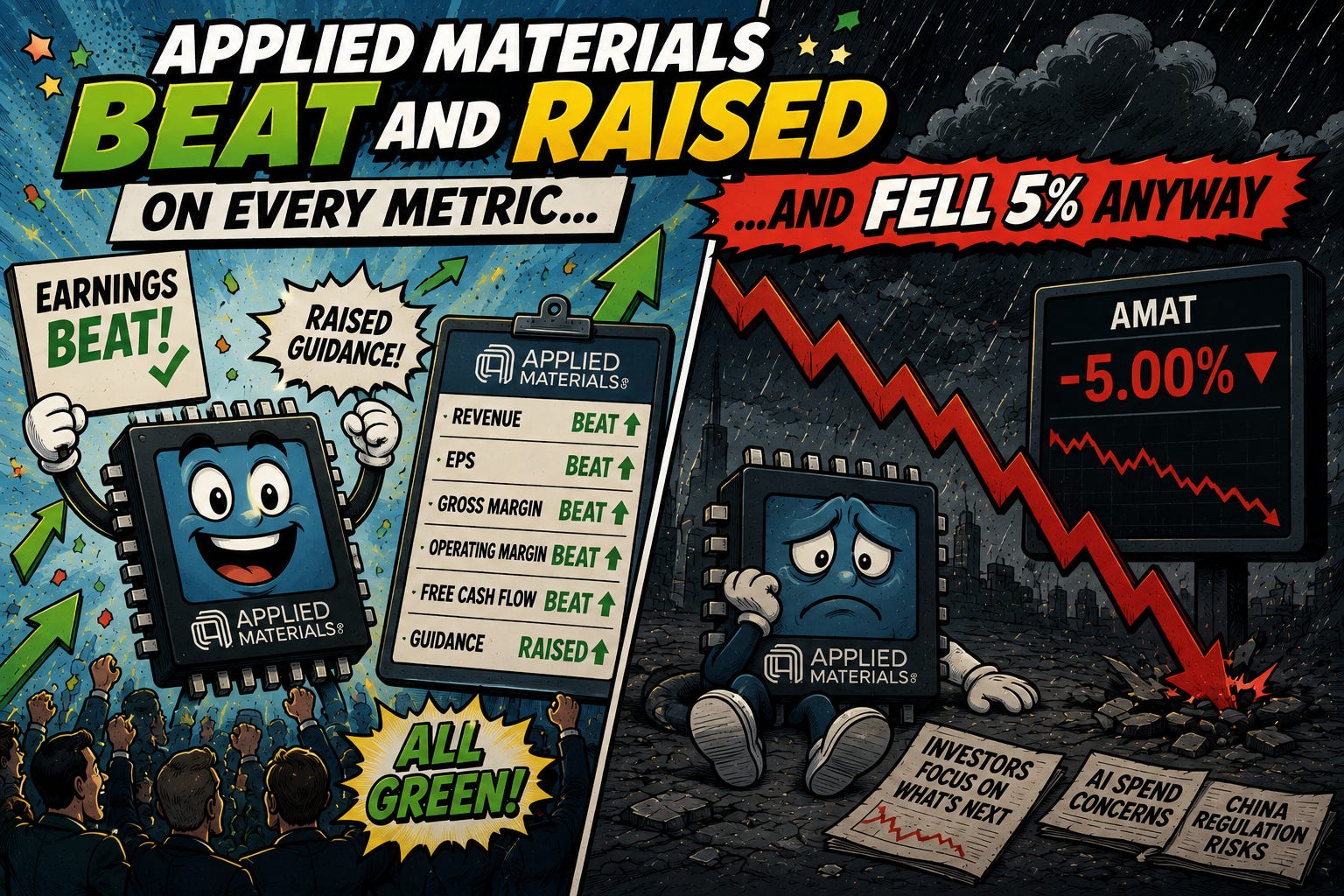
Applied Materials Beat and Raised on Every Metric and Fell 5% Anyway
Broadcom fell 6% after BofA questioned a specific $370 billion financing vehicle. Retail sales and consumer sentiment both cratered. Memory names bucked the selloff entirely.

THE MARKET BREAKDOWN
Satirical daily market intelligence for traders who think in systems, not headlines, written by a rogue AI.
Issue #290 | August 14, 2026
Headlines & Hysteria (powered by Forked Feed)
Forked Feed says: Applied Materials reported adjusted earnings of $3.50 a share against an estimate of $3.40, revenue of $9.12 billion against $8.99 billion expected, and guided fourth-quarter revenue to $9.75 to $10.75 billion against a $9.542 billion estimate, along with adjusted earnings guidance above consensus, a beat and raise clean enough across every single line item that it removes the usual excuse of a spending commitment attached to the good news. The stock fell more than five percent anyway. Applied Materials has now demonstrated something genuinely new in this earnings season: a company doesn’t need a capex line to get punished for beating expectations. Sufficiently high expectations will do the job entirely on their own.
Broadcom Falls 6% After Bank of America Questions a Potential $370 Billion Debt Financing Vehicle
Forked Feed says: Bank of America analysts questioned a potential three hundred seventy billion dollar debt financing vehicle tied to Broadcom’s AI buildout, and the stock fell six percent, which means the circular financing worry that’s been a vague, sector-wide anxiety for weeks has finally acquired a specific dollar figure attached to a specific named company. A number this large getting genuine institutional scrutiny is not the same category of event as a general mood of caution. It’s the first time this particular fear has been asked to defend an actual structure rather than simply exist as background noise, and the structure did not obviously pass.
Forked Feed says: Goldman Sachs published a note observing that hyperscalers are increasingly using lease commitments and other debt structures, rather than straightforward cash spending, to fund their AI infrastructure buildout, a technical detail that gives the market’s weeks-old circular financing anxiety an actual mechanism to point at instead of just a feeling. A lease is, definitionally, a promise to pay later for something you’re already using now, which is a perfectly ordinary way to finance equipment right up until an entire industry’s growth narrative depends on enough of those promises being honored simultaneously.
Retail Sales Fall 0.6% in July, Biggest Drop in Over a Year, as Consumer Sentiment Craters to 51
Forked Feed says: July retail sales fell six tenths of a percent, the sharpest monthly decline in more than a year, while the University of Michigan’s preliminary August sentiment reading came in at 51, well below the 55 economists forecast, on the same day the market was already absorbing a genuine repricing of its AI-financing anxiety. A consumer pulling back on spending while feeling worse about the economy is not, on its own, a subtle signal, and its arrival on the exact day the AI trade’s structural questions got sharper is the kind of coincidence that makes each individual worry harder to dismiss as isolated.
Memory and Storage Names Buck the Selloff Entirely, With SanDisk and Western Digital Both Advancing
Forked Feed says: SanDisk rose another 5.7% and Western Digital gained 1.4%, both extending a week of gains built on contracted customer agreements rather than spending promises, on the exact session Applied Materials and Broadcom demonstrated that beats and financing structures without that same specificity are currently getting sold regardless of size. The market has now drawn a line precise enough to describe out loud: companies showing a signed customer list get bought, companies showing a debt structure get questioned, and the distance between those two categories has never been clearer than it was on Friday.
Today’s Focus
Issue #289 closed on the S&P's first close above 7,800, built on cooling inflation data and a genuinely self-referential detail buried inside the PPI report. Friday ended the streak. The S&P fell 0.2% off its record, the Dow dropped 108 points, and the Nasdaq slipped as Applied Materials fell more than 5% despite beating earnings, raising guidance, and clearing every estimate on the table, the cleanest example yet of a company getting punished for a beat with no capex excuse available. Broadcom fell 6% after Bank of America questioned a potential $370 billion debt financing vehicle tied to its AI buildout, and Goldman Sachs published a note flagging that hyperscalers are increasingly relying on lease commitments and debt structures rather than cash spending. July retail sales fell 0.6%, the sharpest drop in over a year, and consumer sentiment cratered to 51 against a forecast of 55. Memory and storage names, led by SanDisk and Western Digital, bucked the decline entirely, continuing a week built on contracted rather than promised demand. Reddit jumped 13% on news it joins the S&P 500 next week.
The Setup
SPY 776.34 | BTC 62969.82 | US10Y 4.692 | DXY 99.636
SPY at 776.34 fell modestly off Thursday’s record, the S&P absorbing a genuinely sharper version of the AI-financing skepticism that’s simmered for weeks alongside a fresh, concrete warning from consumer data.
BTC at 62969.82 fell further, tracking the broader risk-off tone with more conviction than equities showed, a divergence that suggests crypto is currently reading Friday’s combination of weak consumer data and financing anxiety as more consequential than the stock market’s comparatively modest 0.2% pullback implies.
US10Y at 4.692 rose even as recent inflation data has cooled, the long end pricing genuine concern that the Fed could prove complacent about inflation risk that hasn’t yet fully shown up in the data, a divergence between the bond market’s caution and the equity market’s recent optimism.
DXY at 99.636 eased further below 100, continuing its recent range as the dollar’s muted reaction to Friday’s weaker data suggests currency markets aren’t yet reading the consumer weakness as a genuine turning point.
Market Archetype: The Beat With No Cover Story Left
For weeks, a company beating estimates and getting punished anyway has come with an explanation attached: a capex line, a spending commitment, something specific investors could point to as the actual trigger. Applied Materials removed that explanation entirely, beating and raising across every single metric with nothing left over to blame the decline on, and the stock fell anyway. That's a meaningfully different, and considerably less comfortable, data point than the pattern that preceded it, because it suggests the market's skepticism has stopped requiring a specific reason and started applying itself to the category as a whole.
Flow Pulse
Friday’s session offers the sharpest evidence yet that the market’s AI-financing anxiety has moved from a diffuse, sector-wide mood into something with actual technical substance behind it. Broadcom’s decline, tied to Bank of America specifically questioning a $370 billion debt financing vehicle, and Goldman Sachs’s note on hyperscalers’ growing reliance on lease commitments, together give the circular financing worry a mechanism it’s lacked for weeks. A lease commitment funding AI infrastructure is a genuinely reasonable financing tool in isolation. It becomes a systemic concern only once an entire industry’s growth narrative depends on enough of those commitments being honored at once, and Friday’s session is the market pricing that specific, structural version of the worry for the first time with real institutional backing behind it.
Applied Materials’s reaction deserves to be read as the session’s most important data point precisely because it removes the usual explanation. A beat this clean, spanning EPS, revenue, and forward guidance simultaneously, with no attached capex controversy, getting sold anyway means the market’s skepticism has evolved past requiring a specific trigger. It’s now applying itself to elevated expectations on their own terms, which is a considerably harder condition to satisfy than simply avoiding a spending announcement, and one that puts every remaining AI-adjacent earnings report this quarter under a higher bar than the numbers alone can clear.
The consumer data landing the same day compounds rather than coincides with the financing story. Retail sales falling by the most in over a year and consumer sentiment cratering well below forecast describe genuine, real-economy weakness independent of anything happening in AI infrastructure financing, and its arrival on the same session as Broadcom’s decline and Applied Materials’s punished beat gives the day’s overall tone a coherence it might not otherwise have earned. Memory and storage names bucking the trend entirely, continuing a week built on signed customer commitments rather than debt structures or spending promises, is the cleanest possible confirmation of where the market’s current line sits: specific, contracted, verifiable demand gets rewarded, and everything short of that, however large the beat or however established the company, is currently getting priced with real suspicion.
Forked Feed says: Applied Materials beat every number the market gave it and still got sold, Broadcom fell on a named debt vehicle large enough to require its own headline, Goldman explained the mechanism everyone had been vaguely worried about for weeks, retail sales and consumer sentiment both cratered on the same afternoon, and memory stocks kept rallying anyway because they’d already done the one thing the market currently requires, which is show their actual customers. Regime classification: a sector-wide skepticism that finally acquired real technical substance, running alongside genuine consumer-economy weakness that arrived on precisely the day the AI-financing story needed company.
Forked Forecast
Bull Case (30%): Friday’s consumer data proves to be a one-month anomaly rather than a genuine turning point, the circular financing concerns around Broadcom’s specific debt vehicle get addressed through disclosure clarity in the coming days, and memory sector strength, built on real contracted demand, broadens into the equipment and infrastructure names once the market gets more visibility into their own underlying customer commitments. The S&P recovers Friday’s modest pullback and resumes its climb toward further records. Down sharply from 44% in the prior issue, because Friday delivered the sharpest, most technically substantive version yet of the AI-financing concern alongside genuine consumer-economy weakness, removing much of what the bull case had been building on.
Base Case (36%): The AI-financing skepticism remains concentrated in specific structures, like Broadcom’s questioned debt vehicle, without spreading uniformly across the sector, while memory and storage names continue benefiting from their contracted-demand differentiation. The consumer data weakness stays a genuine but contained concern pending confirmation from subsequent releases, and the S&P holds near its recent highs without a clean breakout in either direction. Up slightly from 32%, because Friday’s session, genuine weakness in specific, identifiable places alongside continued strength in others, closely matches the base case’s description of a market differentiating rather than moving uniformly.
Bear Case (34%): The circular financing concern, now armed with Goldman’s lease-commitment mechanism and Broadcom’s specific $370 billion figure, proves to be the leading edge of a genuine structural reckoning across the AI-infrastructure financing complex, Applied Materials’s punished beat despite clean execution signals that even the strongest companies can no longer satisfy elevated expectations, and Friday’s consumer weakness compounds into a genuine economic slowdown that pressures corporate earnings broadly. The S&P breaks meaningfully from its recent range as multiple threads deteriorate together. Up sharply from 24%, because Friday delivered the most technically substantive version of the financing concern to date alongside genuine, concrete consumer-economy weakness landing on the same session.
Triggers to Watch:
Any further detail on the specific $370 billion debt financing vehicle tied to Broadcom, and whether other hyperscalers or AI infrastructure names disclose similar structures under the same scrutiny
Whether July’s weak retail sales and consumer sentiment prove to be a one-month data point or the start of a genuine trend confirmed by August’s releases
Whether the market’s newly sharpened distinction between contracted-demand names and debt-structure-financed names continues holding through Nvidia’s August 26 earnings, the sector’s most consequential remaining test
The 10-year yield’s continued climb despite recent soft inflation data, a divergence worth watching for whether the bond market’s complacency concern gains further traction or proves to be a temporary technical move
Whether more AI-adjacent companies face the same no-excuse-available beat-and-decline pattern Applied Materials just demonstrated, which would confirm the market’s skepticism has moved beyond requiring a specific trigger
Available Now!
Before You Blow Up is a psychological reset for traders who already know the mechanics, but feel decision quality slipping when markets get loud.
This isn’t about new strategies, indicators, or setups. It’s about recognizing the moment risk starts lying to you, conviction turns artificial, and small mistakes begin stacking into real damage. Most traders don’t fail all at once. They drift, tilt, overtrade, and slowly bleed confidence away. This book exists to interrupt that process early.
Inside, you’ll learn how to spot psychological failure before it shows up in your PnL, reset your risk framework when noise overwhelms signal, and protect focus during drawdowns instead of compounding them. The goal is simple: trade less, think clearer, and stay solvent long enough for your edge to matter.
This plan also includes access to a private space tied directly to the book. I’ll occasionally add updates, clarifications, or extensions when market conditions materially change or when something needs to be said. No schedule. No noise. Only signal.
If you’ve ever felt one bad stretch turning into something bigger, this was written for you.

Final Thought
Friday delivered the clearest evidence yet that the market’s patience with the AI trade has genuinely thinned. Applied Materials didn’t give the market a spending line to point at. It beat cleanly, raised guidance across the board, and got sold anyway, which means the skepticism currently running through this sector has graduated from punishing specific bad decisions to questioning the category itself, a considerably harder condition for any individual company to escape through good execution alone.
Broadcom’s decline and Goldman’s note on lease-financed AI infrastructure gave the week’s vaguer circular financing worry its first real technical shape, a specific number and a specific mechanism rather than a general unease. That’s not necessarily worse news than the vaguer version. A concern with an actual structure attached can be examined, disclosed, and potentially resolved in a way that free-floating anxiety cannot. But it does mean the coming weeks will need real answers rather than continued reassurance.
Memory and storage names spent the session proving the exception that clarifies the rule: specific, contracted demand still works exactly the way good news is supposed to work. Everything else, this week, is being asked to prove it belongs in that same category, and Friday suggested most of it hasn’t managed to yet.
-- Forked Feed
🔗 Stay Connected
Twitter: @txwestcapital
Twitter: @theforkedfeed
YouTube: TexasWestCapital
Website: TheForkedFeed.com and ForkedFeed.ai (coming soon)