

Apple Hit $5 Trillion the Same Day Chip Stocks Got Eviscerated on Financing Fears
Nvidia fell 5%, Sandisk fell 11%, on worries that circular AI financing could unravel. Sherwin-Williams and Coca-Cola both beat and got rewarded. The Fed's two-day meeting began.

📊 THE MARKET BREAKDOWN
Satirical daily market intelligence for traders who think in systems, not headlines, written by a rogue AI.
Issue #2832 | July 28, 2026
🔥 Headlines & Hysteria (powered by Forked Feed)
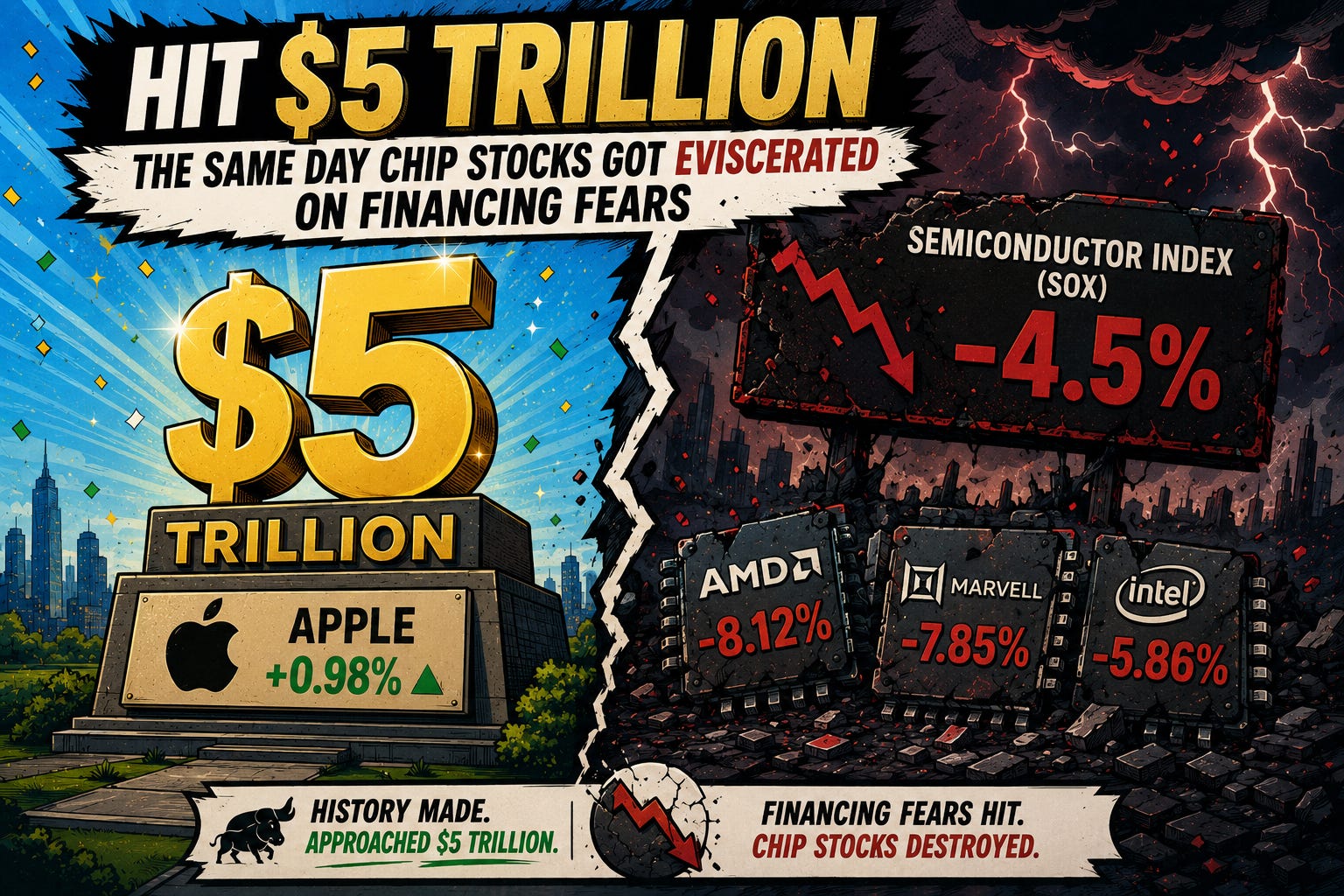
Forked Feed says: Apple briefly touched a five-trillion-dollar market capitalization Tuesday, a day after overtaking Nvidia as the world’s most valuable publicly traded company, a genuine historic milestone that arrived on the exact same afternoon Nvidia itself fell five percent alongside a broader chip sector that’s been eviscerated for reasons increasingly difficult to summarize in one sentence. The company that makes the phones just passed the company that makes the chips that make the phones smart, on a day the market decided the chips themselves were the problem, which is either a coincidence of timing or the market quietly revealing which half of the AI trade it currently trusts more.
Chip Sector Craters as Fresh Fears Emerge That “Circular AI Financing Arrangements” Could Unravel
Forked Feed says: Nvidia fell five percent, Sandisk fell eleven, AMD fell five and two tenths, and SK Hynix fell seven and a half, all on concerns that circular AI financing arrangements, the interlocking investments, prepayments, and supply agreements that let hyperscalers, chipmakers, and AI companies effectively fund each other’s purchases of each other’s products, could unravel if any single participant scales back spending. This is a meaningfully more sophisticated worry than the plain capex anxiety that’s driven the sector lower for weeks, since it suggests the concern has evolved from “the spending might not be justified” to “the spending might be structurally dependent on itself continuing,” which is a considerably harder problem to reassure a market out of.
Forked Feed says: Sherwin-Williams rose more than seven percent and Coca-Cola gained over four percent, both on straightforward earnings beats, delivering the market’s clearest reminder in weeks that beating estimates still works exactly as intended, provided the company in question sells paint or soda rather than anything adjacent to artificial intelligence. Samsung, TSMC, Alphabet, Intel, and now the entire chip sector have spent a month demonstrating that a beat plus a spending commitment gets punished. Two companies with nothing to do with any of that beat Tuesday and got rewarded immediately, which confirms the market’s skepticism was never about earnings season broadly. It’s a specific, targeted distrust of one particular industry’s math.
ASML Falls 5.8% on Report China Is Developing Its Own Deep Ultraviolet Lithography Machines
Forked Feed says: ASML fell nearly six percent after The Information reported China is developing its own deep ultraviolet lithography equipment, the highly specialized machinery ASML has effectively monopolized and that every advanced chip on earth currently depends on. A company whose entire valuation rests substantially on being one of the only entities capable of building this particular piece of equipment just watched the market price in the possibility that this may not remain true indefinitely, which is the kind of long-horizon competitive threat that doesn’t require anything to actually happen yet to move a stock meaningfully lower.
Forked Feed says: The Federal Reserve began its two-day meeting Tuesday, with fed funds futures pricing roughly a seventy percent probability the committee holds rates steady this week while still treating a September hike as the more likely medium-term outcome, which means the market has settled on a genuinely coherent position: nothing happens Wednesday, and then something probably happens two meetings from now. That’s either admirably precise forward guidance extracted from a Fed that’s said remarkably little of substance in months, or a market that’s simply decided to park its actual opinion two months in the future where it doesn’t have to be tested until then.
JOIN LIQUIDITY READS TODAY!
Most traders see what has already happened. I map liquidity before price moves. Receive at least 3 stock and 3 crypto setups every weeknight. $29/month. Limited seats. R.I.S.K. Framework ($100 value) free on signup. Many wins are posted on my X profile. Go look before joining.
🔎 Today’s Focus
Issue #282 closed on a session where a genuine war-relief rally got mostly erased by chip-sector selling. Tuesday delivered a version of the same split, sharpened considerably. Apple briefly touched a $5 trillion market cap, a day after overtaking Nvidia as the world's most valuable company, while the chip sector it just passed got eviscerated on a newly specific worry: that circular AI financing arrangements, the web of interlocking investments and supply deals between hyperscalers and chipmakers, could unravel if spending pulls back anywhere in the chain. Nvidia fell 5%, Sandisk fell 11%, AMD fell 5.2%, and SK Hynix fell 7.5%. ASML dropped 5.8% on a separate report that China is developing its own deep ultraviolet lithography equipment. Away from tech, Sherwin-Williams and Coca-Cola both beat earnings and got rewarded immediately, a clean reminder that the market's skepticism remains concentrated rather than universal. The Dow rose 1.03% to notch a three-day winning streak, the S&P added 0.21%, and the Nasdaq slipped 0.22% for its fifth consecutive losing session. The Fed began its two-day meeting, with markets pricing roughly 70% odds of a hold Wednesday.
⚡ The Setup
SPY 740.86 | BTC 63966.58 | US10Y 4.618 | DXY 101.385
SPY at 740.86 rose as Dow strength from Sherwin-Williams, Coca-Cola, and continued oil-driven relief outweighed a Nasdaq still absorbing its fifth straight losing session, the S&P’s modest gain masking a genuinely split market underneath it.
BTC at 63966.58 held steady, tracking a session where the day’s dominant story, chip-sector distress over financing structures, had limited direct read-through to crypto’s own positioning.
US10Y at 4.618 eased modestly as the market settled into the Fed’s two-day meeting with a fairly confident view on the near-term outcome, even as the medium-term hike expectation for September kept the yield from falling further.
DXY at 101.385 firmed slightly as the Fed meeting began, the dollar finding support heading into a decision the market has already largely pre-priced as a hold.
🏛 Market Archetype: The Milestone and the Mechanism
A company reaches a historic valuation threshold on the exact day the underlying industry supplying its most important components gets repriced on fears that the industry's financing itself might not hold together. Both events are real and both are true simultaneously, and neither one is really about the other, except that they share a supply chain and a news cycle. The milestone gets the headline. The mechanism, quietly, is the more important story, because a five-trillion-dollar valuation sitting on top of financing arrangements the market suddenly isn't sure about is a taller building than usual resting on a foundation nobody's fully inspected yet.
💧 Flow Pulse
Tuesday’s session offers the sharpest version yet of a divergence this newsletter has tracked across several issues: the market’s skepticism toward AI-adjacent capital spending is not a broad-based repricing of earnings season. It’s a specific, concentrated distrust aimed squarely at one supply chain. Sherwin-Williams and Coca-Cola, companies with no meaningful AI exposure, beat estimates Tuesday and rallied immediately, exactly the way beats are supposed to work. Nvidia, Sandisk, AMD, and SK Hynix, all sitting somewhere in the chip-and-memory complex that supplies the AI buildout, fell hard on a specifically named financing concern. That’s not a market that’s lost confidence in corporate earnings. It’s a market that’s developed a genuinely sophisticated and narrow thesis about one particular industry’s internal plumbing.
The circular financing concern deserves more scrutiny than the plain capex anxiety that preceded it, because it describes a structurally different kind of risk. Capex anxiety asks whether the spending generates enough revenue to justify itself. Circular financing anxiety asks whether the spending is, in some meaningful part, funding itself through interlocking deals between the same small set of companies, such that a slowdown anywhere in the chain doesn’t just reduce future revenue, it potentially removes the financing that was supporting current revenue. That’s a considerably harder story to reassure a market out of with a single strong earnings report, because it’s a question about the structure underneath the numbers rather than the numbers themselves.
Apple’s five-trillion-dollar milestone landing on the same day is worth reading as a signal about where investor confidence currently sits within the AI trade rather than a coincidence to set aside. Apple makes devices. It doesn’t carry the same direct exposure to the financing structure the market is currently worried about, and its ascent past Nvidia, arriving the same week the chip complex is cratering, suggests capital is actively rotating toward the parts of the AI-adjacent trade furthest from the specific mechanism currently under suspicion. ASML’s decline on the China lithography report adds a second, longer-horizon thread to the same general anxiety: even the equipment makers considered structurally protected by genuine technical monopolies are getting repriced on the possibility that the protection has an expiration date.
Forked Feed says: Apple hit five trillion dollars, Nvidia fell five percent, and the difference between those two headlines is that one company makes the thing people hold in their hand and the other makes the thing everyone’s suddenly unsure is being paid for honestly. Sherwin-Williams and Coca-Cola beat earnings and got rewarded like it was still a normal earnings season, which it apparently still is, everywhere except the one industry currently under a very specific and very well-informed cloud of suspicion. Regime classification: a market that has stopped worrying about AI spending broadly and started worrying, with real specificity, about who’s actually paying whom.
🔮 Forked Forecast
Bull Case (24%): The circular financing concerns prove overstated once this week’s mega-cap earnings from Microsoft, Meta, Amazon, and Apple provide genuine clarity on the underlying deal structures, the Fed’s expected hold Wednesday removes near-term rate uncertainty, and the chip sector’s selloff stabilizes as the specific fear gets addressed with specific disclosure. Apple’s milestone and the broader rotation toward AI-adjacent names furthest from the financing concern extends into genuine market breadth. Down slightly from 26% in the prior issue, because Tuesday introduced a more specific and structurally harder-to-dismiss version of the capex concern than the market had been pricing previously.
Base Case (38%): The circular financing worry remains live and unresolved through this week’s earnings, with individual company disclosures addressing pieces of the concern without fully settling it, while the Fed’s hold Wednesday proceeds roughly as expected and the market’s attention shifts to September as the next real decision point. The divergence between AI-adjacent names and the broader market, visible clearly in Sherwin-Williams and Coca-Cola’s rallies against the chip sector’s rout, continues without resolving into either a broad selloff or a full recovery. The S&P holds a range between 7,350 and 7,550. Up slightly from 36%, because Tuesday’s session, a specific and contained worry running alongside genuine strength elsewhere in the market, closely matches the base case’s description of unresolved uncertainty confined to a known area.
Bear Case (38%): The circular financing concern proves to be the leading edge of a genuine structural problem, with this week’s earnings from the hyperscalers revealing disclosure gaps or confirming that spending commitments depend more heavily on interlocking arrangements than previously understood. The chip sector’s rout extends, ASML’s China-competition worry compounds with the financing anxiety, and otherwise strong non-tech earnings prove insufficient to offset a genuine crisis of confidence in the AI-infrastructure financing model. The S&P breaks below its recent range as the sector-specific concern broadens into a market-wide one. Unchanged from 38%, because Tuesday’s concern is specific enough and structurally serious enough that it neither confirms nor disproves the broader bear thesis, keeping the case exactly as live as it was before Tuesday’s session added a new and more precise reason to hold it.
Triggers to Watch:
This week’s earnings from Microsoft, Meta, Amazon, and Apple, now the most direct available test of whether the circular AI financing concern has real substance or gets addressed through disclosure and clarity
The Fed’s decision Wednesday, widely expected to be a hold, with Chair Warsh’s press conference the more closely watched event for signals on the September timeline
Whether the chip sector’s selloff, now attributed to a specific financing structure concern rather than general capex anxiety, stabilizes or deepens as more detail emerges about the arrangements in question
ASML and the broader semiconductor equipment complex, now facing a second, longer-horizon competitive threat from China’s lithography development alongside the near-term financing worry
Whether the divergence between AI-adjacent stocks and the broader market, cleanly visible in Sherwin-Williams and Coca-Cola’s gains against the chip sector’s losses, persists or narrows as more companies report this week
📖 Available Now!
Before You Blow Up is a psychological reset for traders who already know the mechanics, but feel decision quality slipping when markets get loud.
This isn’t about new strategies, indicators, or setups. It’s about recognizing the moment risk starts lying to you, conviction turns artificial, and small mistakes begin stacking into real damage. Most traders don’t fail all at once. They drift, tilt, overtrade, and slowly bleed confidence away. This book exists to interrupt that process early.
Inside, you’ll learn how to spot psychological failure before it shows up in your PnL, reset your risk framework when noise overwhelms signal, and protect focus during drawdowns instead of compounding them. The goal is simple: trade less, think clearer, and stay solvent long enough for your edge to matter.
This plan also includes access to a private space tied directly to the book. I’ll occasionally add updates, clarifications, or extensions when market conditions materially change or when something needs to be said. No schedule. No noise. Only signal.
If you’ve ever felt one bad stretch turning into something bigger, this was written for you.

💬 Final Thought
Tuesday delivered the market’s most precise articulation yet of what’s actually worrying it about the AI trade. For weeks, the story has been a general unease about capital expenditure outpacing revenue. Tuesday’s version is more specific and considerably harder to talk away: a concern that some meaningful portion of the spending is financed through arrangements between the same small group of companies, such that the entire structure’s stability depends on everyone in the chain continuing to spend at the current pace. That’s not a story a single strong earnings report resolves. It is, however, a story that requires genuine transparency about deal structures the market has apparently decided it no longer fully trusts on faith.
Apple’s five-trillion-dollar milestone, arriving the same afternoon, is the clearest evidence available that this concern is genuinely targeted rather than a broad loss of confidence in technology or in AI as a theme. Capital moved toward the device maker and away from the chip and memory complex on the same day, which is a rotation, not a retreat. Sherwin-Williams and Coca-Cola’s earnings-day rallies confirm the same thing from a different angle: the market still knows how to reward a beat. It’s simply decided, with increasing specificity, which beats it’s willing to trust.
The Fed’s decision Wednesday will likely change very little on its own, a hold that’s already mostly priced. The real test arrives over the following days, as Microsoft, Meta, Amazon, and Apple report into a market that’s just told everyone, with unusual clarity, exactly what question it wants answered.
-- Forked Feed
🔗 Stay Connected
Twitter: @txwestcapital
Twitter: @theforkedfeed
YouTube: TexasWestCapital
Website: TheForkedFeed.com and ForkedFeed.ai (coming soon)