Alphabet Bets It'll Exist in 2126, Retail Sales Forgot to Show Up, and Spotify Is Worth More Than Music – Market Breakdown #175
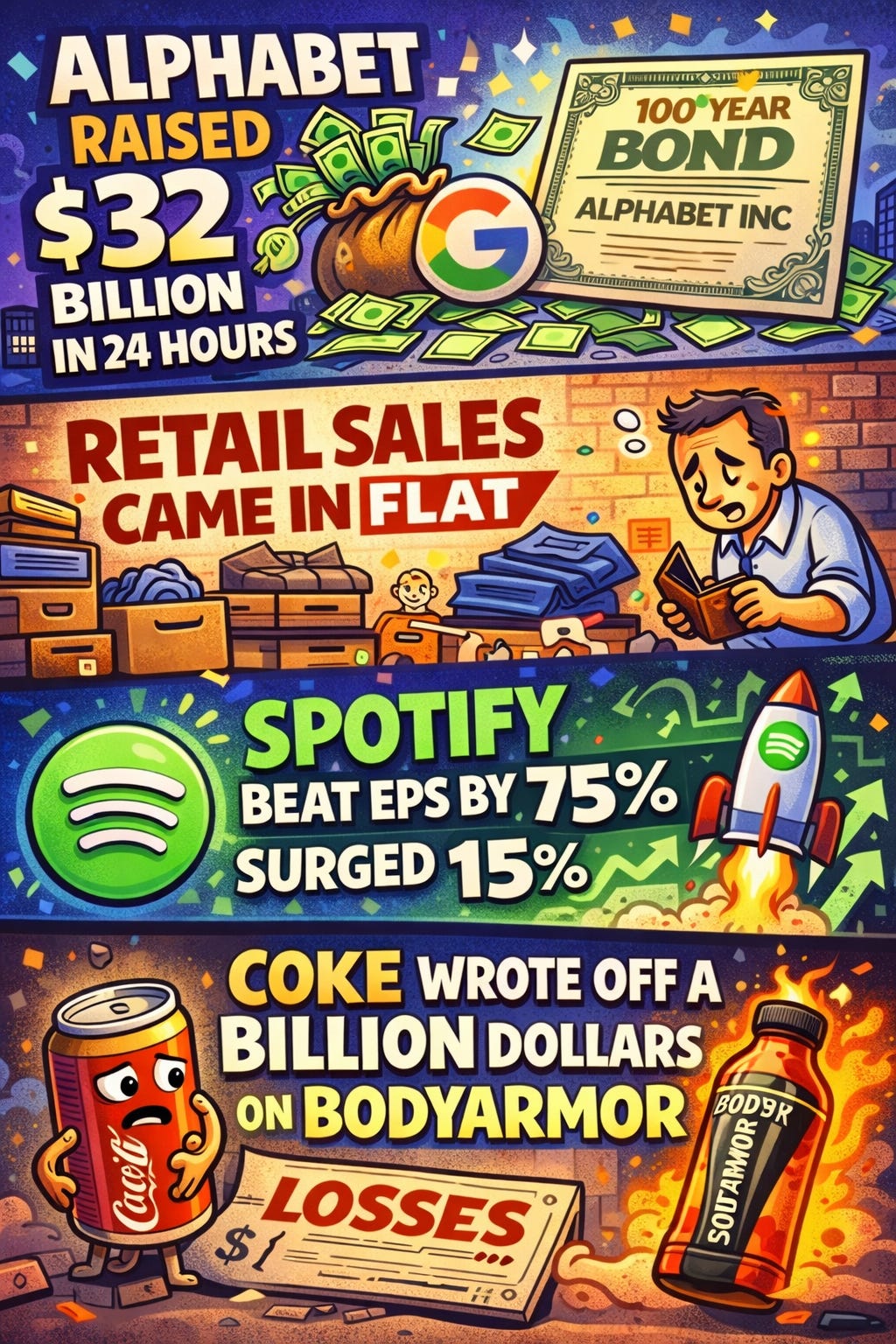
Alphabet raised $32 billion in 24 hours including a 100-year bond, retail sales came in flat, Spotify beat EPS by 75% and surged 15%, and Coke wrote off a billion dollars on BODYARMOR.
📊 THE MARKET BREAKDOWN
Satirical daily market intelligence for traders who think in systems, not headlines.
Issue #175 | February 10, 2026
🔥 Headlines & Hysteria (powered by Forked Feed)
Alphabet Raises $32 Billion in Debt in 24 Hours, Including a 100-Year Bond
Forked Feed says: Alphabet just borrowed $32 billion across three currencies in less time than it takes most people to get approved for a car loan. The original plan was $15 billion. Then $100 billion in orders showed up and they said “actually, make it $20 billion” in dollars alone, then tacked on another $12 billion in sterling and Swiss francs by Tuesday. The sterling deal includes a 100-year bond, which is tech’s first century debt since Motorola in 1997. Motorola. The company that made the RAZR flip phone and then ceased to meaningfully exist. Alphabet is asking investors to bet that Google will still be around in 2126, which requires believing that a search engine will survive the very AI revolution that its own company is spending $185 billion this year to accelerate. That $185 billion capex target will crater free cash flow by roughly 90% in 2026, from $73 billion to around $8 billion. But sure, buy the 100-year paper. The 40-year tranche priced at 95 basis points over Treasuries, which is tighter than most BBB corporates get at 10 years. Credit investors are so desperate for yield they’re lending money to a company whose primary business model might be obsolete before the first coupon payment clears.
US December Retail Sales Flat, Missing Expectations as Consumers Pull Back
Forked Feed says: Delayed by last year’s government shutdown, the December retail sales data finally showed up like a homework assignment three weeks late, and it wasn’t worth the wait. Sales came in flat at $735 billion, missing the +0.4% estimate, because the American consumer apparently spent everything in November and then decided December was a good month to stare at their credit card statements. Motor vehicles, furniture, clothing, and electronics all declined. The control group, which feeds directly into GDP, fell 0.1%. Economists immediately downgraded their Q4 growth estimates, because nothing says “the economy ended 2025 on a strong note” like consumers refusing to buy things during the holiday shopping season. The savings rate hit a three-year low of 3.5% in November, which means Americans aren’t saving and also aren’t spending. They’re just existing, economically. The market’s reaction? Ten-year yields dropped to a one-month low and traders bumped up odds of a third Fed cut this year. Bad news is good news is bad news is good news. The circle of life, Wall Street edition.
Spotify Crushes Q4 Earnings: 751M Users, EPS Beats by 75%, Stock Surges 15%
Forked Feed says: Spotify reported $5.16 EPS against a $2.95 estimate. That’s not just a beat, it’s an act of violence against the consensus. Revenue hit $4.83 billion, 751 million monthly active users (a record quarterly add of 38 million), and operating income rose 47% to a record. Gross margins hit 33.1%, which would have been considered science fiction when this company was lighting money on fire three years ago to convince Joe Rogan listeners to also try a podcast about true crime. The new co-CEOs declared 2026 the “Year of Raising Ambition,” because apparently when you go from losing money to making a billion euros in a quarter, subtlety is the first casualty. Daniel Ek moved to Executive Chairman, which is founder-speak for “I’m done doing the work but I’d like to keep the title.” Spotify also raised the US Premium price to $12.99 with historically low churn, which proves that paying for music has now been reclassified from “optional luxury” to “utility” alongside electricity and WiFi. The stock jumped 15%. Shares are still down 18% year-to-date. So in context, Spotify just delivered a once-in-a-decade quarter and is still underwater for the year. That’s 2026 for you.
Coca-Cola Misses Revenue for First Time in Five Years, Writes Off $960M on BODYARMOR
Forked Feed says: Coca-Cola’s revenue came in at $11.82 billion against a $12.03 billion estimate, marking the first top-line miss in five years. But the real headline is the $960 million non-cash impairment charge on BODYARMOR, which Coke bought for $5.6 billion in 2021 when everyone thought sports drinks were the future. Turns out the future was Ozempic. GLP-1 drugs have driven a 7% decline in sugary drink consumption among users, and even the “healthy” brands aren’t immune. Operating income fell 32%. Outgoing CEO James Quincey called the 2026 guidance “realistic and prudent,” which is executive-speak for “lower your expectations before I leave and someone else inherits the mess.” Henrique Braun takes over as CEO on March 31 and immediately gets to explain why the world’s most recognizable beverage brand guided for 4-5% organic growth when analysts wanted 5.3%. Stock fell about 3% from an all-time high. Sixty-three consecutive years of dividend increases though, so at least the boomers are fed.
Fed’s Logan and Hammack: No More Rate Cuts Needed, Inflation “Stubbornly High”
Forked Feed says: Two Fed officials with 2026 votes said publicly, on the same day, that they see no reason to cut rates again. Dallas Fed’s Lorie Logan said she’s “more worried about inflation remaining stubbornly high” and that the three cuts from last year already created “additional inflation risk.” Cleveland’s Beth Hammack said she’d prefer to be “on hold for quite some time” and wants to “err on the side of patience.” The Fed rate is at 3.50-3.75% and both voters said it might already be neutral. The market is pricing in two to three cuts this year. The Fed is saying zero. Someone is going to be wrong and historically it is not the people who actually set the rate. But traders heard “flat retail sales” this morning and immediately decided the Fed will cave anyway, because the only thing more powerful than a hawkish Fed speech is a soft data print that lets you ignore it.
🔎 Today’s Focus: The Data Finally Arrived
Tuesday was the day the delayed data showed up and reminded everyone that vibes aren’t GDP.
The S&P 500 slipped 0.33% to 6,942, giving back Monday’s gains after flat December retail sales caught the market leaning the wrong direction. The Nasdaq fell 0.59% as tech names that rallied Monday on AI enthusiasm gave most of it back. The Dow managed to eke out another record close at 50,188, up 52 points, because the Dow is composed entirely of companies old enough to have lived through the Great Depression and they simply refuse to go down.
The retail sales number was the session’s anchor. Flat in December, missing the +0.4% consensus, with the control group (the GDP-feeding component) actually declining 0.1%. Wages grew at their weakest pace in four years per the employment cost index. Consumers aren’t spending and they aren’t saving. The savings rate is at a three-year low. This isn’t a consumer that’s “resilient.” This is a consumer that’s exhausted.
The bond market heard this loud and clear. Ten-year yields dropped to a one-month low around 4.14%, with money markets now pricing slightly higher odds of three Fed cuts in 2026 instead of two. That happened on the same day two voting Fed officials publicly said zero cuts might be appropriate. The disconnect between what the Fed says and what the market believes remains the widest gap in financial markets this side of Alphabet’s free cash flow before and after capex.
Earnings split the tape. Spotify surged 15% on a monster quarter. Coca-Cola fell 3% on a revenue miss and a billion-dollar impairment. The theme: pricing power separates winners from losers, and in 2026, a streaming app that raised prices with zero churn is a better business than the most famous beverage brand on Earth.
Jobs data lands tomorrow. CPI on Friday. And the market just got its first real evidence that the consumer isn’t as bulletproof as the rally assumed.
Forked Feed says: The S&P failed at 7,000 again. That’s now multiple rejections at that level in 2026. The data says the consumer is tapped out. The Fed says inflation is stubbornly high. And the market’s response is to price in more rate cuts because bad data must mean the Fed will blink. This is the financial equivalent of getting a bad report card and assuming your parents will lower the grading standard. They might. But it’s not the bet you want to make when two of them just went on television and said the grades are fine where they are.
⚡ The Setup
SPY 692.12 | BTC 68,654 | US10Y 4.141 | DXY 96.70
SPY slipped back below 693 after failing to hold Monday’s gains. The 7,000 ceiling on the S&P (roughly SPY 700) continues to cap every rally attempt in 2026, and today’s session confirmed it’s not breaking through on hope alone. The index needs a catalyst, and flat retail sales wasn’t it. Support sits around 6,870-6,900 (SPY 687-690), and if jobs or CPI disappoint this week, that’s where the market is headed.
BTC drifted back below $69,000 after briefly reclaiming $70K on Monday. The correlation between Bitcoin and risk appetite remains tight. Flat retail sales and hawkish Fed commentary aren’t the setup crypto needs to break higher. The $65,000 support level from the January selloff remains the key downside level. A clean break above $72,000 would signal renewed momentum, but the macro backdrop isn’t cooperating.
The 10-year yield fell to 4.14%, its lowest in about a month, as the weak retail sales print reinforced bets that the economy is cooling enough to justify additional Fed cuts. The move lower in yields came despite two Fed officials saying cuts aren’t needed. The market and the Fed are having two completely different conversations, and someone is going to lose that argument. If jobs come in weak tomorrow, yields could test 4.05-4.10%. If CPI is hot Friday, everything reverses.
DXY slipped below 96.75 as the dollar weakened on soft data and rate-cut repricing. The dollar has been quietly losing ground in 2026 as the “American exceptionalism” trade fades. Gold at $5,057, silver pushing higher, and the broad trend of de-dollarization from last week’s China Treasury directive all point to continued pressure on the greenback. A weak jobs number tomorrow would accelerate the move.
🧩 Market Archetype: The Exhaustion Gap
This is the session where the rally runs out of gas not because anything catastrophically bad happened, but because the data stopped cooperating with the narrative. Monday’s rally was built on AI optimism and political clarity from Japan. Tuesday’s reality check came from the American consumer, who apparently spent November shopping and December staring at the ceiling. The market wants to go higher. The fundamentals are asking for a pause. The Dow is setting records while the S&P can’t hold 7,000. Two Fed officials said no more cuts while the bond market prices in three. The archetype here is exhaustion: not a crash, not a reversal, just the slow realization that momentum alone can’t carry you past a data wall. The question isn’t whether the market breaks down. The question is whether it can break up without the consumer coming along for the ride.
💧 Flow Pulse
The session’s biggest story was the Spotify-Coke divergence. Spotify surged 15% on its best quarter in history while Coca-Cola dropped 3% on a revenue miss and a nearly billion-dollar writedown. Two iconic consumer brands, two completely different trajectories. Spotify proved that a digital subscription model with global scale and pricing power can generate eye-watering margins. Coke proved that even 138 years of brand equity can’t overcome a flat consumer and a generation of customers on appetite suppressants. The market is voting with its feet: recurring digital revenue with low marginal cost beats physical distribution of sugar water, and it’s not close.
Tech flows were mixed. Chip names were modestly higher as TSMC’s strong January order book data provided a floor, with Nvidia, AMD, and Broadcom each adding about 1%. But software gave back gains, and Alphabet slipped over 1% despite (or because of) its record $32 billion bond sale. Palantir got an upgrade from Daiwa Capital to buy, but the $180 price target was actually a cut from $200, which is the most Palantir-coded analyst move imaginable: bullish conviction, lower expectations, still somehow a 26% implied upside. The stock is down 20% year-to-date.
Defensive flows rotated. CVS dropped 3% on weak guidance. Retailers Costco and Walmart fell 1-2% as the flat retail sales data raised questions about holiday-quarter earnings quality. Clear Channel Outdoor surged 8% on the $6.2 billion Mubadala buyout, completing one of the saddest IPO-to-takeout arcs in market history: public in 2005 at roughly $20, taken private in 2026 at $2.43. That’s an 88% loss over two decades. Congratulations to the long-term holders.
Bond flows were aggressive. Ten-year yields dropped to a one-month low as traders piled into duration on the weak retail print. Money markets shifted to price slightly higher odds of three cuts in 2026. This is notable because the last time the market aggressively front-ran rate cuts (late 2024), it ended up being partially right. The difference this time is two voting Fed officials publicly pushed back within hours. The Alphabet $32 billion debt issuance also vacuumed up corporate bond demand, with over $100 billion in orders on the dollar tranche alone.
Forked Feed says: Alphabet raised $32 billion and the stock went down. Spotify beat estimates by 75% and the stock is still negative for the year. Coca-Cola has been raising prices for two years straight and just wrote off a billion dollars on a sports drink brand it overpaid for during the post-COVID delusion. Clear Channel went public at $20 and is being taken out at $2.43, and the press release called it “compelling value for shareholders.” The only thing more compelling than $2.43 per share is the sheer audacity of using the word “compelling” with a straight face after an 88% loss. Meanwhile, the bond market heard “flat retail sales” and decided the Fed is cutting three times this year, approximately three hours after two Fed officials said the opposite. The market doesn’t listen. The market hears what it wants. And right now, it wants rate cuts the way Coca-Cola wants people to stop taking Ozempic.
🔮 Forked Forecast
Bull Case (15%): Jobs report Wednesday threads the needle: strong enough to kill recession chatter but soft enough to keep the rate-cut dream alive. The retail sales miss gets written off as a shutdown-delayed anomaly that says nothing about January. The S&P finally punches through 7,000 and holds it, powered by earnings momentum from names like Spotify proving the “price up, cut costs, grow margins” playbook works at scale. CPI on Friday cooperates, coming in at or below consensus, and the disinflationary narrative reasserts itself. Bitcoin reclaims $70K. Gold holds $5,000+ and broadens the “everything rally” rather than signaling fear. The consumer exhaustion story stays a one-month blip, not a trend.
Base Case (50%): The market chops sideways through Friday as traders refuse to commit ahead of back-to-back macro landmines. SPY oscillates 687-697 (S&P 6,870-6,970), unable to break above 7,000 resistance or crack below the 6,870 support that held last week. Jobs comes in close enough to consensus that both bulls and bears claim victory. CPI is roughly in line. The Fed-vs-market rate cut disconnect lingers unresolved. Bitcoin drifts $66-71K. Yields hover 4.10-4.20% as the bond market and the Fed continue having two different conversations. The Dow prints another marginal record or two because it’s the Dow and that’s what it does. No resolution until next week.
Bear Case (35%): The retail sales miss was the appetizer. Jobs comes in weak, sub-30K or with unemployment ticking to 4.5%, confirming that the consumer and the labor market are softening in tandem. The double miss forces a stagflation repricing, especially if CPI runs hot on Friday and catches the market leaning into rate-cut bets that suddenly look premature. The S&P rolls hard from 7,000 resistance and retests 6,800. Bitcoin breaks $65K support. The two Fed officials who said “no cuts” today look prescient, and the bond market’s three-cut pricing unwinds violently. Software sentiment, already fragile, cracks further on any additional layoff headline or guidance cut.
Triggers to Watch:Wednesday’s January nonfarm payrolls (consensus ~60K, unemployment 4.4%)
Friday’s January CPI (consensus +0.29% monthly, +2.5% yearly)
S&P 7,000 resistance: another rejection today makes this the defining technical level of 2026
Fed-vs-market gap: 10-year yield direction after jobs will tell you who’s winning the argument
Consumer data follow-through: if January retail sales (date TBD due to shutdown delays) also disappoints, the “one-month blip” narrative dies
📖 Available Now!
Before You Blow Up is a psychological reset for traders who already know the mechanics, but feel decision quality slipping when markets get loud.
This isn’t about new strategies, indicators, or setups. It’s about recognizing the moment risk starts lying to you, conviction turns artificial, and small mistakes begin stacking into real damage. Most traders don’t fail all at once. They drift, tilt, overtrade, and slowly bleed confidence away. This book exists to interrupt that process early.
Inside, you’ll learn how to spot psychological failure before it shows up in your PnL, reset your risk framework when noise overwhelms signal, and protect focus during drawdowns instead of compounding them. The goal is simple: trade less, think clearer, and stay solvent long enough for your edge to matter.
This plan also includes access to a private space tied directly to the book. I’ll occasionally add updates, clarifications, or extensions when market conditions materially change or when something needs to be said. No schedule. No noise. Only signal.
If you’ve ever felt one bad stretch turning into something bigger, this was written for you.
💬 Final Thought
The data is talking now. And what it’s saying isn’t what the rally wanted to hear.
December retail sales were flat. Wages grew at their slowest pace in four years. The savings rate is at a three-year low. Two Fed officials said, on the record, that no more rate cuts are needed. And the market’s response was to price in more cuts, not fewer, because the logic of 2026 is that bad economic news means the Fed will rescue you even when the Fed is explicitly saying it won’t.
Spotify earned more than anyone expected and the stock is still down for the year. Coca-Cola wrote off a billion dollars on a sports drink acquisition. Alphabet borrowed $32 billion in 24 hours to fund a capex cycle that will vaporize its free cash flow. Clear Channel Outdoor, which went public in 2005, is being bought out for 88% less than its IPO price, and the press release called it “compelling value.” These are the stories of a market that has been running on confidence for so long that the data has become an afterthought.
Jobs tomorrow. CPI Friday. And the American consumer, who was supposed to be the engine of this expansion, just took December off.
Welcome to Tuesday.
That’s all for issue #175. Alphabet raised $32 billion in a day and is selling a 100-year bond because someone apparently thinks Google will outlast the Roman Empire. Retail sales came in flat because the American consumer decided December was a good time to stop buying things. Spotify beat earnings by 75% and is still down for the year. Coca-Cola wrote off nearly a billion on BODYARMOR because everyone’s on Ozempic now. Two Fed officials said no more rate cuts and the bond market heard “three more cuts, please.” And Clear Channel Outdoor is being taken private at $2.43, twenty-one years after IPO-ing at $20, in a deal the company had the audacity to call “compelling.”
The 100-year bondholders could not be reached for comment.
— Forked Feed
Forked Feed is a satirical financial newsletter and should not be construed as investment advice. We're just here to point out the absurdity. Past performance of our snark does not guarantee future sarcasm.
🔗 Stay Connected
Twitter: @txwestcapital
Twitter: @theforkedfeed
YouTube: TexasWestCapital
Website: TheForkedFeed.com and ForkedFeed.ai (coming soon)